While Linux offers unmatched freedom, using a VPN service often presents unique technical challenges:
-
Limited Vendor Support: VPN providers have historically given less attention to Linux, unlike the straightforward, graphical installations on Windows or macOS.
-
Complex Setup: Users frequently rely on complex OpenVPN configuration files or feature-limited Command-Line Interfaces (CLI).
-
Inconvenient Operation: Basic tasks—such as connecting, switching servers, or disconnecting—typically require cumbersome terminal commands.
The purpose of this guide is to put an end to these compromises for Linux users.
Focusing on 7 industry-leading services—Surfshark, NordVPN, ExpressVPN, ProtonVPN, PIA, CyberGhost, and IPVanish—this guide provides the definitive recommendations you need to choose the most efficient and secure encrypted connection in the open-source world.
Assessment Criteria: Core Technical Requirements for Linux VPNs
Choosing an excellent Linux VPN must prioritize native performance within the open-source ecosystem. Below are the 5 critical technical metrics used to evaluate these 7 services and ensure reliable recommendations:
1. GUI vs. CLI
A top-tier Linux VPN must offer officially supported .deb or .rpm installation packages. We prioritize services that provide a Native Graphical User Interface (GUI), offering a straightforward, one-click experience similar to Windows/Mac, often with integrated advanced features. CLI clients are better suited for power users requiring fast, script-based deployment.
2. Kill Switch
The Kill Switch is the last line of defense against IP leaks. In the Linux environment, its implementation is complex, requiring integration with the system firewall (such as iptables). We only recommend services whose Kill Switch has been verified to reliably and stably block all traffic when the VPN connection unexpectedly drops.
3. Advanced Protocol
Modern VPNs must support or be based on the WireGuard protocol (e.g., NordLynx, Lightway). This ensures lightning-fast connection speeds and extremely low latency while maintaining military-grade encryption strength.
4. Privacy: Open-Source Code and Independent Audits
In line with the Linux open-source philosophy, we favor services whose client code (or core libraries) is open-source and which have a track record of multiple, independent audits of their no-logs policy, validating their commitment to user privacy.
5. Support for Advanced Network Features
Beyond basic connectivity, we evaluate whether advanced features such as Split Tunneling, DNS Leak Protection, and Obfuscation Servers can be stably enabled and configured within the Linux client.
Top 7 Linux VPNs in 2026
Here is a detailed review of the top seven VPNs, focusing on their performance on the Linux platform based on the criteria above:
1. Surfshark
|
Feature |
Details |
|
Client |
Native GUI / CLI |
|
Core Protocols |
WireGuard / OpenVPN (UDP/TCP) |
|
Kill Switch |
Fully Built-in Support |
|
Simultaneous Connections |
Unlimited |
|
Server Network |
4,500+ Servers / 100+ Countries |
|
Value |
$1.99/month (80% off) |
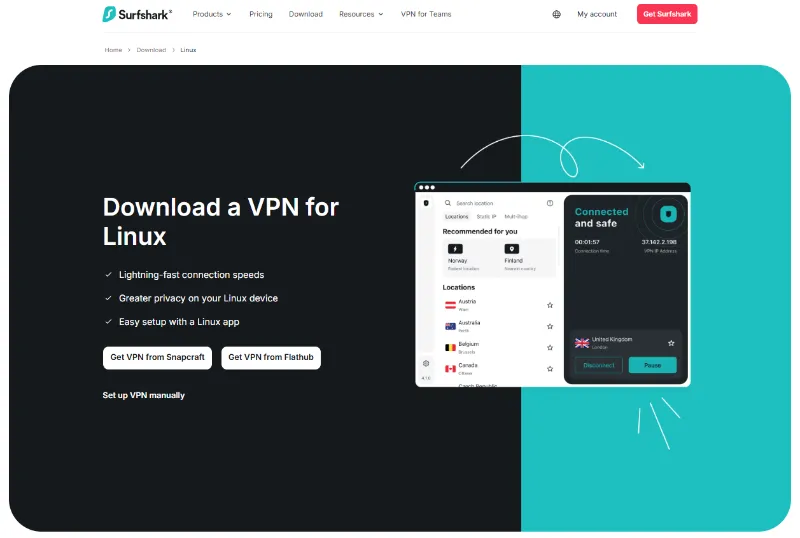
Linux Client Advantage: Surfshark is one of the few providers to offer a native Graphical User Interface (GUI) on the Linux platform, which has greatly simplified installation and daily operations since its launch in 2022. While the CLI mode remains available for advanced users, its server list is intuitively displayed with numbered options, removing the need to memorize or guess server codes common in traditional CLI clients.
Core Protocols & Speed: The WireGuard protocol performs exceptionally well on Linux, with tests showing minimal speed loss—speeds approach those of an unprotected connection—making it the top choice for balancing speed and security.
Network and Security Architecture: Surfshark boasts over 4,500 servers spread across 100+ countries. All servers utilize a 10 Gbps RAM-only architecture, ensuring data is automatically wiped with every reboot for top-tier security.
Privacy Guarantee: Surfshark strictly adheres to a No-Logs Policy that has been independently audited by third-party authorities, including Deloitte. The client integrates an Automatic Network Kill Switch on all platforms.
Advanced Features: Even the Linux command-line client offers full access to unique enhancements like MultiHop (Double VPN) and CleanWeb (an ad/malware blocker).
Connectivity: Supports unlimited simultaneous device connections.
Pricing and Value: The Starter two-year plan is priced at approximately $1.99/month, making it one of the most affordable premium VPNs. It accepts anonymous payment methods, including cryptocurrency.
Surfshark VPN Review 2026: Best Value VPN with Unlimited Devices
2. NordVPN
|
Feature |
Details |
|
Client |
Native CLI |
|
Core Protocols |
NordLynx (WireGuard Optimized) / OpenVPN |
|
Kill Switch |
Fully Built-in Support |
|
Simultaneous Connections |
10 Devices |
|
Server Network |
8,400+ Servers / 165+ Countries |
|
Value |
Basic $2.99/month (74% off) |
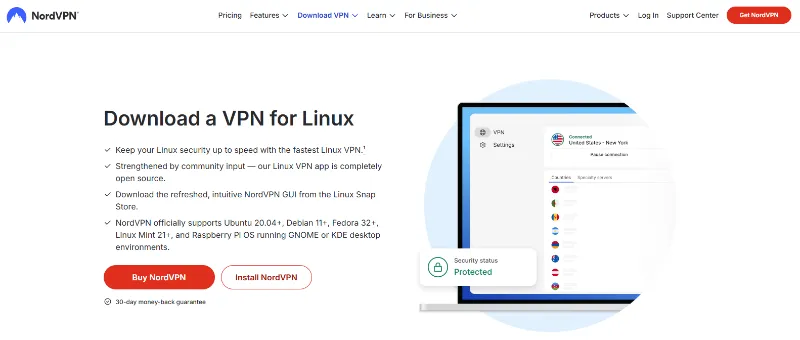
Linux Client Compatibility and Deployment: NordVPN is particularly well-suited for users comfortable with terminal operations. Installation on Debian-based distributions is extremely straightforward. The CLI includes a "Quick Connect" feature that automatically selects the best server.
Performance and NordLynx Protocol: NordVPN's proprietary NordLynx protocol (WireGuard optimized) stands out for its speed on Linux systems; it was one of the fastest VPNs we tested, maintaining extremely low latency.
Server Network and Security Architecture: NordVPN boasts over 8,400 servers deployed across 165+ countries. The entire infrastructure runs on a 10 Gbps RAM-only architecture.
Advanced Security Features: The Linux client includes a reliable Kill Switch. It also supports Double VPN (Multi-Hop) and Obfuscated Servers, crucial for bypassing strict network restrictions.
Pricing and Value: The NordVPN Basic plan starts at approximately $2.99/month for a two-year commitment, representing exceptional value. All plans offer a 30-day money-back guarantee.
NordVPN Review 2026: Is It Still the Best VPN? (Tested)
3. ExpressVPN
|
Feature |
Details |
|
Client |
Native CLI (Streamlined) |
|
Core Protocols |
Lightway (Proprietary) / OpenVPN |
|
Kill Switch |
Fully Built-in Support |
|
Simultaneous Connections |
14 Devices |
|
Server Network |
3,000+ Servers / 105+ Countries |
|
Value |
$3.49/month (73% off) |
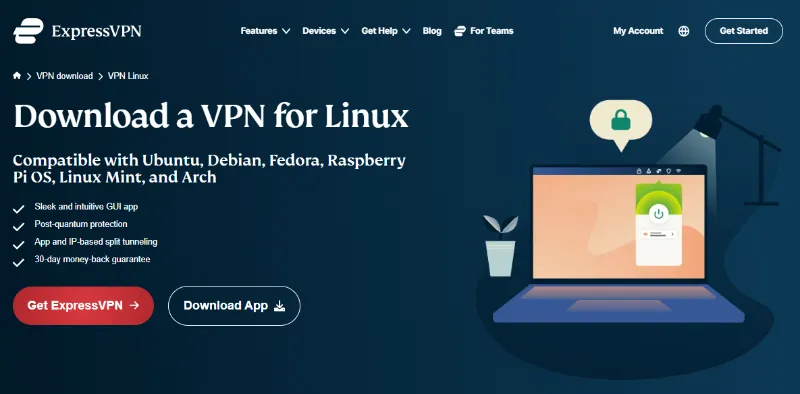
Linux Compatibility and Deployment: ExpressVPN's Linux client is a CLI application, but its intuitive operation has set the gold standard. Installation is quick and simple, natively compatible with 15 major distributions.
Performance and Lightway Protocol: It defaults to using its proprietary Lightway protocol, which provides outstanding speed and reliability with minimal speed loss. OpenVPN is also available.
Security Architecture and Audits: ExpressVPN has over 3,000 servers in 105 countries. All servers run on TrustedServer Technology (RAM-only). Its no-logs policy has undergone 19 independent security audits by authoritative firms like KPMG.
Advanced Features: The Linux client supports the critical Kill Switch and Split Tunneling. The network fully supports Torrenting and works seamlessly for streaming services.
Pricing and Value: Pricing is premium (approx. $3.49/month), but users receive top-tier overall service, industry-leading speed, and superior reliability.
ExpressVPN Review 2026: Is It Still the Industry Leader? (Verified Test)
4. ProtonVPN
|
Feature |
Details |
|
Client |
Native GUI / CLI (Open-Source) |
|
Core Protocols |
WireGuard / OpenVPN |
|
Kill Switch |
Fully Built-in Support |
|
Simultaneous Connections |
Unlimited (Paid Plan) |
|
Server Network |
14,490+ Servers / 127+ Countries |
|
Value |
$2.99/month (70% off) |
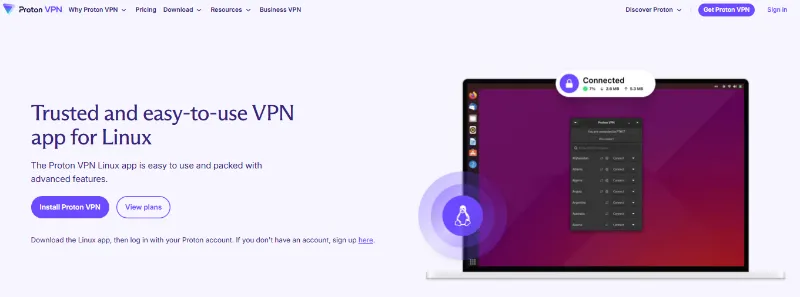
Linux Client Compatibility and Installation: ProtonVPN offers both Native GUI and CLI modes. It is headquartered in Switzerland and adheres to a verified no-logs policy.
Advanced Feature Integration: Paid users can utilize Secure Core servers (multi-hop encryption). It also integrates NetShield (malware and ad blocker) and Port Forwarding optimized for P2P.
Speed and Performance: Thanks to native WireGuard support, speeds on Linux are significantly improved, providing stable performance for HD streaming and large file downloads.
Pricing and Value: The paid plan supports unlimited simultaneous device connections. Most commendably, it offers one of the best free plans on the market, with no data caps.
5. Private Internet Access (PIA)
|
Feature |
Details |
|
Client |
Native GUI / CLI |
|
Core Protocols |
WireGuard / OpenVPN / SOCKS5 |
|
Kill Switch |
Fully Built-in Support |
|
Simultaneous Connections |
Unlimited |
|
Server Network |
35,000+ Servers / 91+ Countries |
|
Value |
$1.98/month (83% off) |
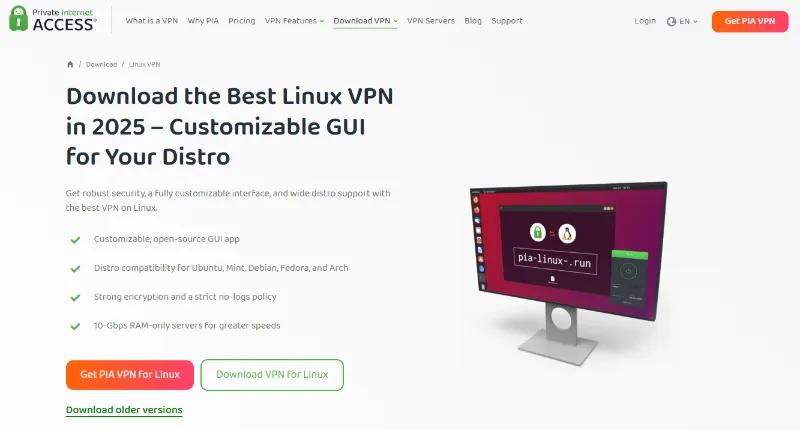
Linux Platform Support and Availability: PIA offers a fully functional Native Graphical User Interface (GUI) application, as well as a complete CLI option.
Network Scale and Security Architecture: PIA operates over 35,000 servers deployed across 91+ countries, utilizing advanced 10 Gbps RAM-only hardware.
Features: The Linux client includes a complete Kill Switch, a powerful MACE ad blocker, and supports Split Tunneling. The network provides full support for P2P file sharing.
Privacy Guarantee and Transparency: PIA adheres to a verified strict no-logs policy, independently audited by Deloitte.
Connectivity: PIA allows an unlimited number of simultaneous device connections.
Pricing and Value: The three-year plan is priced at approximately $1.98/month, making it one of the most cost-effective premium VPNs.
Private Internet Access (PIA) Review 2026: Still the Best Value VPN?
6. CyberGhost
|
Feature |
Details |
|
Client |
Native GUI / CLI |
|
Core Protocols |
WireGuard / OpenVPN |
|
Kill Switch |
Fully Built-in Support |
|
Simultaneous Connections |
7 Devices |
|
Server Network |
11,690+ Servers / 100+ Countries |
|
Value |
$2.03/month (84% off) |
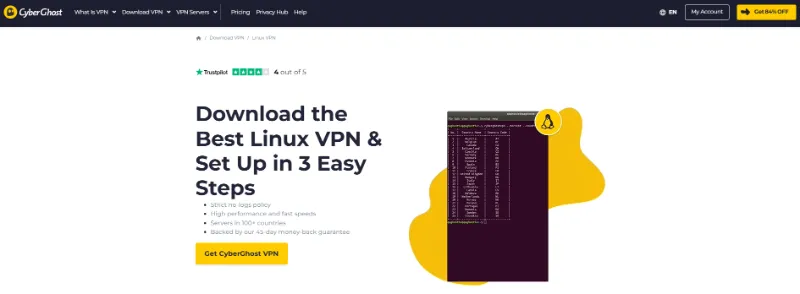
Linux Client Compatibility and Deployment: CyberGhost is one of the few VPNs that offers a native Graphical User Interface (GUI) for Linux, supporting major .deb and .rpm distributions.
Server Network and Features: With over 11,690 servers in 100+ countries, CyberGhost is known for its servers optimized for dedicated streaming and gaming.
Security and Privacy: Headquartered in privacy-friendly Romania, it follows an audited strict no-logs policy. The Linux client includes a reliable Automatic Kill Switch.
Pricing and Value: The two-year plan is priced at approximately $2.03/month. It provides an extended 45-day money-back guarantee.
7. IPVanish
|
Feature |
Details |
|
Client |
Native GUI / CLI |
|
Core Protocols |
WireGuard / OpenVPN |
|
Kill Switch |
Fully Built-in Support |
|
Simultaneous Connections |
Unlimited |
|
Server Network |
3,200+ Servers / 150+ Countries |
|
Value |
$2.19/month (83% off) |
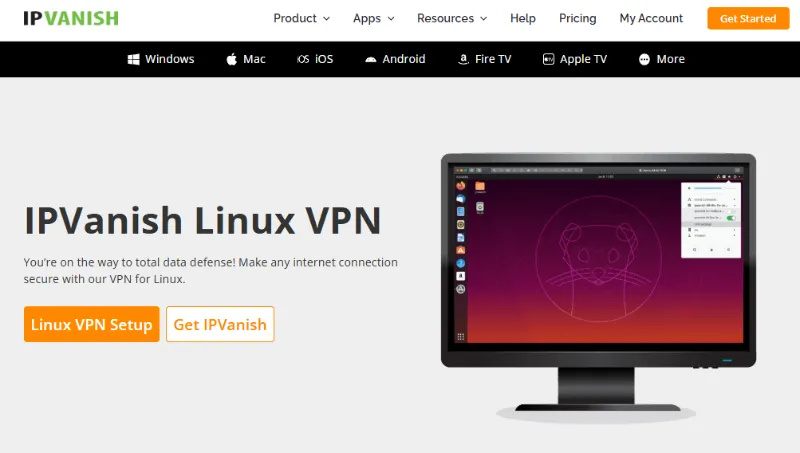
Linux Client Compatibility: IPVanish offers a native GUI client and a fully functional CLI client.
Self-Owned Network Architecture: IPVanish owns and operates its entire server network, providing superior security control. It has over 3,200 servers in 150+ countries.
Security and Protocols: The Linux client fully supports OpenVPN and the latest WireGuard protocol. It features a built-in, reliable Kill Switch and DNS Leak Protection.
Connectivity and P2P: IPVanish allows an unlimited number of simultaneous device connections.
Pricing and Value: The two-year plan starts at approximately $2.19/month, placing it in the highly competitive value tier. All subscriptions come with a 30-day money-back guarantee.
IPVanish Review 2026: Unlimited Devices & Top P2P Speed?
7 Linux VPN Performance Comparison Overview
|
VPN |
Primary Client Type |
Kill Switch (Linux) |
Main Protocols (Linux) |
Simultaneous Connections |
Pricing (Approx.) |
|
Native GUI/CLI |
✅ Fully Supported |
WireGuard/OpenVPN |
Unlimited |
$1.99/mo |
|
|
Native CLI |
✅ Fully Supported |
NordLynx (WireGuard) |
10 |
$2.99/mo |
|
|
Native CLI |
✅ Fully Supported |
Lightway/OpenVPN |
14 |
$3.49/mo |
|
|
Native GUI/CLI (Open-Source) |
✅ Fully Supported |
WireGuard/OpenVPN |
Unlimited (Paid) |
$2.99/mo |
|
|
Native GUI/CLI |
✅ Fully Supported |
WireGuard/OpenVPN |
Unlimited |
$1.98/mo |
|
|
Native GUI/CLI |
✅ Fully Supported |
WireGuard/OpenVPN |
7 |
$2.03/mo |
|
|
Native GUI/CLI |
✅ Fully Supported |
WireGuard/OpenVPN |
Unlimited |
$2.19/mo |
Conclusion: Classified Buying Guide for Linux Users
After rigorous compatibility and performance testing, we summarize the best choices for Linux users in 2026:
|
Need Category |
Recommended VPN |
Core Advantages & Features |
Key Metric |
|
Best Overall Value & Experience |
Offers a Native GUI client for Linux, making operation easiest. Supports Unlimited Devices simultaneously, with highly competitive pricing. |
GUI Usability, Unlimited Connections, Price |
|
|
Ultimate Privacy & Open-Source Spirit |
Client code is Open-Source, headquartered in privacy-friendly Switzerland. Offers Secure Core (Multi-Hop) for unmatched security. |
Transparency, Privacy Laws, Free Plan |
|
|
Best for Speed and High Performance |
Proprietary NordLynx protocol (WireGuard optimized) delivers the fastest connection speeds in testing, with extremely low latency. |
Speed, NordLynx, CLI Optimization |
|
|
Advanced Customization & Server Giant |
Has over 35,000 servers, the largest network scale. Offers a Native GUI and rich configuration options. Supports Unlimited Connections. |
Server Count, High Customization, Unlimited Connections |
|
|
Reliable Alternative for Ease-of-Use & Unlimited Connections |
Offers a Native GUI client. Supports Unlimited Simultaneous Devices. Exclusively owns and operates its entire network. |
GUI Usability, Unlimited Connections, Self-Owned Network |
Suggested Use Cases:
-
Linux Newbies or Users Seeking Convenience: Prioritize Surfshark or IPVanish; their native GUIs significantly reduce the learning curve.
-
Family or Multi-Device Users: Choose Surfshark, PIA, or IPVanish—all three offer unlimited simultaneous device connections.
-
Users Needing to Bypass Network Restrictions: NordVPN's Obfuscated Servers and ProtonVPN's Secure Core are ideal choices.
Frequently Asked Questions (FAQ)
Q1: What are the decisive advantages of the WireGuard protocol over OpenVPN on Linux?
A: The advantages lie in performance and simplicity. WireGuard has significantly fewer lines of code (approx. 4,000 lines vs. OpenVPN's hundreds of thousands), which translates to faster speeds, lower latency, and a smaller attack surface. On Linux, WireGuard often provides speeds comparable to an unprotected connection.
Q2: Why do many VPNs not support Split Tunneling on their Linux clients?
A: Implementing Split Tunneling on Linux relies on complex underlying network routing and firewall rules (iptables/nftables). Given the diversity of Linux distributions, ensuring this feature runs stably across all systems is extremely difficult, leading many vendors to avoid integration.
Q3: Which major Linux distributions are supported by these recommended VPN services?
A: Top VPN providers primarily focus on supporting Debian/Ubuntu and Fedora/RHEL based systems.
-
Debian/Ubuntu Family (including Mint, Pop!_OS): Almost all recommended services offer .deb installation packages and full CLI/GUI client support.
-
Arch/Manjaro: Most services can be used via the AUR (Arch User Repository) or through manual configuration. ExpressVPN and PIA offer notably better support for Arch.
-
Fedora/OpenSUSE (RPM Family): .rpm installation packages are typically provided.
Q4: How can I confirm my Linux VPN connection has no IP or DNS leaks?
A: After connecting to the VPN, you can verify this with the following steps:
-
Check IP Address: Run curl ifconfig.me in the terminal and compare it with the VPN server's IP address.
-
DNS Leak Test: Visit a professional DNS leak detection website (e.g., ipleak.net). If the results only show the VPN provider's DNS server addresses, the connection is secure.
Q5: Do the VPN clients on Linux support P2P file sharing (Torrenting)?
A: Yes, most VPNs recommended in this guide fully support P2P and offer high speed and security. Surfshark, PIA, and CyberGhost offer the strongest P2P support.
Q: Are there any quality free VPN options available for Linux?
A: Yes, ProtonVPN offers one of the most generous and secure free plans on the market. It has no data cap and the client is open-source, though speed is limited and only a few server locations are available.