Thinking about buying a $20 lifetime VPN deal on StackSocial? Read this before you pay. We expose the Ponzi-scheme economics behind one-time VPN plans.
⏳ Are Lifetime VPNs a Scam?
In short: Yes, the vast majority are. Running a secure VPN requires massive, continuous costs (server rentals, bandwidth, 24/7 support). A one-time payment of $30 cannot sustain these recurring costs. Eventually, these companies must either slow down your speeds to a crawl, shut down and run away with your money, or secretly sell your private data to advertisers to keep the lights on. Stick to reputable subscription VPNs instead.
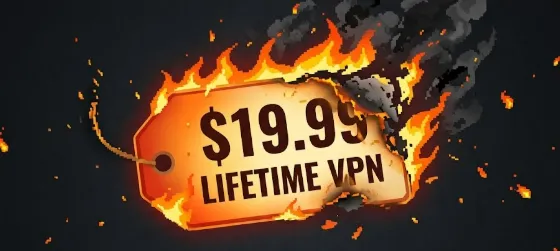
The Hype and Chaos of Lifetime VPN Packages
While browsing major software deal websites (such as StackSocial or BundleHunt) or watching recommendation videos from certain tech influencers, you have likely run into tempting advertisements like this:
"For just $19.99 (or $39.00), enjoy lifetime ultra-high-speed, unlimited top-tier VPN service! Limited-time 90% off, don't miss out!"
For digital nomads and average consumers who are already tired of paying recurring monthly subscription bills ranging from $5 to $12 for various streaming services, cloud storage, and VPNs, this "one-time purchase, once and for all" temptation is almost overwhelmingly persuasive. Many people do a quick calculation: as long as this service lasts for 4 to 5 months, they have already "broken even," and every subsequent year of use is pure profit.
But does a free lunch truly exist? From a business logic perspective, what kind of financial calculations are hidden behind this seemingly highly cost-effective "lifetime package"? When we talk about "lifetime," whose lifetime is it really?
This article will deeply deconstruct the fundamental business logic flaws of lifetime VPNs, analyze how they step-by-step evolve into "money-grabbing Ponzis" disguised as technology, and outline the four realistic risks you must face after purchasing, helping you avoid falling into the trap of becoming a "lifetime sucker."
You might have seen these 'lifetime' deals pushed by tech influencers. But as we exposed in our guide on [YouTube-Advertised VPNs: Are They Actually Worth Buying?], heavy marketing doesn't always equal a trustworthy product.
Defining Core Concepts: Understanding the Matching Logic of Lifetime VPNs and Ponzi Schemes
To determine whether a lifetime VPN is a Ponzi scheme, we must first start from the underlying business model and economic model, clarify the core concepts of both, and then analyze the high degree of overlap in their operational logic.
I. The Ponzi Scheme Economics of Lifetime VPNs
A Ponzi Scheme is one of the most classic models in the history of financial and commercial crime. Its core essence is "robbing Peter to pay Paul."
In a standard Ponzi scheme:
-
Lack of self-sustaining capability: The project itself does not generate any substantive profit, or its promised excess returns far exceed the actual earning capacity of its underlying assets.
-
Using new money to pay old members: The project operator uses the principal injected by subsequent new investors to pay "investment returns" to early, established investors, thereby creating a false illusion of prosperity with sound operations and stable returns.
-
Fragile reliance on cash flow: Due to the lack of a healthy, sustainable commercial self-sustaining mechanism, the lifeline of the entire system depends completely on the "speed of incoming new funds." Once the inflow of new funds slows down, stops, or encounters a concentrated "run" by old investors, the capital chain will break in an instant, and the entire massive system will collapse.
II. What is a "Lifetime VPN"?
A "Lifetime VPN" is an extremely tempting marketing tactic typically launched by VPN service providers.
-
Pricing Strategy: Consumers only need to make a one-time payment of a relatively low fee (usually between $15 and $49) to obtain virtual private network services that the provider claims can be used "for a lifetime" (or equivalent to the device life cycle or company survival period).
-
User Psychological Inducement: For consumers, compared to traditional mainstream subscription-based VPNs (such as ExpressVPN, NordVPN) that require an annual payment of $50 to $100, the "lifetime version" costs only as much as a two-to-three-month subscription to achieve a "once and for all" solution. Intuitively, it seems like an incredibly cost-effective "lifetime asset."
III. The "Matching Logic" Between the Two: Why Do Lifetime VPNs Inherently Possess "Ponzi Attributes"?
To understand why lifetime VPNs easily slide into "Ponzification," we must first break a cognitive misconception: VPN services are fundamentally different from ordinary, standalone software.
1. Economic Differences Between Software Assets and Heavy-Asset Services
|
Dimension |
Standalone Software (e.g., WinRAR, PDF Readers) |
VPN Services |
|
Physical Cost |
Near zero. After being sold, developers bear almost no subsequent marginal costs. |
Extremely high. Requires continuous renting of global servers and purchasing expensive dedicated or shared bandwidth. |
|
Maintenance Characteristics |
One-time development, followed only by low-frequency patch maintenance. |
24/7 continuous real-time operations and maintenance (O&M), frequent updates to the IP pool to combat blocking/censorship, and iteration of multi-platform clients. |
|
Marginal Cost |
Marginal cost decreases to zero. Adding one more user does not increase server expenses by a single penny. |
Marginal cost is constant and high. Adding one more active user means occupying an additional share of bandwidth and consuming more server computing power. |
2. The Fatal Capital "Matching Chain"
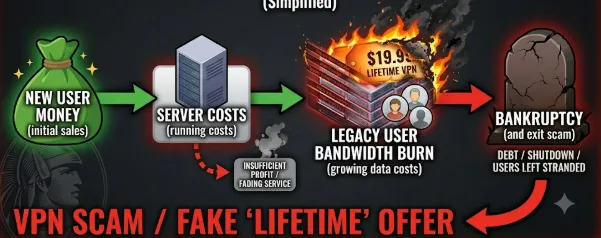
When a VPN provider abandons the healthy "monthly/annual payment" recurring subscription model and pivots to full reliance on a "one-time lifetime purchase," its financial statements fall into a vicious cycle of drinking poison to quench thirst. We can clearly see its fatal capital and resource matching chain through the table below:
|
Stage / Node |
Direction of Operation |
Core Mechanism |
Economic Essence & Consequences |
|
New Money Injection |
New Users |
Relying on pervasive marketing to attract new users and inject one-time lifetime purchase funds. |
Short-term life-sustaining money. This is the platform's sole, non-sustainable cash inflow when there are no other monetization options. |
|
Daily Operational Consumption |
Company Cash Pool |
Funds in the cash pool flow towards server rentals, data center hosting, backbone bandwidth, and anti-blocking/censorship combat. |
Rigid fixed expenses. As long as nodes are not shut down, this portion of bandwidth and hardware/software expenses will continue to increase as the user base grows. |
|
Legacy User Free-riding |
Global Network Nodes |
Legacy users no longer provide a single cent of subsequent funding. However, as long as they connect to a node, they will consume expensive server traffic and computing power. |
Bottomless pit marginal costs. Every active "lifetime user" is a liability on the company's balance sheet, continuously devouring the funds contributed by new users. |
 Company Cash Pool
Old users' bandwidth consumption must be paid for by new users' one-time buyout fees: Although old users no longer provide a single cent of subsequent funding, as long as they continue to use the service, they will keep consuming server traffic and bandwidth. This long-term, bottomless pit of operating costs can only be covered by the buyout fees paid by newly joined users.
-
Fragile cash flow maintenance line: In the absence of cross-subsidies from other businesses (such as advertising or selling users' private data), the company's sole source of funding to keep servers running and pay for data center bandwidth is the steady stream of new users purchasing the service.
-
The insurmountable "tipping point": As the database of old users grows geometrically, the daily maintenance and bandwidth costs of the servers rise linearly or exponentially. At the same time, the penetration rate of any market has its upper limit. Once the growth of new users slows down or dries up, and the incoming "buyout fees" can no longer cover the daily "consumption" of the massive old user base, the cash flow will dry up in an instant.
IV. The "Ponzi-style" life cycle trajectory of lifetime VPNs
The life cycle of the vast majority of low-priced lifetime VPNs follows a standard and irreversible trajectory of "Ponzi-style" decline. The following are the core characteristics and operational states of each stage:
|
Development Stage |
Operational Status & Financial Characteristics |
Server & Bandwidth Conditions |
End-User Experience & Outcome |
|
[Stage 1: Honeymoon Period] (Golden Cash-Magnet Phase) |
Explosive growth of new users, with a massive influx of lifetime buyout fees. The company's book funds are extremely abundant. |
Server load is extremely light, and bandwidth capacity is more than sufficient. |
Excellent experience. Lightning-fast network speeds and stable connections, earning an outstanding early reputation on social platforms and forums. |
|
[Stage 2: Congestion Period] (Service Degradation Phase) |
Existing user base continues to accumulate. The inflow speed of new funds gradually fails to cover the daily bills of global nodes. |
Server load is severe, bandwidth is strained, and nodes begin to experience congestion. |
Precipitous drop in experience. Vendors start using hostile tactics like "speed throttling," "bandwidth limits," and "increased advertisements" to maliciously force old users out in order to cut costs. |
|
[Stage 3: Collapse Period] (Ponzi Burst / Harvesting Phase) |
New user growth hits a ceiling, and cash flow completely collapses. |
Unable to pay server room/IDC bills; servers are gradually suspended or directly shut down. |
Service disruption without warning. Vendors flee, resurrect under a new guise (rebrand), unilaterally rescind lifetime contracts to force subscription conversions, or covertly sell user privacy to cash out. |
Phase 1: The Honeymoon Phase (The Golden Cash-Grab Period)
The service provider is just starting out, with a small user base and abundant server bandwidth. At this point, utilizing low-price "lifetime" gimmicks allows them to frantically absorb an extremely substantial amount of initial capital in a short period. Since there are few users, the speed is exceptionally fast, and the network word-of-mouth is excellent.
Phase 2: The Congestion Phase (The Service Degradation Period)
As existing users continue to accumulate, the server load becomes heavier and heavier, and operating costs begin to skyrocket. At this stage, the inflow of new money begins to fall behind the consumption rate of operational costs. To cut expenses, the service provider starts resorting to tactics such as "speed throttling," "bandwidth capping," and "frequent disconnections" to force out existing users. They may even proactively reduce server nodes, causing the user experience to suffer a cliff-like drop.
Phase 3: The Harvest and Collapse Phase (The Ponzi Explosion)
When the number of newly added users hits a ceiling, the capital chain completely breaks. At this point, service providers usually adopt one of the following methods to end the game "gracefully" or "brutally":
-
Absconding without warning: Directly shutting down the servers, dissolving the company, and completely losing contact.
-
Rebirth under a new guise: Declaring the original brand bankrupt, while the original team takes the technology and equipment to switch to a new brand name (a new guise) to continue peddling a new round of the "lifetime version."
-
Forced unilateral breach of contract: Claiming "force majeure" or "operational adjustments" to cancel the original "lifetime" contract, forcing users to transition to a paid subscription model, and refusing to provide services if they do not pay.
-
Under-the-table transactions (selling privacy): Since they can no longer collect money directly from users, they package and sell users' internet behavior data, real IPs, and other privacy information to third-party advertisers, or use the users' devices as botnet nodes.
Why Buy-Once VPNs Ultimately Fail (The Hidden Costs)
To understand why a "lifetime VPN" is a false proposition, we need to do the math. A healthy VPN provider that guarantees privacy and speed faces the following continuous and high hard costs every single day:
|
Operational Steps / Phases |
Core Consumption & Cost Categories |
Core Requirements & Explanations for Continuous Operations |
|
1. User Establishing Connection |
Basic Access Point & Routing Maintenance |
Stable allocation and transit for carrying massive connection requests daily. |
|
2. Client Maintenance & Updates |
Software R&D & Security Patch Costs |
Frequent adaptation to upgrades of mainstream operating systems (Windows, macOS, iOS, Android) and patching security vulnerabilities. |
|
3. Global Physical Server Leasing |
Hardware Colocation & Server Rental Fees |
Leasing physical servers in data centers around the world to provide multi-node options. |
|
4. Massive Bandwidth Consumption |
Traffic & Bandwidth Costs (Variable Costs) |
The greater the user traffic consumption, the higher the bandwidth fees the provider must pay to the telecommunications backbone network. |
|
5. Regular Replacement of IP Addresses |
Acquisition and Replacement Funds for Premium IP Blocks |
To combat blockages from streaming media (e.g., Netflix, Disney+) and firewall blocking, clean new IPs must be continuously purchased. |
|
6. 24/7 Customer Support |
After-sales Customer Service & Technical Labor Costs |
Maintaining a 24/7 online customer service team to answer user configuration and connection issues. |
Note: All the interconnected operations mentioned above require a continuous flow of cash support; if the funds in any single link are broken, the entire service will collapse.
Therefore, because the production cost of the service is continuous and incremental, in terms of business logic, it is absolutely impossible to achieve long-term healthy operations through a one-time buyout.
In-Depth Analysis: How Lifetime VPNs Step-by-Step Evolve into a "Ponzi Scheme"?
A typical lifetime VPN provider usually goes through the following four life cycle stages:
Lifetime VPN Life Cycle Stages Comparison Table
|
Stage |
Stage 1: High-profile Cash Grab (Honeymoon Period) |
Stage 2: Service Deterioration (Bottleneck Period) |
Stage 3: Extreme Exploitation (Going Rogue Period) |
Stage 4: Shedding the Shell / Exit Scam (Harvesting Period) |
|
Core Status |
Low-price promotions attract a massive amount of buyout funds, resulting in abundant cash on the books. |
The sudden surge in users causes costs to skyrocket, with no continuous capital inflows following. |
Cash flow is about to bottom out, and the merchant begins to profit by compromising user experience and security. |
Funds are completely broken, and the service can no longer be maintained. |
|
Service Performance |
Few users in the early stage, servers are not overloaded, speeds are extremely fast, and reputation is excellent. |
To cut costs, the merchant reduces bandwidth and takes some servers offline; connections start to slow down and frequently disconnect. |
Maliciously blocking high-traffic "non-compliant" accounts; secretly collecting and selling users' browsing logs and privacy data for monetization. |
Servers are shut down due to unpaid bills, and the merchant announces bankruptcy or runs away (exit scam). Soon after, they rebrand with a new name and logo to repeat the same operation. |
In-depth Phase Analysis
Phase 1: High-profile Monetization (The Honeymoon Phase)
-
Core Situation: The merchant launches an extremely tempting, low-priced "lifetime buyout" package. This attracts a massive wave of paying users in a short period, leading to a rapid accumulation of cash on the books and an illusion of highly abundant funds.
-
Service Performance: Since the project is in its early stages, the user base is still small, and server resources are ample and far from overloaded. During this time, the service speed is exceptionally fast, connection is stable, and user word-of-mouth is excellent, which further drives FOMO (fear of missing out) and bandwagon purchases.
Phase 2: Service Deterioration (The Bottleneck Phase)
-
Core Situation: As the user volume experiences explosive growth, the operational costs for servers and bandwidth skyrocket. Because the one-time buyout mechanism lacks continuous inflows of subscription revenue, the cash flow begins to experience significant pressure.
-
Service Performance: To cut operational costs, the merchant starts reducing bandwidth and taking some servers offline. Users will noticeably experience slower connections, higher latency, and frequent disconnections.
Phase 3: Extreme Exploitation (The Dark Phase)
-
Core Situation: The cash flow on the books is nearing exhaustion, and legitimate operations are no longer profitable. The merchant abandons all hope of maintaining a good reputation and shifts to forcibly extracting residual value by compromising the experience and privacy security of existing users.
-
Service Performance: The merchant begins to arbitrarily and maliciously ban "non-compliant" accounts that consume large amounts of data to reduce resource consumption. More severely, they secretly collect and sell users' browsing logs and private data for monetization.
Phase 4: Golden Cicada Sheds Its Shell (The Harvest Phase)
-
Core Situation: The funding chain is completely broken. The merchant is both unable and unwilling to pay any further operational costs, leading to a total collapse of the service.
-
Service Performance: Servers are forcibly shut down by the hosting provider due to unpaid bills, and the merchant directly declares bankruptcy or vanishes without a trace ("runs away"). Shortly after, the team behind the scenes will often repackage themselves under a new brand and logo to repeat this exact same exit-scam cycle.
Why It Is Not Recommended to Buy: The Four Practical Risks Faced by Consumers
If you still feel that "anyway, it only costs dozens of yuan and is not expensive, so it is worth buying to have a try, as it will pay off if it lasts for a few years," you might be underestimating the following four practical risks. In the internet service industry, especially in network acceleration, privacy protection, and various SaaS (Software as a Service) fields, low prices and "lifetime" offers are often not welfare benefits, but a carefully designed consumer trap.
1. Risk of Sudden "Exit" and Bankruptcy: The "Lifetime" Scam Under Information Asymmetry
What you perceive as "lifetime" refers to your lifetime (Lifetime); whereas the "lifetime" in the merchant's legal terms actually refers to "the lifecycle of this product." As long as the merchant announces that the product has ceased operations, the company has gone bankrupt, or the product has been upgraded to a "new version" that no longer supports old licenses, your "lifetime contract" instantly turns into a useless piece of paper.
-
The "killing the goose to get the golden egg" model of capital cash-out: The sole purpose of many unscrupulous merchants launching a "lifetime version" is to quickly amass a massive cash flow in the short term. Once these funds are received, they do not use them for server expansion or technological research and development, but instead transfer them away directly. Subsequently, they shut down the service outright under the pretext of "servers being blocked," "company restructuring," or "force majeure factors."
-
The industry's unwritten rule of shell-reincarnation: In the network services industry, when a brand "collapses," the team behind the scenes might package a "brand-new" brand using the exact same code, a different logo and domain name on the very next day, and continue to attract customers. As an old user, you can only watch as your original software fails to connect, and you cannot even find anyone to complain to. You think you got a bargain, but in reality, you have only become an "interest-free loan provider" for the merchant's quick cash-out.
2. Privacy Sellout and Security Risks (The Most Fatal Risk): The "Safe Passage" You Imagine Is Actually a Privacy "Harvester"
Your original intention of using a VPN is to protect your privacy, but for a lifetime VPN to survive, there is an extremely high probability it will betray your trust. Many cheap VPNs have ad trackers, malware, or traffic collection plugins embedded in their underlying SDKs. They not only log your web footprint but also analyze and sell your spending habits. You think you bought a secure channel, but in reality, you are "paying a toll" for the leakage of your own privacy.
-
There is no free lunch, let alone a loss-making business: Server bandwidth, purchasing and maintaining IP addresses, and customer service salaries—all of these are ongoing, hard monthly costs. For a merchant who only charges you a few dozen yuan as a "lifetime fee," after consuming the initial funds, what do they use to pay these bills generated every month? There is only one answer: turning you into their "commodity."
-
Dark web transactions and traffic hijacking: Your internet behavior tracks (logs), real personal IP addresses, email addresses, and even temporary account passwords entered on unencrypted web pages are all highly sought-after "sweet treats" in the eyes of dark web black markets and ad networks. Even worse, some low-quality clients will run silently in the background, turning your computer or phone into a hacker's "zombie PC" (botnet) to launch Distributed Denial of Service (DDoS) attacks, or forcing pop-up ads in your browser to channel profits to the merchant through traffic hijacking.
3. Extremely Poor Service and Connection Experience: The "Active Unsubscribe" Strategy of a Slow Death
As servers overload, the experience of using a lifetime VPN typically plummets off a cliff 3 to 6 months after purchase. Inability to connect, high latency, and frequent disconnections will become the norm. When faced with your complaints, customer service will either ignore them entirely or reply with perfunctory bots. Ultimately, you will voluntarily give up using it because you cannot tolerate the extremely poor experience, and the merchant's goal is thus achieved.
-
The inevitable result of too many people and too little resource: To keep running, lifetime merchants must continuously attract new users to secure new funds. However, server capacity is limited. When thousands of new users flood into the same bandwidth, the server load instantly surges. To save money, merchants will absolutely not expand equipment proportionally, resulting in everyone's network speed being compressed to the extreme.
-
Deliberate "cold treatment": Much of the time, the deterioration of the experience is not entirely due to technical limitations, but rather an operational strategy of the merchant. They know very well that if you keep using it at high frequency, you will continuously consume their server bandwidth (which is their operating cost). Therefore, they force you to "retreat in the face of difficulties" by deliberately limiting speeds, prolonging ticket response times, or even blocking connections during peak hours. As long as you uninstall the software, they completely save the subsequent cost of serving you.
4. Overlord Clauses and "Lifetime" Wordplay: "Legal Fraud" Hidden Under the Guise of Compliance
If you carefully read the Terms of Service (ToS) of those lifetime plans, you will find they are full of traps. Merchants often hide disclaimers like this in those dozens of pages of dense English or Traditional Chinese terms that you click "Agree" to:
"The company reserves the right to change the terms of service, limit daily traffic, or terminate services at any time without prior notice."
-
Invisible "Soft Limits" (Throttling): Some lifetime VPNs that claim "unlimited traffic" actually set a soft limit of 10GB or even 5GB per month in the background. Once you download a few large files or watch a few high-definition videos and exceed the limit, your speed will be throttled to the point where you can't even open a webpage. When you go to argue with customer service, they will bring out the "Fair Use Policy" in the terms of service to shut you up.
-
The "Golden Cicada Shedding Its Skin" of Version Upgrades: You bought the lifetime version of V1.0. A year later, the merchant announces the launch of V2.0, a "brand-new architecture version," claiming it uses more advanced encryption and faster servers. Meanwhile, the V1.0 in your hand is classified as a "Legacy" version, no longer maintained, or even shut down directly. If you want to use V2.0? Sorry, please pay for a subscription again. Legally, they have not broken their promise of "V1.0 lifetime," but in reality, you have been completely abandoned.
Real Examples of Lifetime VPN Exit Scams (ProXPN & More)
In the history of the VPN industry's development, countless pioneers have proven through their practical actions that the "Lifetime Plan" is a utopian path incapable of landing, or even an outright Ponzi scheme:
Case 1: The Quiet Demise of ProXPN ("Lifetime" Vanishes into Thin Air)
Background & Origin: ProXPN was once one of the most popular "lifetime VPN" star products on major discount websites such as StackSocial and Slickdeals. In the mid-2010s, it attracted a massive wave of bargain-hunting users with extremely low prices—typically requiring only $29 to $39 for "lifetime unlimited access"—ultimately selling tens of thousands of lifetime licenses.
The Collapse: As time went on, a continuous stream of "lifetime users" flooded in, but these users no longer generated subsequent subscription fees. This meant that ProXPN's operators had to use extremely low lifetime revenue per customer to cover indefinitely growing server bandwidth costs, IP rental fees, and customer support labor costs.
To sustain operations, ProXPN began to aggressively throttle bandwidth. In its later stages, its network performance became unbearable, with frequent connection drops and speeds as slow as a snail.
Ultimate Fate: After struggling for several years, the brand quietly shut down all of its servers and took its official website offline, without providing any compensation, explanation, or proper transition plan to its users. Countless users who had purchased the lifetime package could not even find an email address to complain to; their "lifetime service" turned into a pile of dead, unconnectable code in just two to three years.
Case 2: Windscribe's Narrow Escape (A Conscious Awakening and Clear Bookkeeping)
Background & Origin: During its startup phase, the well-known VPN provider Windscribe briefly offered "lifetime plans" to carve out a path in a highly competitive red ocean market dominated by giants and to quickly raise seed capital to build its early server network.
The Collapse: As their user base expanded, Windscribe’s founding team quickly realized the terrifying nature of this model. Unlike traditional software where the cost per user decreases as the user base grows, VPN services behaved like financial "black holes" due to users' long-term heavy downloading and media streaming.
The founder later published a famous, brutally honest industry blog post, candidly admitting:
"Selling lifetime plans is a poisoned chalice. While it brings in cash in the short term, it is a financial disaster as legacy users continuously consume bandwidth. If we continue to sell lifetime plans, we will sooner or later go bankrupt, or be forced to sell user data and privacy to survive. Therefore, we must stop selling it entirely and apologize to all our users."
Ultimate Fate: Windscribe chose to pull back from the brink. They completely removed their lifetime plans and transitioned to a healthy monthly/annual subscription model. Because they transitioned in time and honored their promise to early lifetime users (using healthy subsequent subscription revenues to subsidize the early lifetime users), they managed to survive to this day. This case proves from the opposite perspective that even legitimate providers who genuinely want to offer good service cannot violate basic economic laws.
Case 3: KeepSolid (VPN Unlimited)'s Chain of Tricks ("Lifetime" in Name Only)
Background & Origin: KeepSolid's VPN Unlimited is another major player that has long been active on various discount platforms with its "lifetime plans." To continuously secure new funds, they not only sold individual lifetime editions but even introduced "Family Lifetime Plans" and "Business Lifetime Plans."
The Collapse: As more and more legacy users accumulated and new funds failed to cover server operating costs, KeepSolid began playing "word games" and deploying "downgrade schemes."
-
Service Downgrades: Server nodes for lifetime users were quietly throttled, and they were blocked from using newly developed high-speed dedicated lines (such as WireGuard protocol nodes or streaming-dedicated nodes). The new nodes were restricted only to monthly/annually paying "Premium Members."
-
Forced Upgrade Traps: Many lifetime users found their clients frequently bombarded with forced pop-ups saying: "Due to technical upgrades, your legacy lifetime protocol has expired. Please pay the price difference to upgrade to the new lifetime protocol."
-
Unwarranted Account Bans: On foreign forums like Reddit, a large number of lifetime users complained that their accounts were permanently banned without warning under the guise of "bandwidth abuse" or "violation of terms of service." In reality, this was simply the provider maliciously purging "zombie lifetime users" who generated zero profit.
Ultimate Fate: Although the brand survives to this day, its "lifetime package" has long reduced to a useless, nominal-only feature. While users technically hold lifetime access rights, the actual experience is extremely poor. To get services that meet even the baseline of acceptability, they still need to continuously spend money on add-on packages.
Case 4: Anonymous "Airports" & Low-Quality VPNs' "Harvesting Loop" ("Lifetime" is a Precursor to an Exit Scam)
Background & Origin: In niche forums, social media, and private groups, countless unregistered and unlicensed "airports" (shadowsocks/V2Ray providers) or white-label VPNs operate actively. Their most common marketing tactic is to launch "lifetime unlimited traffic plans" priced as low as dozens or a hundred RMB, under the banners of "Double 11 Specials" or "Anniversary Mega Sales."
The Collapse: The operational costs of such services are extremely low. They usually rent a few cheap VPS servers, apply open-source protocol templates, and start doing business. The underlying logic of their lifetime packages is incredibly simple: harvest quickly, break even, and run.
-
Phase 1: Aggressive promotion to attract hundreds or thousands of users with rock-bottom prices.
-
Phase 2: As the user count increases, the servers lag. Since there is no continuous cash flow to expand capacity, the operators simply give up and perform zero technical maintenance.
-
Phase 3: When funds from newly joined users are no longer enough to pay for the next month's server rent, or when faced with regulatory risks, the operators directly shut down the servers, delete their Telegram groups, and vanish into thin air.
Ultimate Fate: A few months later, the same operator switches to a sleek new web template, adopts a brand-new name, launches a "lifetime membership package" once again, and begins a new cycle of harvesting. For users who purchase these services, their so-called "lifetime" often lasts for only 3 to 6 months.
Avoiding the Lifetime Trap: Legitimate VPN Providers & In-Depth Evaluation
When looking for tools to protect online privacy and data security, many people are often attracted by low-quality VPNs on the market claiming to offer "lifetime free," "one-time purchase," or "ultra-low-cost lifetime service." However, network services are consumable items that require continuous maintenance of hardware and technology; there is no such thing as a truly "free lunch" in this world.
To help everyone more intuitively see the essential differences between "legitimate subscription-based VPNs" and "low-quality 'lifetime' one-time VPNs," this article will deeply analyze the survival models of both and recommend the currently globally recognized safest and technologically most advanced legitimate VPN providers.
I. Survival Rules Comparison: Why "Subscription Models" Are the Guarantee of Security?
We can see at a glance from the following five core dimensions why only the "subscription model" can support a truly secure VPN service:
|
Comparison Dimension |
Legitimate Subscription-Based VPN (e.g., NordVPN, Proton VPN) |
Low-Quality "Lifetime" One-Time VPN |
|
Commercial Model |
Continuous monthly/annual subscription fees: Healthy cash flow, transparent and sustainable financial status, with sufficient funds for software and hardware maintenance. |
Relying on new user buyouts: Highly characteristic of a Ponzi scheme (using new money to subsidize existing users). As user backlog and server costs rise, it is bound to eventually collapse or exit-scam. |
|
Primary Goal |
Improve service quality and retain existing users: High retention rate is the lifeline of the subscription model, so providers will continuously optimize user experience. |
Compress service costs as much as possible: Since they cannot make continuous profits from old users, providers will reduce bandwidth and maintenance as much as possible, aiming only to acquire more new paying customers. |
|
Privacy Protection |
Strict "No-Logs" policy: Services undergo independent audits by authoritative third-party organizations (e.g., PwC, Deloitte), making it impossible and unnecessary to log user privacy. |
Highly likely to collect and sell user data: Lacking continuous subscription revenue, operational costs can only be subsidized by collecting, packaging, and selling users' browsing histories and personal privacy data. |
|
Server Quality |
Self-built or 10Gbps high-end servers: Numerous global nodes, abundant bandwidth, and high network throughput. |
Rented cheap shared-bandwidth servers: Highly prone to congestion, frequent IP blocks, extremely high latency, and lack of basic physical security protection. |
|
Technical Updates |
Actively develop new protocols (e.g., NordLynx, Lightway): Great client experience, timely patching of system vulnerabilities, and support for cutting-edge technologies like post-quantum encryption. |
Software rarely updated: Outdated protocols, riddled with security vulnerabilities, highly vulnerable to hacker interception or traffic leaks. |
Part II: Safe Alternatives: The Best Subscription VPNs in 2026
Based on strict screening criteria such as audited no-logs policies, server throughput (10Gbps), proprietary protocols, and operational qualifications, here are our top recommendations for the world's most premium and trustworthy subscription-based VPN providers:
1. NordVPN — The Industry Benchmark for Overall Performance and Speed
-
Main Advantages: Blazing fast speeds, comprehensive feature set, and top-tier security.
-
Core Technologies:NordLynx Protocol: Built on the next-generation WireGuard protocol, offering military-grade encryption with virtually no loss of network bandwidth.
-
10Gbps High-End Servers: Over 6,000 self-operated servers deployed globally, fully supporting 10Gbps bandwidth.
-
Threat Protection Pro: More than just a VPN; it blocks malware, ads, and trackers at the protocol level.
-
Privacy Audits: Successfully completed multiple independent no-logs audits by PwC and Deloitte, making its privacy policy airtight.
-
Best For: HD streaming unblocking, high-speed daily browsing, and heavy network security users.
-
If you want to see exactly how NordVPN performs under pressure, read our full [NordVPN Review: Speed & Security Test], where we break down its NordLynx protocol speeds.
2. Proton VPN — The Guardian of Geek Spirit and Ultimate Privacy
-
Main Advantages: Swiss-based, open-source and transparent, with exceptional anti-censorship capabilities.
-
Core Technologies:Secure Core Architecture: User traffic is first routed through physically secure underground servers in strong privacy-friendly countries (such as Sweden, Iceland, or Switzerland) for double encryption before being transmitted to the destination server.
-
Fully Open Source: The source code for all clients (Windows, macOS, Android, iOS, Linux) is entirely public, allowing anyone to audit its security at any time.
-
NetShield: Blocks ads, trackers, and malware via DNS filtering.
-
Privacy Audits: Headquartered in Switzerland (which has some of the world's strictest privacy laws), outside of the 14-Eyes Alliance jurisdiction, with all services undergoing rigorous security audits.
-
Best For: Journalists, researchers, users with absolute and extreme privacy requirements, and torrenting/P2P enthusiasts.
- If you want to see exactly how Proton VPN performs under pressure, read our full [Proton VPN Review], which prioritizing user freedom and digital security without sacrificing speed or features
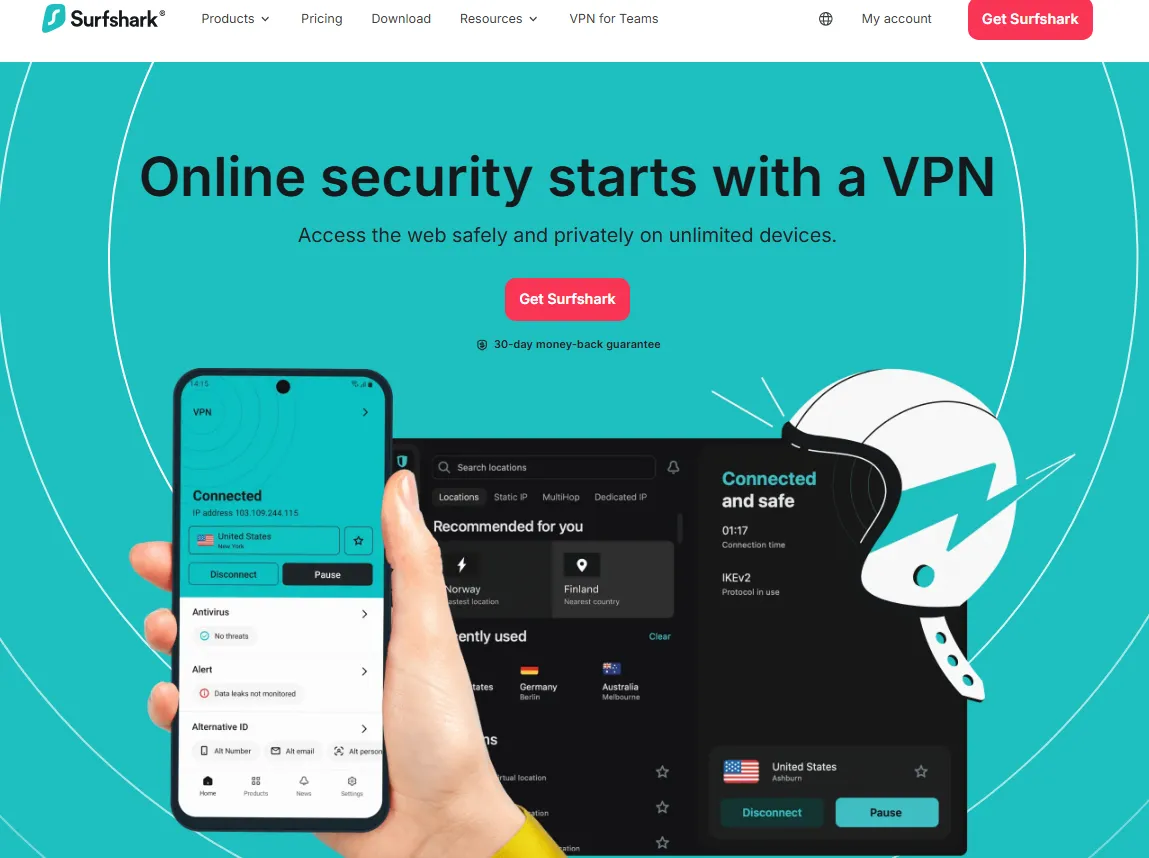
3. Surfshark — The Top Choice for High Cost-Effectiveness and Unlimited Device Connections
-
Main Advantages: Supports unlimited simultaneous device connections on a single account, offering outstanding value for money.
-
Core Technologies:NoBorders Mode: Automatically detects network censorship and dynamically adjusts protocols to help users easily bypass complex network firewalls.
-
Alternative ID: Allows users to generate virtual emails and names to protect their real personal registration information.
-
RAM-Only Servers: Servers run entirely on RAM with no hard drives, meaning all data is instantly and completely wiped upon power outage or reboot.
-
Privacy Audits: Fully audited for no-logs compliance and overall security by Deloitte.
-
Best For: Multi-device households, budget-conscious students, or small/micro enterprises requiring legitimate protection.
-
For users who want the feel of a 'lifetime' deal without the scam, Surfshark's unlimited device policy is the closest legitimate alternative. Check out our [Surfshark VPN Review] to see how one subscription can cover your entire family.
Part III: Tips to Avoid Traps When Purchasing a VPN
-
Absolutely avoid "Lifetime" VPNs: As shown in the comparison chart above, the one-time purchase business model makes it impossible to sustain high-quality services in the long run. Over time, these services almost always degrade into sluggish, ad-ridden rogue software that may even sell your private data.
-
Beware of "No-Logs" promises without third-party audits: Verbal promises of "keeping no logs" are completely meaningless. Credibility only comes from independent audit reports conducted by major international firms like Deloitte, EY, or PwC.
-
Prefer providers with money-back guarantees: Legitimate VPN providers (like the three recommended above) typically offer a 30-day unconditional money-back guarantee. You can test them thoroughly and request a full refund anytime if you are not satisfied.
Frequently Asked Questions (FAQ)
Q: Does "lifetime" VPN refer to "my lifetime" or "the VPN's lifetime"?
A: Legally, it refers to the latter, meaning "the lifecycle of the service or product." As long as the company goes bankrupt, rebrands under a different name, or stops maintaining that specific client, your "lifetime" comes to an end. In actual practice, this "lifetime" usually lasts only 1 to 3 years.
Q: Are those highly-rated lifetime VPNs on StackSocial also scams?
A: The vast majority of them are. Many of the VPNs sold on such platforms are "white-label VPNs" or small startups. The high ratings are often incentivized by merchants who induce users to write positive reviews in exchange for "extra service time" or "cash back." After purchasing these VPNs, you will typically encounter connection failures or extremely slow speeds within a year.
Q: Why did some big-name VPNs also sell lifetime versions in the past?
A: In their early startup stages, many legitimate VPNs used "lifetime plans" as a crowdfunding method (similar to Kickstarter) to raise their first round of seed funding to purchase servers and recruit a team. However, as long as they intended to operate in the long run and become industry giants, they had to close the lifetime access quickly after accumulating their initial user base and transition to a healthy subscription model.
Q: Can I defend my rights and get a refund after a lifetime VPN runs away with the money or its service fails?
A: Defending your rights is extremely difficult, and it is virtually impossible to recover your losses. Most lifetime VPNs are operated by offshore "three-no" teams (no registration, no address, no license) with no formal qualifications, and they are not subject to domestic regulation, leaving no legal entity to hold accountable once they exit. Transactions are mostly conducted through private channels without formal contracts or after-sales receipts. Furthermore, the platform agreements contain disclaimer clauses that evade compensation liabilities, and because unauthorized VPNs are themselves non-compliant, users' channels for seeking redress are extremely limited.
Q: Is it trustworthy when merchants claim "permanent company operations and a lifetime warranty"?
A: Completely untrustworthy; this is invalid and false advertising. No enterprise can guarantee permanent operations—industry mergers, acquisitions, bankruptcies, and business adjustments are highly common. There have already been multiple instances where established VPNs were acquired and subsequently invalidated users' lifetime benefits directly. Moreover, such lifetime promises are merely verbal marketing and are not written into formal contracts, carrying zero legal force. Merchants can alter the rules at will, leaving users with no basis for legal recourse.
Q: Are there any reliable lifetime VPNs? Can I buy a lifetime plan from a legitimate, big-name provider?
A: There is no such thing as a reliable lifetime VPN, and it is highly discouraged to buy one even from a legitimate, big-name provider. While a reputable brand's lifetime plan may not exit immediately, its lifetime benefits can be invalidated at any time due to business adjustments, policy changes, corporate acquisitions, or rising costs. Furthermore, lifetime plans require a high one-time upfront investment with all risks borne by the user, making them far less flexible and secure than regular periodic subscription plans.
Q: Why do so many people on the internet still recommend lifetime VPNs?
A: The core reasons are financial interests and information asymmetry. The commissions that bloggers and community agents receive for promoting lifetime plans are far higher than those for ordinary subscription plans, so they deliberately conceal risks and exaggerate advantages to induce users to buy. At the same time, average users lack commercial awareness and are misled by the superficial benefits of "saving money for a lifetime," ignoring long-term operational risks and blindly following the crowd.
Q: Are the risks of a lifetime VPN the same as those of a lifetime software membership?
A: The risks are completely different. Ordinary lifetime software memberships are primarily based on local feature usage with low server dependence, meaning a one-time fee can cover the costs. In contrast, a VPN is a service with heavy cloud dependence; it must continuously invest in servers, bandwidth, and maintenance costs to remain operational. A one-time payment model for a lifetime cannot support long-term operations, making its collapse risk far higher than that of ordinary lifetime software memberships.