Stop overpaying for airfare. Learn the exact step-by-step method to use a VPN to find cheaper flights, beat dynamic pricing, and the best countries to connect to.
Buying plane tickets can often feel like a pretty user-unfriendly experience. Airlines are constantly adjusting their pricing, which means you might watch the cost slowly creep up while you're waiting for a deal.
A Virtual Private Network, or VPN, can be the solution to finding cheaper flights. It lets you connect to a server in a different geographical location, allowing you to compare prices across different regions and snag the best deal.
With this guide, you'll figure out what truly impacts airfare prices and learn the simple steps to score cheaper tickets using a VPN.
Step-by-Step: How to Book Cheaper Flights Using a VPN
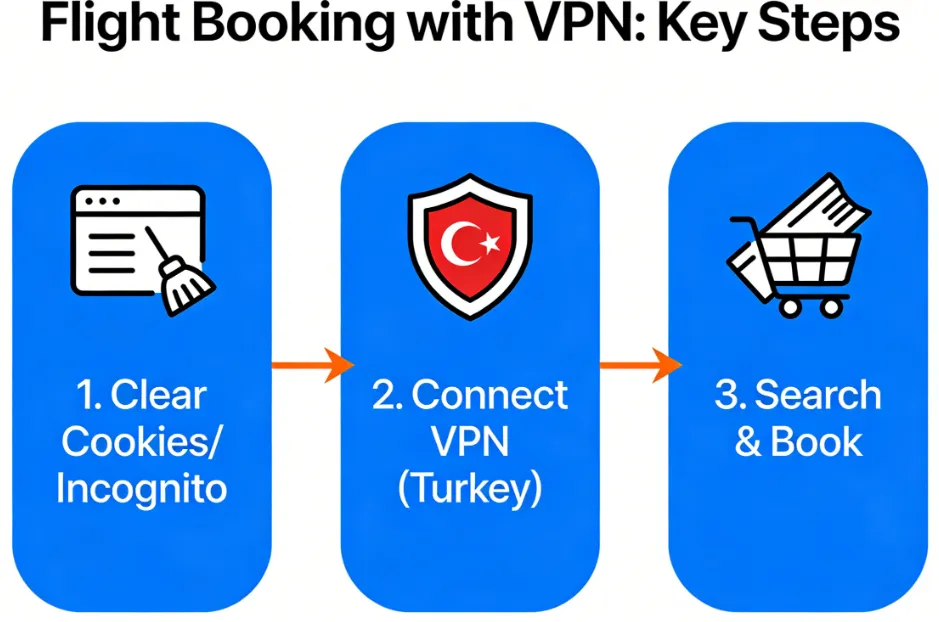
Finding a cheaper fare isn't just about turning on a VPN; it requires a specific process to ensure airlines can't track your previous searches. Follow these steps exactly:
-
Clear Your Digital Footprint: Before doing anything, clear your browser's cookies and cache. Alternatively, open a brand-new Incognito or Private browsing window. Airlines use cookies to see if you've checked a route multiple times, which can trigger price hikes.
-
Connect to Your VPN: Open your VPN app and select a server in a different country. (See our list of the best countries below). For example, if you are in the US booking a domestic flight in Mexico, connect to a Mexican server.
-
Search for Your Flight: Go to an airline's website or a flight aggregator (like Skyscanner or Google Flights) and search for your desired route. Note the price.
-
Compare and Repeat: Close the window, clear your cookies again, and connect your VPN to a different country (e.g., India, Vietnam, or an Eastern European country). Search the exact same route.
-
Book the Best Deal: Once you find the lowest price in a specific currency, proceed to checkout. Pro Tip: Ensure you use a travel credit card with zero foreign transaction fees to avoid losing your savings to bank conversions!

Cheapest Countries to Book Flights from with a VPN (Regional Pricing Revealed)
The secret to accessing the absolute lowest international and domestic fares is knowing which VPN servers to connect to. Based on extensive price testing across numerous countries, we have identified several locations that consistently offer better deals than more affluent nations.
You have the highest probability of maximizing your ticket savings by connecting your VPN to servers located in these four countries:
-
Turkey
-
Ukraine
-
Ecuador
-
Indonesia
Beyond these top-tier options, booking via servers in other Southeast Asian regions, such as Malaysia, is also a highly recommended strategy for securing a below-average ticket price.
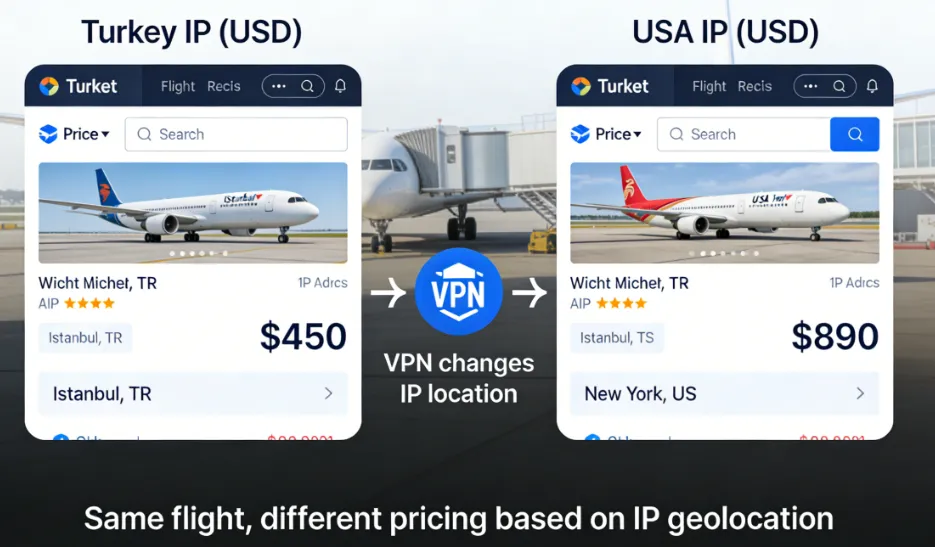
For example, the cheapest countries for flights from India are consistently Nepal and Thailand, often with flights under ₹15,000 round-trip, followed closely by Malaysia, Sri Lanka, and Vietnam, due to proximity, high competition, and budget-friendly travel costs. Other affordable options emerging include Indonesia, Bhutan, and sometimes Singapore, especially when booking in advance or finding deals on budget airlines, notes.
The Best VPN Server Locations for Cheap Flights
Which country should you connect to? The golden rule is that airlines often offer lower prices to people booking from countries with lower average incomes, or from the destination country itself. Here are the best locations to test:
|
Strategy / Server Location |
Why It Works |
Best Used For |
|---|---|---|
|
The Destination Country |
Airlines often offer local residents lower fares than international tourists. |
Domestic flights within a foreign country (e.g., flying from Rome to Milan). |
|
Lower-Income Countries (e.g., India, Vietnam, Argentina) |
Regional pricing means tickets are scaled to local economic conditions. |
Long-haul international flights. |
|
The Airline's Home Country |
National carriers sometimes have exclusive unadvertised deals for local IP addresses. |
Booking directly through a specific airline's official website. |
The 5 Best VPNs to Snag Cheaper Flights in 2025
|
Rank |
VPN Name |
Standout Feature |
Why It's Great for Finding Cheap Flights |
|
1 |
Massive server network and blazing fast speeds |
Our Top Pick Overall. Features the largest number of servers (over 8,400) and broadest country coverage (over 126), with high server density in countries often known for lower airfare, like Mexico, Thailand, and India. |
|
|
2 |
Best value, allowing unlimited device connections |
Budget-Friendly Powerhouse. It's affordable and lets you connect an unlimited number of devices. Its servers are widely distributed, and the connections are speedy. |
|
|
3 |
Super-fast speeds and rock-solid reliability |
The Go-To for Speed and Stability. Offers incredibly fast connection speeds and high reliability when changing IP addresses, helping you avoid detection by travel sites. |
|
|
4 |
High-quality paid version (plus a decent free option) |
Reliable Low-Cost Country Servers. The paid version features servers in key low-fare countries like Mexico, India, and Thailand, helping you uncover regional discounts. |
|
|
5 |
User-friendly interface and great for general use |
Perfect for Beginners & Multi-Use. Very intuitive and easy to use. Its huge number of servers allows for easy connection to various geographical locations for quick price comparisons. |
Why Airfare Prices Are Unstable: Revenue Management vs. Price Discrimination
The cost of an airline ticket seems to be in constant motion. This intense price volatility is driven by a complex interplay of several factors, extending far beyond simple supply and demand. While consumer interest and operating expenses like jet fuel, airport taxes, and maintenance fees certainly play a role, the biggest influence comes from the airlines' own intricate pricing strategies.
The Role of Revenue Management Systems
Airlines use highly sophisticated "revenue management" software to determine and continuously adjust ticket prices. The core logic often relies on a model called Expected Marginal Seat Revenue-b (EMSRb). This system assigns every seat to a specific "fare class" and allows airlines to calculate the price for hundreds of thousands of flights daily.
However, these systems are not as sophisticated as many consumers believe. They tend to set prices for each flight route independently and do not always consider external factors like what competitors are charging or how booking one flight might affect demand for a different flight on the same route.
Contrary to the idea of prices changing moment-to-moment, airlines generally operate with a fixed, limited menu of price tiers for any given flight. When a price suddenly jumps, it usually means that the allocation of seats for one lower-cost tier has been fully sold, automatically pushing the remaining seats into the next, more expensive tier. Therefore, while adjustments appear constant, the actual price points are often rigid, sometimes spaced by as much as $100 intervals.
Some carriers are exploring "continuous revenue management" to allow for smaller, more dynamic price adjustments, but even this newer approach does not fully enable the hyper-personalized, search-based price manipulation that many travelers fear.
Classic Market Forces: Supply and Demand
Traditional economics still influence ticket costs. High demand, especially around major holidays, school breaks, or popular events, invariably pushes fares up. Conversely, if a flight is undersold, the airline might drop the price—within the constraints of their existing price tiers—to fill empty seats. This responsiveness, however, is not always instant or perfectly aligned with market changes due to the tiered pricing structure.
The Myth of Search Tracking
It’s a persistent myth that airline websites use browser cookies to track your searches and actively raise prices just because you've shown interest. While tracking for marketing and behavioral analysis is definitely happening, strong evidence suggesting that major airlines directly hike prices based purely on your repeated searches is scarce. Price changes are far more likely to be triggered by genuine inventory shifts (a seat selling) or predefined pricing rules, rather than your personal browsing history.
IP Address Spoofing: How Airlines Track Your Location (And How to Beat It)
To implement regional pricing, airlines and online travel agencies (OTAs) rely on a few methods to pinpoint your location.
1. IP Address as the Primary Indicator
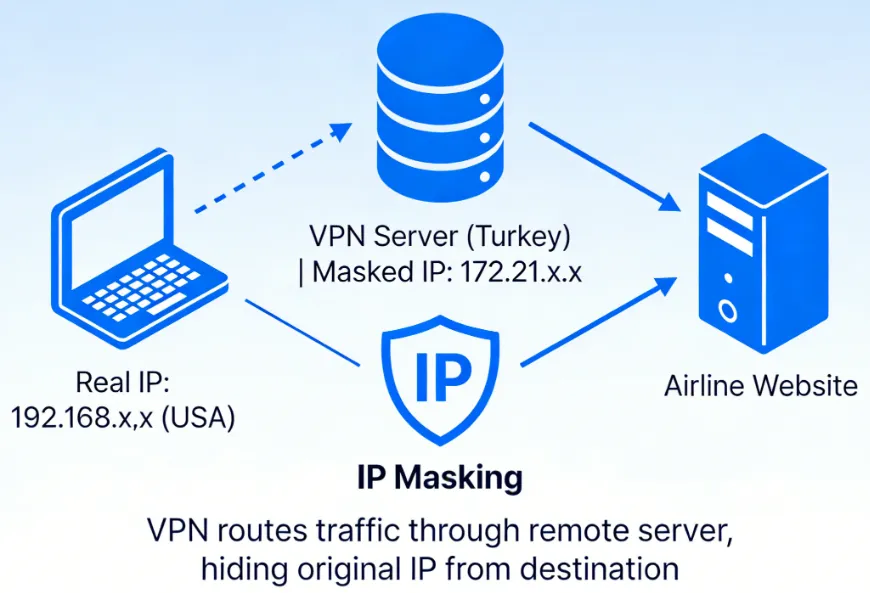
Your IP address, assigned by your internet service provider (ISP), provides the simplest and most common form of geo-targeting. It gives the booking website a reliable, approximate idea of your location—usually down to the city or region. This information is the foundational tool used to display the local currency and enforce regional pricing schemes, which can be based on local market competition or taxes. This is why masking your IP address with a Virtual Private Network (VPN) is the key tactic for viewing prices intended for other countries.
2. Advanced Mobile Location Data
When you use a mobile device, certain travel applications may request access to more granular location services, such as GPS coordinates or Wi-Fi network triangulation. While this level of precision is primarily used for fraud prevention, sending localized notifications, or complying with government regulations, it allows the app to know exactly where you are, rather than just where your connection originates.
3. VPN to Avoid Airline Search Tracking
A VPN helps avoid airline search tracking by masking your IP and location, making it harder for sites to raise prices based on your interest, and encrypts traffic for security. How a VPN Helps: Masks Location (IP Address): Hides your real IP, making websites think you're browsing from another country, which can affect prices.
Encrypts Data: Secures your online activity, protecting sensitive info on public Wi-Fi. Prevents Price Hikes: Stops algorithms from increasing fares based on repeated searches for the same route.
Step-by-Step Guide to VPN Flight Hacking (The Incognito/VPN Strategy)
Utilizing a VPN to hunt for better flight deals is a straightforward process, though the results are never guaranteed. By digitally changing your perceived location, you can potentially unlock regional pricing that is significantly lower than the standard fare offered in your home country. Follow these steps to maximize your chances of securing a discounted ticket:
-
Establish a Baseline: Before activating your VPN, visit your preferred flight aggregator or airline website and record the current price for your desired itinerary. This crucial step gives you a tangible reference point to accurately measure any savings you find.
-
Activate Your VPN and Choose a Strategic Server: Turn on your VPN service. Select a server location in a country often associated with lower localized fares, such as India, Vietnam, Thailand, or Mexico.
-
Ensure Anonymity (Go Incognito): Launch a new private or incognito window in your browser. This is absolutely critical for eliminating any residual cookies or cached data from previous searches that could potentially influence the price displayed.
-
Start Comparison Shopping: Revisit the booking site within the incognito window. The displayed currency and fares should now reflect your new, virtual location. Make a note of the new price.
-
Iterate and Optimize: Disconnect and then repeat steps 2 through 4, connecting to different potentially low-cost countries each time, and meticulously track the various fares you find.
-
Final Booking: Once you identify the most advantageous regional price, connect to that specific server one last time and immediately complete your ticket purchase while maintaining the incognito/private browser state.
The 5 Best VPNs for Snagging Cheaper Flights in 2025
A Virtual Private Network (VPN) is an essential tool for travelers looking to bypass dynamic regional pricing and score better deals on airfare. By masking your IP address, a VPN allows you to virtually "shop" from countries where tickets are often priced lower.
Here is a detailed breakdown of the top five VPNs recommended for finding cheaper flights in 2025, optimized for US English reading habits.
1. NordVPN
|
Category |
Details |
|
Best For |
Overall security, speed, and massive global reach. |
|
Server Network |
Over 8,400+ servers across 126 countries. |
|
Key Features |
NordLynx protocol (proprietary for speed), Threat Protection, Double VPN. |
|
Typical Pricing (2-Year Plan) |
Starts around $2.99 – $3.99/month. |
Key Advantages for Flight Booking:
-
Extensive Coverage: NordVPN's massive footprint ensures you can connect to less common but price-friendly countries like Mexico, Colombia, and Thailand.
-
Blazing Speeds: The NordLynx protocol is one of the fastest on the market, meaning you can switch between locations quickly without lag, which is critical when comparing prices in real-time.
-
Advanced Features: Threat Protection helps block trackers and ads from travel sites, preventing them from logging your browsing habits, which can trigger price hikes.
- NordVPN Review
2. Surfshark
|
Category |
Details |
|
Best For |
Value, budget-friendliness, and unlimited connections. |
|
Server Network |
Over 4,500+ servers across 100 countries. |
|
Key Features |
Unlimited simultaneous connections, CleanWeb (Ad/Tracker Blocker), MultiHop. |
|
Typical Pricing (2-Year Plan) |
Starts around $1.99 – $2.49/month. |
Key Advantages for Flight Booking:
-
Unlimited Devices: You can install Surfshark on every device you own—laptops, phones, tablets—and secure your whole family or travel group under a single subscription.
-
Low Cost, High Value: It offers a premium feature set at an aggressively low price point, making it the top choice for travelers on a tight budget.
-
CleanWeb: This built-in feature actively blocks ads and trackers, providing a cleaner browsing experience and preventing dynamic pricing algorithms from targeting you based on repeated searches.
- Surfshark VPN Review
3. ExpressVPN
|
Category |
Details |
|
Best For |
Speed, reliability, and ease of use (especially for beginners). |
|
Server Network |
Thousands of servers in 105 countries. |
|
Key Features |
Lightway protocol (proprietary for speed/stability), best-in-class customer support. |
|
Typical Pricing (1-Year Plan) |
Starts around $6.67 – $8.32/month. |
Key Advantages for Flight Booking:
-
Rock-Solid Stability: ExpressVPN is renowned for its consistent performance. When you connect to a server, the connection is stable and fast, minimizing the chance of dropped connections during the crucial booking process.
-
Proprietary Lightway: This protocol ensures minimum speed loss and is great at bypassing geo-restrictions, meaning flight sites are less likely to flag your VPN usage.
-
User-Friendly App: Its simple, intuitive interface makes it easy for anyone to quickly switch between countries to compare prices—no tech expertise required.
- Student VPN Discounts 2026: Save 85% on ExpressVPN & More
4. Proton VPN
|
Category |
Details |
|
Best For |
Privacy, security, and a robust free option for casual use. |
|
Server Network |
Over 4,700+ servers across 91 countries. |
|
Key Features |
NetShield (Ad Blocker), Secure Core, based in privacy-friendly Switzerland. |
|
Typical Pricing (2-Year Plan) |
Starts around $4.99 – $5.99/month. |
Key Advantages for Flight Booking:
-
NetShield: Proton VPN's integrated ad and malware blocker is highly effective at shutting down tracking attempts by flight search engines, ensuring your searches remain private and don't influence pricing.
-
Servers in Budget Regions: The network includes reliable servers in many low-income or strategically priced regions, crucial for finding local deals.
-
Focus on Trust: Known for its strong commitment to user privacy (audited, based in Switzerland), you can trust that your search history isn't being logged or compromised while hunting for deals.
- Proton VPN Review
5. CyberGhost
|
Category |
Details |
|
Best For |
Massive server count and beginner-friendly apps. |
|
Server Network |
Over 11,800+ servers across 100 countries. |
|
Key Features |
Dedicated servers for streaming/torrenting, 45-day money-back guarantee. |
|
Typical Pricing (2-Year Plan) |
Starts around $2.03 – $2.29/month. |
Key Advantages for Flight Booking:
-
Highest Server Count: CyberGhost boasts the largest network of servers on this list, offering the greatest range of IP addresses and reducing the likelihood of encountering congested servers or flagged IPs.
-
Simple Interface: Like ExpressVPN, its applications are designed to be extremely easy to navigate, making it simple to test dozens of different country connections in a short amount of time.
-
Generous Guarantee: With a 45-day money-back guarantee, you have plenty of time to fully test its effectiveness on finding cheap flights before committing long-term.
- CyberGhost VPN Review
Why These VPNs Aced the Test (and Are Your Best Bet)
When you're trying to outsmart dynamic airline pricing, the VPN's performance is key. Here’s why these five providers truly stand out for flight hunting:
-
Server Network Breadth (Wide Reach): The main reason for using a VPN is to spoof your location to countries where regional pricing is cheaper (think Turkey, Mexico, or Thailand). These VPNs all have an extensive global footprint, giving you plenty of options to test.
-
Connection Speed and Reliability: You'll be switching servers often during the price-checking process. High-performance VPNs ensure that once you switch countries, your webpages load quickly, helping you lock in limited-time deals without lag.
-
Leak Protection (No IP Leaks): All these services offer robust IP and DNS leak protection. This is crucial because it ensures travel websites cannot detect your real geographical location, effectively stopping them from serving you discriminatory prices.
Is it legal to use a VPN to buy cheaper flights?
In short, yes. In most global jurisdictions, using a Virtual Private Network to explore regional pricing—a form of price arbitrage—is perfectly legal. You are simply accessing publicly available fares that the airline has chosen to display based on geographic location. There is generally no federal or international law prohibiting a consumer from altering their IP address to view these different market offerings.
The key is transparency during the final transaction. While changing your location to browse is fine, you must ensure all personal information, payment details, and travel documents are honest and accurate when you finalize the purchase. Always provide the airline with your true country of residence/billing details. If you have any serious doubts, a quick review of the specific airline's Terms and Conditions is advisable, but for the vast majority of travelers, this remains a safe and ethical way to save money.
Beyond Flight Savings: The Essential Utility of a VPN

A high-quality VPN delivers far more than just discounted airfare; it's an all-in-one digital security toolkit essential for modern life:
-
Fortified Online Security: A premium VPN encrypts your entire internet connection, creating a secure tunnel. This shields your data from malicious actors, ISPs, and third-party trackers, especially crucial when connected to unsecured networks like public Wi-Fi at airports, hotels, or coffee shops.
-
Combatting Price Discrimination: Just as with flights, many e-commerce sites (for tech gadgets, furniture, software, etc.) adjust prices based on location. A VPN allows you to virtually 'hop' markets to find cheaper global rates on all your online purchases.
-
Digital Fingerprint Erasure: By masking your true IP address, a VPN prevents aggressive websites and advertisers from building a detailed profile of your browsing habits, thus enhancing your overall digital privacy.
-
Blocking Annoyances: Many providers include integrated features, such as sophisticated tracker and ad blockers, which clean up your browsing experience and improve page load speeds.
-
Bypassing Bandwidth Throttling: Some internet service providers (ISPs) intentionally slow down your connection during high-traffic activities (like streaming or gaming). By encrypting your data, a VPN makes it impossible for the ISP to distinguish the activity, often eliminating artificial speed limits.
The Incognito Question: Clearing Cookies, VPNs, and Ad Tracker Protection
Does simply using your browser's private setting guarantee a better price? The short answer is: maybe, but not in the way most people think. Many travelers believe that if they search for a flight multiple times, the airline or OTA (Online Travel Agency) will 'track' their interest using cookies and deliberately inflate the fare on the next search.
While airlines certainly use advanced behavioral tracking for marketing, the consensus among experts is that they rarely implement dynamic pricing adjustments solely based on repeated browsing on their primary booking platforms. As discussed earlier, price changes are usually tied to fixed price tiers selling out, rather than personalized price gouging.
However, using Incognito or Private mode is still a best practice. It’s an essential part of the VPN strategy because it ensures you start a fresh session, free of all prior session data, including cookies that might conflict with the new regional IP address provided by your VPN. It helps ensure that the only identifying information the booking site receives is the new IP address, maximizing the chance that you see the price intended for that location. Think of it as cleaning the slate before you try the VPN trick.
Beyond VPNs: Maximizing Your Flight Savings
While using a VPN is a powerful tool for discovering cheaper regional fares, the savviest travelers employ a layered strategy. Combining a VPN with these proven booking tactics can significantly increase your chances of finding the absolute lowest price:
-
Optimal Purchase Timing (Sunday and Late Night): Based on recent industry analysis, Sunday remains the most economical day of the week to book a flight. For minor savings, try searching late at night (past midnight in your target market), as this is when automated revenue management systems may run overnight updates or minor price drops.
-
The Advance Booking Sweet Spot: Don't book too early or too late. For the best domestic fares, the ideal window is typically 1 to 3 months before departure. For international travel, aiming for 3 to 6 months out provides the best value before prices begin their sharp climb.
-
Embrace "Open-Jaw" Itineraries: Instead of locking yourself into a round trip (City A to B, then B to A), consider flying into one city and out of another (City A to B, then C to A). This "open-jaw" strategy, combined with flexible ground transportation between B and C, can often be considerably cheaper than a single round-trip ticket.
-
Prioritize Date Flexibility: This is the single biggest factor in saving money. Flying during the middle of the week (Tuesday, Wednesday) is nearly always cheaper than flying on a weekend. Similarly, traveling during the "shoulder season" (e.g., late spring or early fall) instead of peak summer or holiday periods yields immense savings.
-
Leverage Meta-Search Engines: Always begin your flight quest using aggregate comparison tools like Google Flights or Skyscanner. These platforms scan hundreds of airlines and online travel agencies (OTAs) simultaneously, providing a holistic, unbiased view of the market's current offerings before you commit to a specific carrier.
-
Watch for Seasonal Deals and Sales Events: Mark your calendar for major retail events, particularly the Black Friday/Cyber Monday week, as airlines frequently launch their biggest annual sales during this period. Also, subscribe to airline newsletters to catch sporadic "flash sales" that often occur during low-demand periods.
-
Hunt for Error Fares: Dedicated flight deal trackers occasionally flag "error fares"—tickets published at an unusually low price due to a technical glitch or human data entry mistake. While rare and short-lived, securing one of these can lead to massive savings. Be prepared to book immediately, as they are often corrected within hours.
Frequently Asked Questions (FAQ) on VPN Flight Hacking
Getting started with using a VPN for flight deals often raises a few key questions. Here are the answers to the most common queries travelers have:
Q: Which countries are best to connect to for the cheapest flights?
A: There is no single "cheapest" country that works every time; prices are highly dynamic and dependent on the route. However, a good starting strategy is to target countries that typically have lower average incomes, as airlines often adjust fares to local purchasing power. Servers in nations like India, Vietnam, Thailand, Mexico, and Malaysia are frequently successful locations for comparison shopping. The key is to test multiple locations aggressively.
Q: Do I need to worry about last-minute flights being cheaper?
A: Generally, no. While it's a popular myth, flights scheduled for the immediate future are usually more expensive, sometimes substantially so, as the demand shifts toward business travelers or those with urgent needs. Airlines increase the price on remaining seats as the departure date nears. Very occasionally, a carrier might run a tiny flash sale to move the final few seats, but relying on this is risky. Your best bet is always to book in advance.
Q: What else can I do besides using a VPN to lower my ticket price?
A: The most effective strategy is a multi-pronged approach:
-
Clear your digital footprint (cookies and cache) and use an Incognito/Private browser window for every search.
-
Be flexible with your travel dates (mid-week travel is cheapest).
-
Book in advance during the "sweet spot" (1–6 months out).
-
Set up price alerts via meta-search engines like Google Flights.
-
Try booking on a Sunday for generally lower initial pricing.
Q: What is the most economical day of the week to book a flight?
A: Current travel data strongly suggests that Sunday is the cheapest day to purchase airline tickets, as airlines often roll out promotional pricing or update low-tier fares at the end of the week. While Tuesday was historically considered the best day to book, dynamic pricing models mean that Sunday is now often the winner.
Q: Is it safe to book flights while my VPN is running?
A: Yes, it is entirely safe and, arguably, safer than standard browsing. A high-quality VPN adds a crucial layer of encryption, protecting your sensitive payment and personal data throughout the transaction. You are simply leveraging price differences legally. The only thing you must ensure is that you enter your true personal and billing information during checkout.
Q: When is the cheapest day of the week to buy plane tickets?
A:There's no single "cheapest day" to book flights anymore, as prices change constantly, but data suggests booking earlier in the week (like Sundays for international, or midweek for general savings) can sometimes offer slight advantages, while flying on Tuesdays, Wednesdays, or Saturdays is often cheaper than peak travel days. Google Flights, Skyscanner etc. will help to find the cheapest tickets.
Q: Are there best VPNs for Skyscanner or google flights?
A: For finding cheaper flights on Skyscanner or Google Flights, top VPNs recommended for location spoofing include NordVPN, ExpressVPN, and Surfshark, praised for their large server networks and speed, helping you appear in countries with lower prices; however, some sources note that while useful for privacy, VPNs don't always guarantee massive savings as the best deals might be found by just checking different local versions of the sites directly.