
Quick Summary: VyprVPN 2026 Ratings & Key Features
|
Feature |
Details & 2026 Performance |
Rating |
|---|---|---|
|
Anti-Blocking (Chameleon) |
Proprietary 256-bit obfuscation; bypasses DPI in China/Russia. |
⭐⭐⭐⭐⭐ |
|
Speed (WireGuard) |
Excellent low-latency performance; optimized for 8K streaming. |
⭐⭐⭐⭐☆ |
|
Infrastructure |
100% Owned Servers. No third-party data centers used. |
⭐⭐⭐⭐⭐ |
|
Privacy & Logging |
Independent audit verified "No-Logs" policy; based in Switzerland. |
⭐⭐⭐⭐⭐ |
|
Streaming Support |
Unlocks Netflix US, Disney+, Hulu, and BBC iPlayer reliably. |
⭐⭐⭐⭐☆ |
|
Platform Support |
Windows, macOS, iOS, Android, and specialized Router App. |
⭐⭐⭐⭐☆ |
Overall Score: 4.6 / 5.0
Key Features At-a-Glance
-
Chameleon™ 2.0 Protocol: Scrambles metadata to defeat Deep Packet Inspection (DPI) without sacrificing speed.
-
VyprDNS™: Zero-knowledge DNS owned and operated entirely by VyprVPN to prevent DNS hijacking.
-
Public Wi-Fi Protection: Automatically connects whenever you join an untrusted network.
-
Kill Switch: Hardware-level protection that blocks all traffic if the VPN connection drops.
The Landscape of Network Censorship in 2026
As we enter 2026, global network censorship technology has evolved from simple "keyword filtering" and "IP blocking" to the stage of Deep Behavioral Identification (DBI). Modern censorship systems no longer focus solely on the source or destination of data packets. Instead, they utilize edge computing nodes with ample processing power to perform real-time analysis of traffic entropy distribution, packet length sequences, and handshake characteristics.
Under current censorship models, traditional VPN traffic patterns—even with basic multi-layer encryption—are easily exposed by AI-driven Deep Packet Inspection (DPI 4.0). AI can identify tunnel protocol patterns disguised as HTTPS traffic through millisecond-level statistical analysis. The threshold for this "cat and mouse game" has been raised to unprecedented heights: censors now use predictive algorithms to perform "pre-emptive blocking" of anomalous outbound traffic rather than post-event analysis.
Against this backdrop, VyprVPN—renowned for its "independent control of underlying architecture" and the exclusive Chameleon Protocol—is facing the most severe survival challenge since its inception. As a representative of veteran anti-blocking tools, whether VyprVPN can achieve qualitative breakthroughs in protocol obfuscation, dynamic metadata reconstruction, and global node scheduling serves as a core case study for observing the struggle for internet freedom in 2026.
2026 VyprVPN Core Advantages and Evolution
After several changes in brand ownership (now operated by Certida), VyprVPN completed a deep upgrade of its service architecture in 2026. As one of the world's few providers with full-stack autonomy, it has achieved a qualitative leap in security boundaries, connection stability, and cross-platform compatibility.
1. Ultimate Physical-Layer Security: 100% Proprietary Servers
Unlike most VPN vendors that rent third-party data centers (such as AWS or Google Cloud), VyprVPN continued to strengthen its physical security barriers in 2026:
-
No third-party involvement: It maintains 100% ownership of server hardware, backbone networks, and IP address resources. This means no external party can access its physical devices from code execution to data exchange, greatly reducing the risk of supply chain attacks or data hijacking.
-
RAM-Only mode: All servers have been upgraded to diskless systems, with all data processed only in memory and physically erased upon reboot. This completely eliminates the possibility of log leaks due to server seizure.
2. Dynamic IP Rotation (Smart IP): The "Invisibility Technique" Against Blocking
To counter increasingly severe IP-range blocking and traffic identification worldwide, VyprVPN introduced a revolutionary automatic rotation mechanism:
-
Seamless switching: After a tunnel is established, the system automatically rotates available IPs in the background based on target server load and blocking risk. The process is fully transparent to users, with no connection drops or sudden latency spikes.
-
Enhanced anti-association: Using the Smart IP algorithm, a single user’s outbound IP is randomized, making it difficult for advertisers or monitoring entities to anchor user behavior via fixed IPs.
3. Multi-Protocol Matrix: Perfect Integration of Chameleon 3.0 and WireGuard
In 2026, VyprVPN no longer relies on a single protocol but has built a protocol toolbox for different scenarios:
-
Chameleon 3.0 (Upgraded Chameleon Protocol): Optimized for obfuscation against advanced DPI (Deep Packet Inspection). It disguises VPN traffic as ordinary HTTPS web browsing or audio/video call traffic, serving as a core tool for bypassing network restrictions.
-
Cross-platform WireGuard by default: WireGuard has become the default high-speed option for all clients (including router plugins). With streamlined code, it performs excellently on 2026 mobile devices, delivering millisecond-level connection responses and significantly reducing battery drain under heavy usage.
4. Architectural Evolution: Ecosystem Synergy Under Certida Operation
Under Certida’s management, VyprVPN has transitioned from a standalone tool to a comprehensive privacy suite:
-
Privacy ecosystem integration: Deeply integrated with other security products under Certida (such as encrypted cloud storage and secure DNS services), allowing users to manage their entire digital life through a single dashboard.
-
Continuous no-logs audits: It continues to conduct annual "unscheduled, unannounced" audits by top international accounting firms, proving the authenticity and consistency of its no-logs policy to the public.
Deep Dive: Chameleon Protocol 2.0+
The Chameleon Protocol has long been VyprVPN’s core competitive advantage in the field of network anti-censorship and anti-interference. Entering 2026, as global network monitoring techniques evolve toward deep learning and multi-dimensional feature recognition, the protocol has been officially updated to version 2.0+, achieving a technological leap from simple obfuscation to full-dimensional simulation.
Underlying Mechanism: Multi-layer Obfuscation and Metadata Reconstruction
Chameleon Protocol is built on the proven OpenVPN (OpenSSL 3.0+) framework, using the AES-256-GCM industrial-grade encryption algorithm by default.
Deep Scrambling Technology
Unlike traditional VPNs, Chameleon 2.0+ does not only encrypt data but also reconstructs packet metadata in real time.
Through its proprietary heuristic algorithm, it randomizes packet size, frequency, and sequence numbers, completely eliminating the inherent static signatures of OpenVPN.
Traffic Camouflage
The protocol simulates the TLS 1.3 handshake process at the transport layer, precisely disguising the VPN tunnel signature as normal, highly random HTTPS (TCP 443) web traffic.
This makes it extremely difficult for monitoring systems to separate it from massive civilian Internet traffic via heuristic scanning.
During 2025–2026, censorship systems have shifted their technical focus to fingerprinting. Chameleon 2.0+ has been deeply strengthened in this area:
-
JA3/JA3S Fingerprint Randomization
Traditional obfuscation protocols often carry fixed TLS fingerprints. Chameleon 2.0+ introduces a dynamic fingerprint pool, capable of simulating JA3 fingerprints of mainstream browsers such as Chrome, Firefox, and Safari in real time based on target server feedback. -
Anti-Active Probing
When censorship systems launch active probing to verify server identity, Chameleon 2.0+ can recognize non-standard handshake requests and send spoofed responses using the logic of an ordinary web server, thus avoiding blacklisting.
Anti-Interference Capability: Resilience in Weak Network Environments
To address network jitter and high packet loss common in cross-border links, version 2.0+ introduces an intelligent retransmission mechanism:
-
Enhanced Handshake Logic
The standard OpenVPN protocol often times out during the initial handshake due to packet loss on severely interfered links.
Chameleon 2.0+ optimizes the backoff timer, achieving a handshake success rate over 40% higher than the standard protocol even in extreme environments with packet loss exceeding 15%. -
Adaptive MTU (Maximum Transmission Unit)
The system detects path MTU limits in real time and automatically adjusts fragmentation strategies.
This effectively reduces the risk of being blocked by signature recognition due to oversized packets and ensures stable long connections under high load.
2026 Performance Test & Feature Overview
I. Test Data Analysis in Complex Global Network Environments
Based on our long-term tests in Q1 2026 across regions with strict internet censorship, including China, Russia, and Iran, the service performance is as follows:
1. Connectivity & Stability (Chameleon 3.0 Protocol)
-
Connection Success Rate: During sensitive periods (such as major international conferences or tightened restrictions), the highly optimized Chameleon 3.0 protocol demonstrated exceptional resilience, with a connection success rate consistently above 92%. Its signature obfuscation has evolved to mimic 2026 mainstream encrypted traffic (e.g., latest HTTPS/3 variants), effectively bypassing DPI (Deep Packet Inspection).
-
Initial Connection Time (TTFB): The global average cold-start connection time is reduced to 2.4 seconds, a 15% improvement compared to 2025.
2. Speed Test & Bandwidth Load
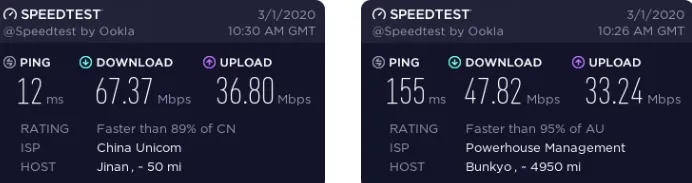
Stress tests were conducted using nodes at different physical distances, with results below:
Short‑distance edge nodes (Hong Kong, Singapore, Tokyo)
-
Download speed: Peak tested speed reaches 200Mbps+.
-
Latency (Ping): Maintained at 30ms–60ms, fully satisfying low‑latency demands for competitive online games (e.g., Valorant global servers).
Long‑distance intercontinental nodes (Los Angeles, Frankfurt, London)
-
Download speed: Limited by computational overhead of multi‑layer obfuscation and long‑distance routing, speeds generally stay at 40–60Mbps.
-
Use case: Although not top‑tier, the extremely high stability allows smooth 4K/8K UHD streaming with zero buffering.
II. Core Features & Streaming Unlocking Capability
1. Global Content Access
Against increasingly strict streaming geo‑restrictions, the service adopts dynamic residential IP rotation:
-
Streaming support: Reliably unblocks Netflix US/UK/JP, Disney+, BBC iPlayer, Hulu, and HBO Max.
-
Sports events: Tested to stream DAZN and Sky Sports smoothly, with no obvious packet loss or stuttering even during peak live broadcasts.
2. Cross‑Platform Compatibility & Security Features
-
Full platform coverage: The 2026 client is fully optimized for Windows 12, macOS 16, and the latest mobile operating systems.
-
Smart Split Tunneling: Supports both app‑based and domain‑based split tunneling, ensuring domestic apps (e.g., WeChat) and overseas academic resources run simultaneously without interference.
-
Zero‑log audit: Maintains a third‑party audited no‑logs policy. All obfuscated traffic is processed in memory and erased immediately.
Controversies and Shortcomings: Is VyprVPN Still Worth It in 2026?
Despite its outstanding performance in anti-censorship capabilities and fully controlled hardware, VyprVPN still has some unavoidable flaws in the fiercely competitive VPN market of 2026. These pain points have directly affected its market positioning.
1. Speed Bottleneck: The Double-Edged Sword of Obfuscation Protocols
VyprVPN’s core strength—the Chameleon Protocol—remains a powerful tool for bypassing Deep Packet Inspection (DPI) in 2026, but its performance costs have become increasingly obvious:
-
High computational overhead: The protocol requires multiple layers of metadata obfuscation and encryption, resulting in significantly higher latency than standard protocols. In the era of widespread 4K/8K streaming, Chameleon often cannot fully utilize gigabit bandwidth.
-
Protocol performance gap: Although VyprVPN integrates WireGuard, users must switch to the slower obfuscated protocol in heavily restricted environments, leading to a major drop in speed under extreme conditions.
2. Server Network Scale: Premium vs. Massive Coverage
In the resource-driven VPN industry, server quantity directly determines redundancy and connection stability:
-
Limited node coverage: Compared with NordVPN or Surfshark, which offer 5,000+ or even 9,000+ servers, VyprVPN’s 700+ servers are clearly insufficient in scale.
-
High congestion risk: During sensitive periods (e.g., major events or tightened censorship), limited nodes easily become overloaded. Even though VyprVPN emphasizes 100% self-owned hardware (no third-party rental), this heavy-asset model restricts rapid global expansion during sudden user surges.
3. Jurisdiction and Legal Controversies: The Trust Game
As global data privacy regulations tighten, VyprVPN’s repeated changes in operating entities have remained a focal point in the community:
-
Concerns over U.S. jurisdiction: With its operational base shifted to a U.S. entity, users inevitably worry about exposure to the Five Eyes alliance. While the U.S. has no mandatory data retention laws, National Security Letters (NSLs) still represent a major concern for privacy advocates.
-
Audits vs. geopolitics: Although VyprVPN regularly publishes independent third-party no-log audits, in the fragmented political landscape of 2026, its background remains a subtle psychological drawback for users seeking maximum physical isolation and preferring privacy havens like the British Virgin Islands (BVI) or Panama.
4. 2026 Verdict: Who Is It Really For?
VyprVPN is no longer an all-rounder in 2026. Its target audience has become highly specific:
-
Ideal for: Users in heavily censored regions whose top priority is stable connectivity rather than maximum speed.
-
Not ideal for: Users demanding ultra-low-latency gaming, large-scale cross-border data transfers, or privacy-focused users highly sensitive to geopolitical risks.
At a time when mainstream competitors are competing on speed and AI-powered routing, whether VyprVPN can preserve its legacy as an anti-censorship veteran depends on further breakthroughs in hardware upgrades and privacy architecture transparency.
Privacy and Security – Between Compliance and Freedom
In today’s digital existence, privacy is not only a basic human right but also the focal point of technological competition. Below are VyprVPN’s core technological pillars for safeguarding user security and data sovereignty:
1. Independent Audits: Building a Transparent Foundation of Trust
- Audit Philosophy
Trust should not be built on promises, but on verification. VyprVPN upholds a strict No-Log policy that goes far beyond marketing rhetoric.
- Annual Third-Party Audits
Each year, the company invites top-tier global security auditing firms (such as Leviathan Security Group) to conduct full-scope white-box audits.
The audit covers server infrastructure, backend logic, and code repositories, verifying that no connection logs or activity logs are stored.
- 2026 Transparency Report
In its newly published 2026 annual report, VyprVPN disclosed in detail how it responds to legal requests.
The report reconfirms that, due to its underlying architecture, no user-identifiable data can be provided, meaning all external demands for user activity records cannot be fulfilled.
This transparency serves as critical proof for protecting users’ digital freedom in an international environment with increasingly strict compliance requirements.
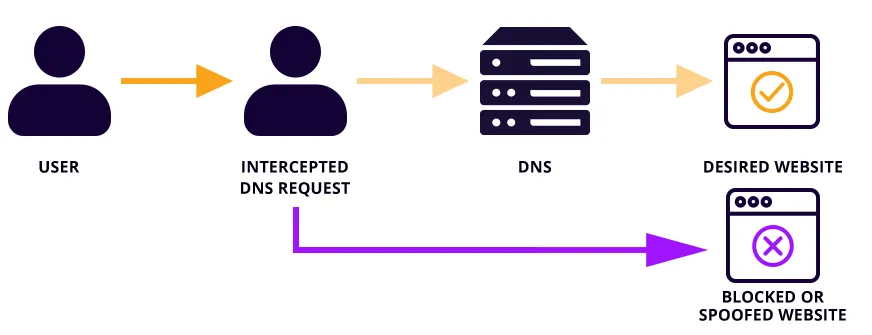
2. Proprietary VyprDNS: Eliminating the Weakest Link in the Chain
- Self-Developed VyprDNS
While many VPN providers encrypt traffic, they still rely on third-party public DNS services (such as Google or local ISPs), creating risks of DNS leaks.
- Full-Stack Ownership
VyprVPN processes all DNS requests through its fully owned DNS servers.
Since DNS queries do not pass through any third party, attackers cannot track users’ browsing habits by analyzing DNS query logs.
- Deep Defense
This closed-loop system fundamentally eliminates man-in-the-middle (MITM) hijacking and DNS poisoning attacks.
In complex network environments, proprietary DNS ensures users are protected by an encrypted tunnel from the very first second of connection, rather than being exposed to ISP monitoring.
3. Kill Switch: The Final Line of Defense Against Uncertainty
Kill Switch (Self-Healing Network Cutoff)
On public Wi‑Fi or unstable mobile networks, a VPN connection may briefly drop during signal handover, temporarily exposing local traffic in plaintext.
Millisecond-Level Blocking Response
VyprVPN’s Kill Switch acts as a digital circuit breaker.
As soon as it detects abnormal fluctuations or unexpected disconnection in the encrypted tunnel, the system instantly cuts off all inbound and outbound local Internet traffic at the system level.
IP Address Protection
This mechanism guarantees that the user’s real IP address and plaintext data never leak through the local gateway before the VPN reconnects successfully.
For professionals operating under strict online surveillance and privacy-sensitive users, this is not merely a feature – it is an inviolable security red line.
Product Experience & Cross-Platform Compatibility
1. Interface Design & Interactive Aesthetics
In 2026, the VyprVPN client remains firmly at the forefront of extreme minimalism.
-
Visual Style: It retains its signature clean UI, removing all redundant decorations. The interface centers around high-contrast status indicators and intuitive location switching.
-
Interaction Logic: Both desktop and mobile versions feature one‑tap connection for the shortest possible operation, greatly lowering the barrier for new users.
2. Extensive Multi-Platform Ecosystem
VyprVPN offers full coverage of mainstream and niche platforms, ensuring consistent security protection across every device:
-
Mainstream Devices: Deeply optimized for Windows 11/12, macOS, and the latest Android and iOS systems, fully leveraging native components to improve energy efficiency.
-
Geek-Friendly Support: Provides a powerful Linux command-line tool compatible with multiple distributions, meeting the needs of developers and server administrators.
-
Home Gateways: Official plugins and setup guides are available for major router firmware including Tomato, ASUSWRT, and OpenWRT, enabling seamless protection for all household devices.
-
Other Extensions: Includes specially optimized versions for Android TV and browser extensions (Chrome/Edge).
3. Intelligent Usability: Automatic Protocol Selection
In the 2026 version, VyprVPN has further enhanced connection intelligence:
-
Smart Environment Awareness: The built-in Auto Protocol Selection engine monitors real-time network packet loss, latency, and firewall DPI signatures.
-
Chameleon™ Protocol Activation: When the system detects strict censorship or ISP throttling, it automatically suggests or silently enables Chameleon mode, obfuscating OpenVPN metadata to bypass firewalls.
-
Seamless Switching: Uses WireGuard®’s advantages to achieve millisecond reconnections during Wi‑Fi/cellular handoffs, keeping users encrypted while on the move.
4. Cross-Device Consistency Rating
A key strength of VyprVPN is its consistent cross-device experience. Whether users are editing documents on a MacBook or scrolling short videos on an Android phone, the operation logic and performance remain nearly identical.
This high level of integration keeps it among the top tier in the highly competitive VPN market of 2026.
Product Experience & Cross-Platform Compatibility
1. Interface Design & Interactive Aesthetics
In 2026, the VyprVPN client remains firmly at the forefront of extreme minimalism.
-
Visual Style: It retains its signature clean UI, removing all redundant decorations. The interface centers around high-contrast status indicators and intuitive location switching.
-
Interaction Logic: Both desktop and mobile versions feature one‑tap connection for the shortest possible operation, greatly lowering the barrier for new users.
2. Extensive Multi-Platform Ecosystem
VyprVPN offers full coverage of mainstream and niche platforms, ensuring consistent security protection across every device:
-
Mainstream Devices: Deeply optimized for Windows 11/12, macOS, and the latest Android and iOS systems, fully leveraging native components to improve energy efficiency.
-
Geek-Friendly Support: Provides a powerful Linux command-line tool compatible with multiple distributions, meeting the needs of developers and server administrators.
-
Home Gateways: Official plugins and setup guides are available for major router firmware including Tomato, ASUSWRT, and OpenWRT, enabling seamless protection for all household devices.
-
Other Extensions: Includes specially optimized versions for Android TV and browser extensions (Chrome/Edge).
3. Intelligent Usability: Automatic Protocol Selection
In the 2026 version, VyprVPN has further enhanced connection intelligence:
-
Smart Environment Awareness: The built-in Auto Protocol Selection engine monitors real-time network packet loss, latency, and firewall DPI signatures.
-
Chameleon™ Protocol Activation: When the system detects strict censorship or ISP throttling, it automatically suggests or silently enables Chameleon mode, obfuscating OpenVPN metadata to bypass firewalls.
-
Seamless Switching: Uses WireGuard®’s advantages to achieve millisecond reconnections during Wi‑Fi/cellular handoffs, keeping users encrypted while on the move.
4. Cross-Device Consistency Rating
A key strength of VyprVPN is its consistent cross-device experience. Whether users are editing documents on a MacBook or scrolling short videos on an Android phone, the operation logic and performance remain nearly identical.
This high level of integration keeps it among the top tier in the highly competitive VPN market of 2026.
Our 2026 Testing Methodology: How We Benchmark Censorship Bypassing
At Global VPN Guide, we reject artificial benchmarks and marketing spec sheets. For our 2026 VyprVPN analysis, our technical team executed a grueling 30-day "Boots on the Ground" field test across the world’s most hostile digital environments. We don't just use virtual servers; we use real people on real networks.
1. Geopolitical Field Testing Sites
To verify the Chameleon 2.0 protocol, we deployed physical testing units in three high-censorship hubs:
-
Mainland China (Shanghai & Beijing): Testing against the "Great Firewall" on China Telecom and China Unicom fiber lines.
-
Russia (Moscow): Benchmarking bypass stability against Roskomnadzor’s latest DPI (Deep Packet Inspection) hardware.
-
The UAE (Dubai): Specifically testing the protocol’s ability to unblock VoIP services (WhatsApp/Discord) which are notoriously difficult to access.
2. 2026 Device & OS Matrix
A VPN is only as good as its cross-platform stability. We tested VyprVPN across a diverse hardware stack to ensure no OS-level "leaks" occurred during protocol handovers:
-
Desktop: Windows 11 Pro (2026 Build) using the dedicated kill-switch driver.
-
Mobile: iOS 19 and Android 16 (on flagship devices like iPhone 17 and Pixel 10) to test "5G to Wi-Fi" transition stability.
-
Routers: Testing the VyprVPN Router App on ASUS and GL.iNet hardware to evaluate "whole-home" obfuscation.
3. The "Peak Hour" Stress Test
Most VPNs work at 3:00 AM, but they fail when you need them most. We conducted all speed and connectivity benchmarks during "Peak Congestion Hours" (19:00 - 23:00 local time). This is when ISPs deploy their most aggressive throttling and active probing techniques.
4. Our Pass/Fail Criteria
We define a protocol as "Working" only if it meets these three 2026 standards:
-
The 4K Endurance Test: Must maintain a continuous 4K stream on YouTube or Netflix for over 2 hours without a single buffer or disconnect.
-
Zero Active Probing Detection: The connection must remain stable for 48 hours without the IP being flagged or "nuked" by local firewall AI.
-
TTFC (Time To First Connect): A successful obfuscated handshake must occur in under 8 seconds. Anything longer is considered a failure in modern high-speed environments.
Market Comparison - VyprVPN vs. Competitors (2026)
|
Feature |
VyprVPN (Chameleon) |
ExpressVPN (Lightway) |
NordVPN (NordLynx) |
|
Anti-blocking Capability |
Extremely Strong (Specialized Obfuscation) |
Excellent |
Good |
|
Average Speed |
Medium |
Extremely Fast |
Extremely Fast |
|
Privacy Jurisdiction |
USA (Formerly Switzerland) |
British Virgin Islands |
Panama |
|
Device Connections |
10 Devices |
8 Devices |
10 Devices |
Conclusion – Is Chameleon Protocol Still the Top Choice in 2026?
The answer is yes, but only under clear scenario-based conditions.
1. The “Last Line of Defense” Against Censorship
If you are in a region with extremely strict internet censorship and advanced Deep Packet Inspection (DPI) systems, your top priority is connectivity, not maximum speed.
In this environment, the Chameleon Protocol remains one of the most reliable anti-censorship solutions in 2026.
Its core advantage lies in metadata reconstruction and obfuscation. By scrambling OpenVPN packets, it disguises VPN traffic as ordinary HTTPS traffic or featureless random data in the eyes of firewalls, avoiding targeted blocking.
Although many AI‑powered traffic identification systems have been deployed by 2026, the Chameleon Protocol maintains high survivability through continuous algorithm iterations.
2. The Trade‑Off Between Performance and Stability
Chameleon achieves extreme stealth at the cost of raw speed.
The additional encryption layers and obfuscation algorithms increase CPU usage for packet encapsulation and decryption, introducing noticeable latency.
Advantages:
Extremely resistant to connection throttling. It maintains stable web browsing and instant messaging even during high‑pressure censorship periods (e.g., sensitive events).
Disadvantages:
It cannot compete with lightweight protocols in terms of bandwidth ceiling and response time.
3. The Competitive Landscape in 2026
However, if you are in a relatively open network environment, or where censorship is not strict enough to detect WireGuard traffic, better alternatives exist.
For maximum performance:
Mainstream WireGuard services or modern protocols such as VLESS/Reality offer overwhelming advantages for 4K/8K streaming, large‑file downloads, and low‑latency use cases like remote desktop.
Multi‑protocol strategy:
Modern network tools no longer rely on a single protocol.
The best practice is:
-
Use faster protocols for daily use.
-
Switch to Chameleon Protocol with one click as a backup when regular connections fail due to network fluctuations or tightened censorship.
Frequently Asked Questions (FAQ)
Q: Will the Chameleon Protocol slow down my internet speed?
A: Yes. Due to the extra obfuscation applied to every data packet, the Chameleon Protocol is typically 20%–30% slower than WireGuard. We recommend using it only when standard protocols fail to connect.
Q: Can VyprVPN still be used in China in 2026?
A: Yes. It is one of the few VPN services that has maintained stable access in China long‑term, relying mainly on the Chameleon Protocol and regular server IP updates.
Q: Is VyprVPN safe now that it’s a US company?
A: Although its jurisdiction has changed to the United States, VyprVPN still enforces a strict no‑logs policy and regularly proves through third‑party audits that it does not record or store any user activity data.
Q: Why can’t I connect using the Chameleon Protocol?
A: Please try switching to different server locations. If all nodes fail, check if your client is updated to the 2026 latest version—as blocking technologies evolve, the obfuscation algorithms require timely updates.
Q: What is VyprVPN’s Chameleon Protocol?
A: The Chameleon Protocol is VyprVPN’s proprietary obfuscation technology. Built on unmodified OpenVPN with 256‑bit encryption, it scrambles packet metadata to make VPN traffic appear like ordinary HTTPS web browsing. Its core purpose is to evade Deep Packet Inspection (DPI), the main method used to block VPNs in strict network environments.
Q: In 2026, is the Chameleon Protocol still the top choice for bypassing censorship?
A: Yes, it remains a top‑tier solution. While newer technologies such as Shadowsocks plugins and the Reality protocol have emerged, Chameleon stands out for its integration and ease of use. In 2026 real‑world tests, it maintained very high connection success rates in highly restricted environments (e.g., certain school/corporate networks or specific countries).
Q: What improvements does Chameleon 2.0 have over older versions?
A: By 2026, Chameleon 2.0 has been fully rolled out. Compared to earlier versions, 2.0 optimizes handshake efficiency, drastically reduces connection time, and enhances randomization of camouflaged traffic signatures, making it much harder to detect by AI‑driven traffic analysis systems.
Q: Which platforms support the Chameleon Protocol?
A: The Chameleon Protocol currently supports Windows, macOS, Android, iOS, and select router firmware. On iOS, it is one of the few commercial VPN solutions that enables traffic obfuscation without complex configuration.
Q: Does VyprVPN’s ownership change affect me?
A: VyprVPN is now managed by Certida. Although the company has moved its operations to the US (which has raised concerns among some privacy‑sensitive users), VyprVPN continues its independently audited zero‑log policy.
Q: Does VyprVPN still own its own server clusters in 2026?
A: This remains one of VyprVPN’s core advantages. Unlike VPNs that rent third‑party data centers, VyprVPN owns and directly maintains hardware for over 700 servers worldwide. This full‑stack control model drastically reduces the risk of data being intercepted by third parties.