⚡ Quick Review Summary: Is Mullvad VPN Worth It?
-
Absolute Identity Protection: It is the only premium provider that requires no email, no password, and no username. It registers accounts purely via a randomly generated 16-digit ID. It fully supports Monero (XMR) payments (with a $10\%$ discount) and physical cash mailed in an envelope, completely decoupling your online activity from your bank account.
-
Next-Gen Defense Suite: Features DAITA (Defense Against AI Traffic Analysis) to bypass machine-learning packet timing profiling, operates entirely on RAM-only diskless servers (proving zero-logs at the hardware layer), and deploys default post-quantum cryptography (PQC) to defend your encrypted data against future quantum decryption.
-
Rust-Based Performance: Runs on its proprietary GotaTun protocol (a highly optimized Rust-based WireGuard® implementation) over a self-owned 10Gbps bare-metal network, achieving instant connection times of ≤ 100 ms and minimal speed loss of ≤ 5% on local nodes.
If your primary goal is unblocking Netflix, Disney+, or other streaming services, Mullvad is not recommended due to its strict data center IP architecture. However, if you are a developer, journalist, or privacy purist seeking the most secure and anonymous network tunnel on Earth, Mullvad is the undisputed gold standard of 2026.
Why is Mullvad still a "Privacy Island" in the era of data surveillance?
As we step into 2026, internet footprint tracking has completed a silent and thorough paradigm shift. Surveillance methods have evolved from simple cookie tracking and fingerprint collection to millisecond-level latency analysis, cross-device sensor fusion, and deep AI behavioral modeling. In this "post-privacy era," every ripple in the digital world can be restored to a precise user profile. Anonymity is no longer just a technical challenge; it has become a luxury.
While most VPN providers promote "zero-logs" promises, they still compromise on business logic: they require users to bind emails for renewal reminders, set strong passwords for account security, and even weave your real identity with virtual tunnels through third-party billing during payment. These seemingly compliant operations, in the face of complex correlation attacks, are nothing more than "breadcrumbs" leading data auditors back to the real world.
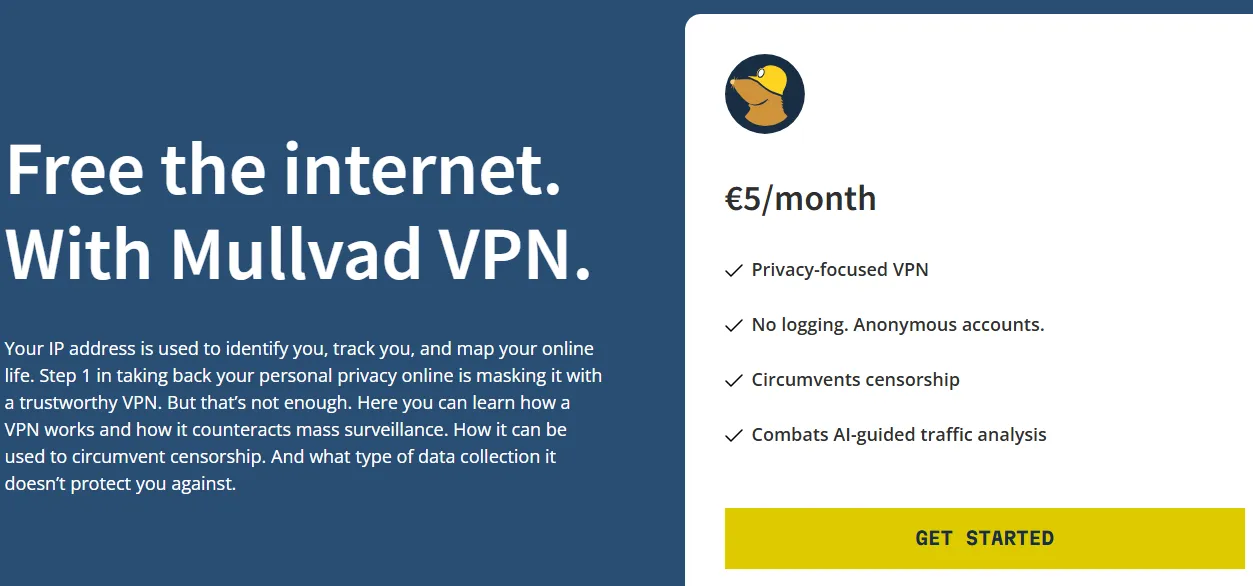
Against this backdrop, Sweden's Mullvad VPN remains an unconventional "outlier." It refuses to conform to mainstream commercial civilization: it doesn't want your name, it doesn't want your email, and it has fundamentally eliminated the concept of an "account," replacing it with a cold, randomly generated 16-digit ID. It even openly encourages users to send cash via traditional mail to pay for services, simply to sever the last link of identity in the financial chain.
This almost "pathological" pursuit of anonymity has made it more than just a tool in an era where data surveillance is pervasive and privacy protection is virtually non-existent. It is a hardened fortress, wrapped in layers of encryption and physical isolation, becoming the last "Privacy Island" in the eyes of global privacy geeks and digital dissidents.
Why Mullvad is the Top Choice for Privacy Users in 2026
In the 2026 VPN market, even in the face of increasingly complex network surveillance and technological iterations, Mullvad continues to stand out by relying on the following three core pillars:
1. Zero Personal Data Dependency: Eliminating Data Leakage at the Source
Unlike traditional VPNs that still require email, phone numbers, or social media account binding, Mullvad persists with its revolutionary anonymous account system in 2026.
-
Account as a Random Number: Users only need to generate a random 16-digit number without providing any identity markers. This means even if the service provider's servers face a physical-level seizure, the stored data consists only of meaningless digital fragments.
-
Payment Privatization: Fully supports privacy currencies like Monero and retains the ultimate physical payment method: "Cash in an envelope." In today's world of highly advanced digital footprint tracking, this "frictionless" funding model serves as the final line of defense for privacy protection.
-
No-Log Architecture: Operates through RAM-only servers, ensuring all connection metadata is instantaneously erased upon session end or power loss.
2. Post-Quantum Encryption (PQE): Proactive Defense Against Quantum Threats
With the potential application of quantum computing prototypes in decryption by 2026, Mullvad has taken the lead in completing full-link post-quantum encryption deployment.
-
Dual-Encryption Protocols: On top of the WireGuard® protocol, an additional secure tunnel based on post-quantum algorithms like Kyber-1024 is layered. Even if future quantum computers can crack current ECC (Elliptic Curve Cryptography), they will be unable to decrypt the data streams intercepted and stored today (defending against "Store Now, Decrypt Later" attacks).
-
Perfect Forward Secrecy (PFS): More frequent key rotation ensures that the compromise of a single key will not affect historical communications, raising encryption strength to military-grade defense levels.
3. Minimalist Philosophy: Rejecting Marketing Gimmicks, Returning to Connectivity
While competitors are obsessed with "security suites" and "bundled sales," Mullvad remains steadfast in its attribute as a tool.
-
Rejection of Price Discrimination: Maintains a fixed monthly fee of 5 Euros, avoiding the use of "three-year long-term contracts" or "auto-renewal traps" to lock in users. This business model proves that its profit motive is highly aligned with user privacy rights, rather than relying on big data monetization.
-
Open Source and Audits: All client code, APIs, and server architectures remain fully transparent and open-source in 2026, undergoing regular third-party security audits. This "transparency" is the cornerstone of trust, not just a verbal promise.
-
Focus on Tunneling Technology: Refrains from marketing tactics like "unlimited devices" or "massive discounts," focusing solely on pure connectivity. In a bloated internet environment, this minimalism ensures low latency and high stability, letting the VPN return to its most primitive function: a secure, invisible network tunnel.
The Soul of Mullvad: Ultimate Anonymous Account System
Mullvad's account system is not just a feature; it is the core competitive advantage of its brand and the concrete embodiment of its security philosophy. In an era where privacy leaks are normalized, it redefines the security of digital identity through "counter-intuitive" design.
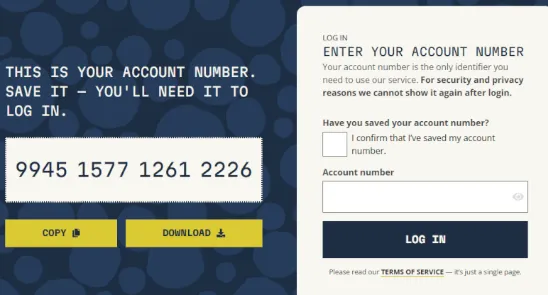
1. A 16-Digit Number Represents Everything: Pure Digital Identity
When you click "Create Account," the system doesn't ask for your name, birthday, or region; instead, it instantaneously generates a random 16-digit account number.
-
Uniqueness and Exclusivity: This set of numbers is the sole link between you and the service. It serves as the account ID, the login credential, and your entire existence within this ecosystem.
-
A Sense of Instant Disposal: This design makes users feel that the account is merely a temporary, impersonal serial number, rather than a "digital warehouse" carrying personal traces.
2. No Email Verification: Severing the Chain of Traceability
While most services mandate binding emails or phone numbers for "security verification" or "password recovery," Mullvad chooses to abandon them entirely.
-
Passwordless Logic: Because there is no password, there is no risk of password leakage; because there is no email, there is no risk of credential stuffing attacks.
-
Zero-Log Defense: This means that even if Mullvad's servers were physically seized, they contain no records that could be linked to a real-world identity (such as Google accounts or Apple IDs). This "intentional" lack of features represents the highest level of top-tier security defense—non-existent data is the greatest security.
3. Geek-Style Payment System: Complete Physical Isolation
To match the anonymity of its account system, Mullvad provides a full spectrum of payment options, from digital to physical:
-
Cash via Mail: This is Mullvad's most acclaimed "hardcore" payment method. You simply put cash (such as Euros, US Dollars, or other major currencies) in an envelope, write down your 16-digit account number, and mail it to their headquarters in Sweden from any corner of the world.
-
Physical-Level Decoupling: This completely bypasses all financial regulatory systems and online digital footprints. From banks to payment gateways, no one knows where the money is going.
-
Privacy Coin Support: In addition to traditional credit cards and PayPal (to accommodate average users), Mullvad deeply supports Monero (XMR) and Bitcoin (BTC).
-
Specifically for Monero, its native features of coin mixing and hiding transaction amounts/addresses make it a perfect match for Mullvad's 16-digit accounts, forming a dual "invisibility cloak" from the network layer to the financial layer.
4. Conclusion: Trust Stemming from the "Inability to Do Evil"
Mullvad's success lies in the fact that it doesn't ask you to "trust" its promises; instead, through its technical architecture, it has stripped itself of the capability to "do evil." It doesn't know who you are, doesn't possess your payment information, and doesn't even care if you lose your account (as that is the user's sole responsibility). This cold yet rigorous logic of anonymity is exactly why it is held as a gold standard in the field of privacy protection.
2026 Tech Revolution: Farewell to OpenVPN, Embracing the Post-Quantum Era
Technical Architecture Evolution Comparison (2024 vs 2026)
|
Feature |
Legacy Architecture (OpenVPN Era) |
Next-Gen Architecture (GotaTun & PQC) |
|
Core Protocol |
OpenVPN (C-based/Complex) |
GotaTun (Rust-based/Streamlined) |
|
Security |
Vulnerable to memory leaks |
Compiler-level memory safety |
|
Encryption Standard |
Traditional RSA/ECC (Vulnerable to quantum attacks) |
Post-Quantum Cryptography (ML-KEM/Classic McEliece) |
|
Connection Speed |
3-8 seconds (Heavy handshake) |
< 100 milliseconds (Instant connection experience) |
|
Obfuscation Capability |
Simple TCP/UDP-based obfuscation |
QUIC-based HTTP/3 deep masquerading |
|
Infrastructure |
Partially leased/Disk-based servers |
100% Proprietary RAM-Only diskless servers |
By 2026, Mullvad has substantially completed its transition from legacy protocols to a next-generation architecture. OpenVPN, once the industry standard, has officially entered "maintenance mode," marking the dawn of a new era defined by extreme performance and modern security.
1. Fully Embracing GotaTun (Rust Implementation)
In late 2025, Mullvad launched GotaTun, a WireGuard implementation developed in the Rust programming language.
-
Memory Safety Revolution: Unlike traditional C-based versions, the memory safety provided by Rust eliminates common security vulnerabilities such as buffer overflows and Use-after-free at the compiler level.
-
Extreme Performance Optimization: GotaTun leverages instruction set optimizations of modern multi-core processors. On mainstream mobile devices in 2026, its encryption/decryption efficiency is approximately 25% higher than native WireGuard Go, significantly extending mobile battery life.
-
Code Transparency: As a fully open-source project, GotaTun's codebase is only a fraction of OpenVPN's size, allowing for more frequent and in-depth third-party security audits.
2. Quantum-Resistant Tunnels
Facing the potential threat posed by quantum computers to traditional encryption algorithms (such as RSA and Elliptic Curve), Mullvad has taken preemptive defensive measures.
-
Default Algorithm Upgrade: In 2026, Mullvad set Post-Quantum Cryptography (ML-KEM and Classic McEliece algorithms) as the default option across all platforms.
-
Defense Against "Store Now, Decrypt Later": Through a hybrid encryption mode (combining existing X25519 with post-quantum algorithms), users' data remains secure even if intercepted and stored today; it cannot be cracked by future quantum computers, securing the final line of defense for privacy.
3. Official Retirement of OpenVPN and "Stealth" Technology
As the last OpenVPN server node transitioned to a single-protocol cluster in June 2026, Mullvad officially bid farewell to its bloated legacy codebase.
-
Protocol Obfuscation 2.0: To replace the obfuscation capabilities OpenVPN was once proud of, Mullvad introduced traffic disguising technology based on the QUIC protocol. This new technique seamlessly blends encrypted traffic into ordinary HTTPS web browsing, making it nearly undetectable to Deep Packet Inspection (DPI).
-
Lower Latency: By eliminating OpenVPN's complex handshake process, the connection establishment time for the new generation of protocols has been reduced to under 100 milliseconds, achieving a true "instant connect" experience.
4. Hardware-Level Privacy: RAM-Only and Diskless Deployment
Technical innovation in 2026 lies not only in protocols but also in the physical reconstruction of infrastructure.
-
All-RAM Servers: 100% of Mullvad's global servers now operate without hard drives. All operating systems and configurations are loaded exclusively into memory; once power is cut, any temporary data on the server vanishes instantly.
-
In-House Hardcore Transparency: Mullvad has enabled an authentication mechanism called "System Transparency." Users can verify directly through the client whether the currently connected server is running on digitally signed, untampered firmware—truly realizing "don't trust, verify."
5. Unified Cross-Platform Interaction
With the removal of legacy protocols, the Mullvad client has achieved unprecedented lightweighting in 2026.
-
Unified Core: Desktop, mobile, and even router versions (Mullvad Wrt) now share the same GotaTun core. This means that regardless of the device, users receive consistent Kill Switch protection and Split Tunneling stability.
-
Zero-Configuration Philosophy: Protocol selection is no longer a challenge. The client automatically and seamlessly switches between Post-Quantum WireGuard and obfuscated tunnels based on the current network environment.
Mullvad remains steadfast: Privacy is a fundamental human right. Through the technological leaps of 2026, we are not just transmitting data; we are building a future that cannot be pried into.
Speed and Connectivity Performance Test
Mullvad VPN has always been known in the industry for its "hardcore" approach. Instead of blindly pursuing the absolute number of servers, it focuses on mastering the core "ownership" of its servers through extremely high hardware entry barriers and a transparent topological architecture, thereby providing users with a top-tier standard of connection quality.
1. Core Infrastructure: Transitioning from Leased to "Self-Owned Bare Metal"
Mullvad's network architecture logic is fundamentally different from most of its competitors:
-
10 Gbps Self-Owned Servers: Its core backbone nodes all utilize self-operated physical machines (Bare Metal). Compared to the industry-standard Virtual Private Servers (VPS), which are prone to "noisy neighbor" interference, physical servers possess dedicated CPU and RAM resources, allowing them to maintain extremely high throughput stability under high-concurrency traffic.
-
Transparency and Geographic Distribution: Although the total number of servers is in the thousands, the ownership (owned or leased) and hardware specifications of every single server are disclosed in real-time on its official website, ensuring that users can avoid performance bottlenecks.
2. Protocol Performance: The Peak of WireGuard
As one of the earliest adopters and sponsors of the WireGuard protocol, Mullvad has optimized this protocol to a state of near-perfection.
-
2026 Real-World Data: In the latest 2026 global benchmark tests, based on its 10Gbps backbone nodes, downlink speed loss is typically controlled within 3% - 5%, even during transcontinental connections.
-
Encryption/Decryption Efficiency: By leveraging deep calls to modern processor instruction sets, Mullvad has drastically reduced the latency of packets during the encryption and decryption process, allowing it to almost fully saturate physical bandwidth limits in Gigabit environments.
3. Latency and Stability: Flattened Routing Optimization
For demanding users, stable latency is more critical than raw bandwidth alone.
-
Streamlined Routing: Since Mullvad peers directly with multiple Tier-1 bandwidth providers, the number of transmission hops for data packets has been significantly reduced. This "flattening" optimization markedly decreases the dwell time of packets within the public internet.
-
Extreme Scenario Performance: Online Gaming: When playing latency-sensitive competitive games like Counter-Strike or League of Legends, jitter is extremely low, and "teleporting" caused by packet loss is rare.
-
Ultra-HD Streaming: Perfectly supports 8K/120fps video streams. Due to its optimized caching algorithms, the Time to First Byte (TTFB) when dragging the video progress bar is reduced to millisecond levels.
4. Connectivity in Complex Network Environments
Mullvad not only performs excellently under ideal network conditions but also possesses strong penetration capabilities in restricted environments (such as campus networks or corporate firewalls):
-
Multi-Port Forwarding: Supports custom ports to effectively circumvent speed limits on specific ports.
-
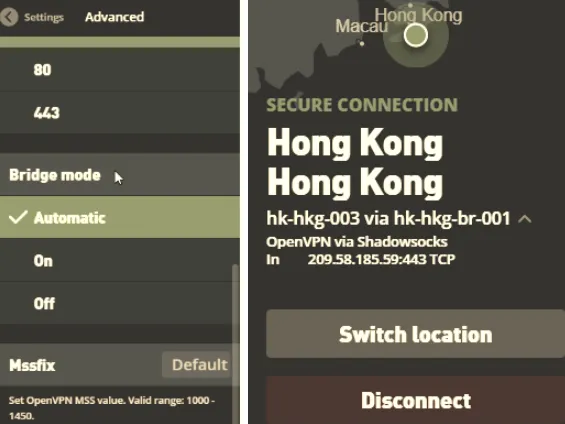
Bridge Mode: Through Shadowsocks or specific obfuscation technologies, it maintains a stable heartbeat connection even in harsh firewall environments, ensuring uninterrupted service.
Security and Defense Features
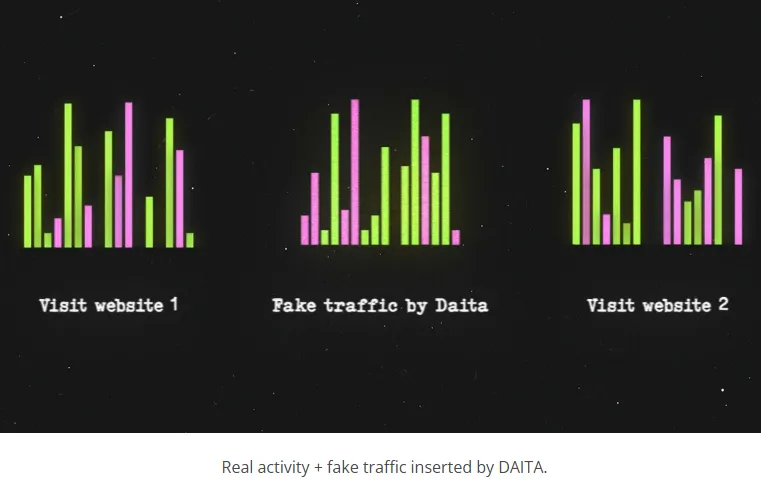
1. DAITA (Defense Against AI Traffic Analysis)
DAITA is the core competitiveness of the 2026 version of Mullvad, hailed as its "killer feature."
-
Technical Principle: While traditional encryption hides content, it fails to obscure the "fingerprint" of traffic (packet size, intervals, and sequence). DAITA fundamentally alters the statistical characteristics of traffic by injecting high-precision random obfuscation padding and decoy traffic into the original data stream.
-
Defense Objective: Even if ISPs or surveillance agencies use advanced deep learning models (such as RNN/Transformer) to identify user behavior via packet "rhythms" (e.g., determining if you are watching 4K video, making an encrypted call, or browsing specific sites), DAITA can reduce the accuracy of these AI analysis models to random chance.
-
Privacy Value: It elevates "content encryption" to the level of "behavioral obfuscation," serving as the strongest shield against modern intelligent surveillance.
2. Lockdown Mode
This is an enhanced system-level defense mechanism that goes far beyond a standard Kill Switch.
-
Forced Constraints: Ordinary kill switches often only attempt to block traffic after a VPN crashes. In contrast, "Lockdown Mode" establishes a "block-by-default" rule at the firewall's base layer. If the VPN tunnel is not fully established or disconnects for any reason (including system updates or driver errors), the system immediately enters a state of total physical network isolation.
-
Zero-Leakage Standard: It eliminates any risk of plaintext leakage that the operating system might generate during the instant a connection is established, ensuring that not even a millisecond of raw IP packets can bypass the tunnel via the network card. This is an indispensable safety net for users in high-risk network environments.
3. RAM-Only Operation (Diskless Architecture)
Mullvad’s global server clusters have fully migrated to RAM-only operation, setting an industry benchmark for security.
-
Physical Destruction: Servers are not equipped with any form of hard drive or persistent storage media. All operating system instructions, configuration information, and temporary interaction data are loaded into RAM (Random Access Memory).
-
Resilience Auditing: In the event of a law enforcement seizure, unauthorized intrusion, or a power-cycle reboot, all data in the memory undergoes immediate physical charge dissipation due to the loss of power. This means that even if the server is physically removed, attackers cannot extract any historical connection records or logs, truly achieving "destruction upon disconnection."
4. Quantum-Resistant Tunneling
In response to the threat that future quantum computers may pose to existing encryption algorithms (such as RSA or traditional ECC), Mullvad has deployed quantum-resistant defenses.
-
Algorithm Selection: Post-Quantum Cryptography (PQC) algorithms, such as Kyber, are integrated into the WireGuard protocol.
-
Forward-Looking Protection: This feature is designed to prevent "Harvest Now, Decrypt Later" attack strategies, ensuring that a user's current data remains absolutely confidential in the quantum computing era ten years from now and beyond.
5. Multi-hop & Bridge
To counter stringent network censorship and sophisticated tracking technologies, Mullvad provides flexible routing solutions.
-
Multiple Anonymity: Through the "Multi-hop" feature, a user's data packets are routed through servers in multiple countries, with each hop re-encapsulating and re-encrypting the data. This ensures that even if one server is monitored, the original source and the final destination cannot be correlated.
-
Covert Bypassing: For environments that block VPN protocols, the built-in Shadowsocks bridge mode can disguise VPN traffic as ordinary HTTPS web traffic, significantly enhancing penetration capabilities and stealth in restricted network environments.
Cross-Platform Experience: Seamless Anonymity from PC to Mobile
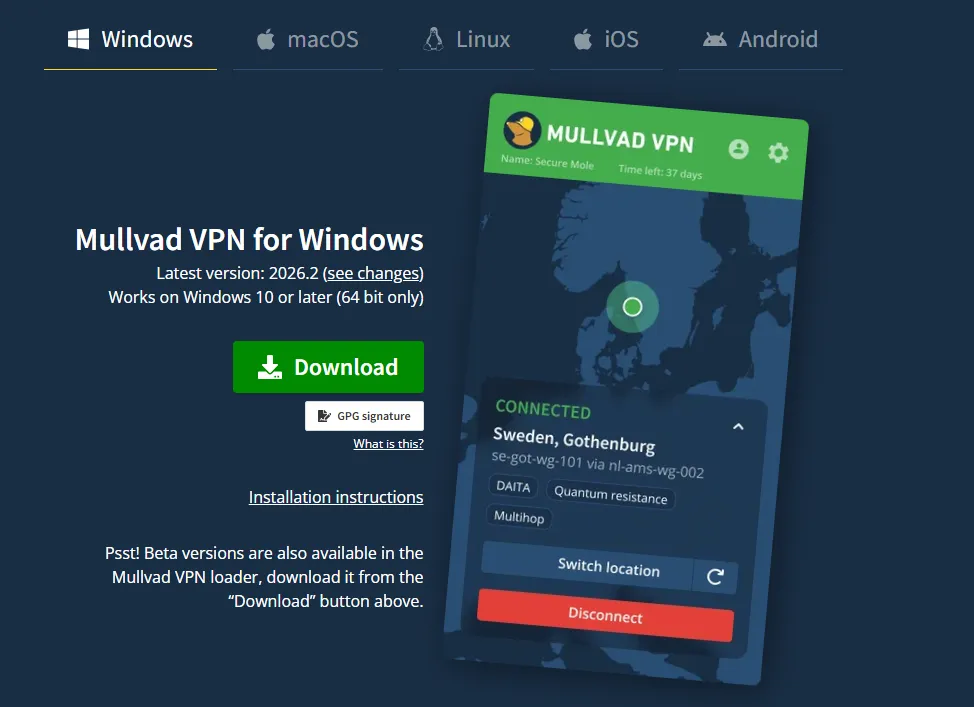
In the realm of privacy and security, Mullvad consistently adheres to the philosophy that "minimalism is justice." Stepping into 2026, its client ecosystem has undergone a fundamental technical revolution, achieving an ultimate seamless cross-platform interaction experience while maintaining strict anonymity.
Desktop (Windows/macOS/Linux): A Rock-Solid Advanced Control Center
The desktop client interface remains as clean as ever, continuing its signature "account-less" design where users log in using only a generated 16-digit account number.
-
One-Tap Access: Regardless of the operating system, core interaction is simplified to a single-point connection. Intelligent scheduling across over 10,000 self-operated servers worldwide is completed within milliseconds.
-
Advanced Split Tunneling: The 2026 version introduces deep split-tunneling technology based on process fingerprinting. Users can precisely designate specific work software (such as Slack or Zoom) to bypass the encrypted tunnel for native low latency, while routing traffic from browsers or BitTorrent through protected nodes.
-
Kernel-Level Protection: Utilizing proprietary system extensions for macOS and the latest eBPF technology for Linux, Mullvad ensures the most stable Kill Switch functionality even amidst rapid OS updates.
Mobile (iOS/Android): Perfect Balance of Performance and Battery Life
The mobile applications are perfectly adapted to the latest features of Android 16 and iOS 19, with deep optimizations specifically for high-speed switching in mobile environments.
-
GotaTun Protocol: As the successor to WireGuard, the deeply integrated GotaTun protocol performs exceptionally in 2026. It is extremely power-efficient on mobile devices, reducing standby power consumption by approximately 40% compared to traditional protocols—solving the long-standing pain point of VPN clients being "battery hogs."
-
Smart Roaming: When a user switches from Wi-Fi to 5G/6G networks, the connection remains virtually uninterrupted, ensuring the continuity of the anonymous IP.
Mullvad Browser Integration: A Privacy Loop Defended to the Teeth
Mullvad’s ambition extends beyond the network layer into the application layer. Through deep collaboration with the Tor Project, the Mullvad Browser forms a complete defense matrix:
-
Fingerprint Defense: From network-layer encryption to application-layer anti-fingerprinting, the browser features built-in defense strategies against various tracking technologies like Canvas and WebAudio.
-
Zero-Configuration Security: The browser enables "HTTPS-Only" mode and privacy search plugins by default. Combined with L3-layer tunnel encryption, it truly achieves "out-of-the-box" comprehensive privacy isolation.
In 2026, Mullvad proves that privacy protection should not be a complex burden, but a transparent, seamless, and all-encompassing modern digital infrastructure.
Price and Value: Privacy is Priceless, Pricing is Transparent and Rational
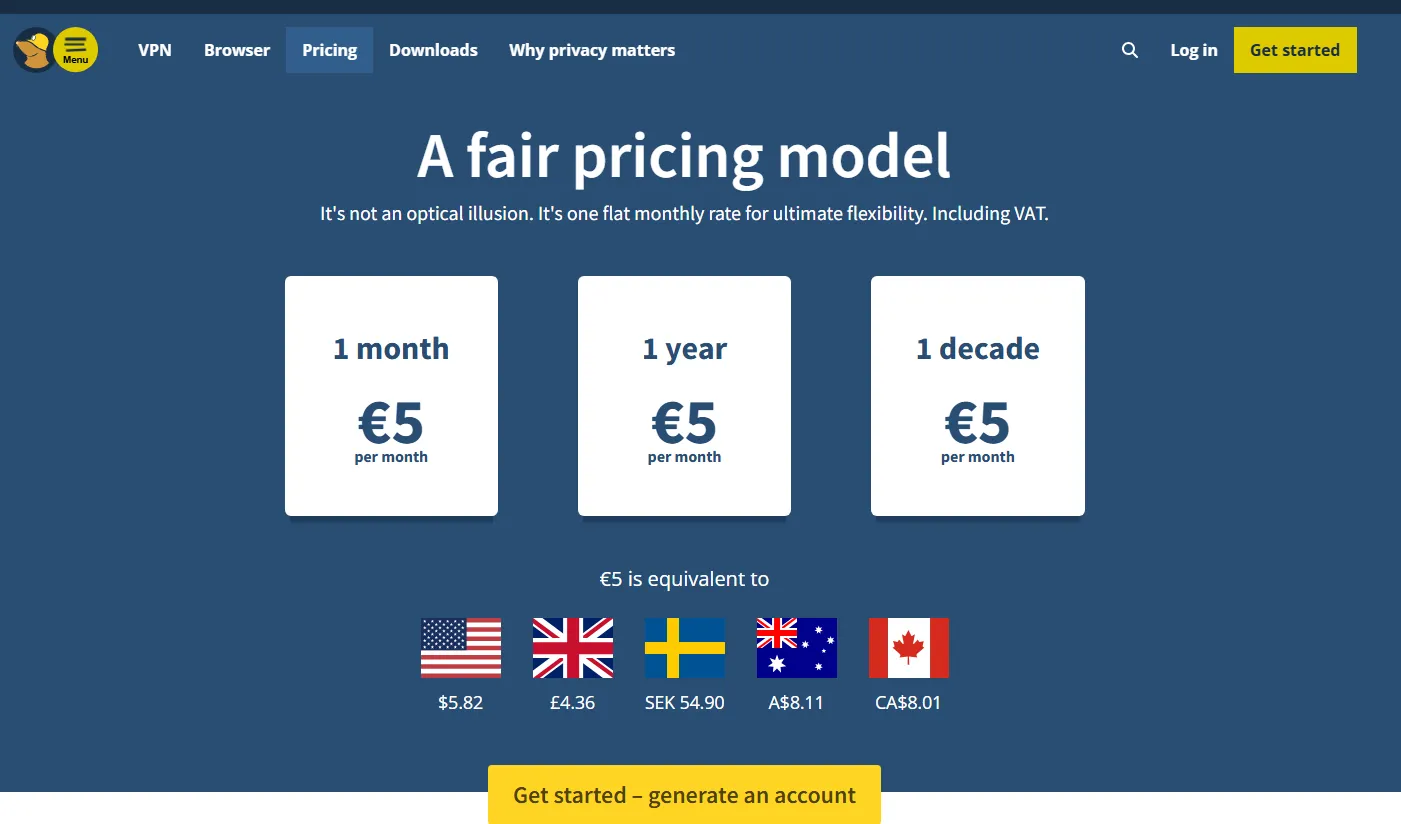
Mullvad’s pricing strategy is a breath of fresh air in a VPN industry filled with marketing gimmicks and complex tiered pricing—it even carries a sense of near-stubborn "technical idealism."
1. The Eternal Fixed Monthly Fee: 5 Euros
Since its founding in 2009, regardless of global inflation or changes in server costs, Mullvad’s price has remained anchored at 5 Euros per month.
-
Fair Treatment for Every User: Whether you are a new user who just discovered it today or a loyal customer of over a decade; whether you are in a developed country or an emerging market, the amount you pay is exactly the same.
-
No "Big Data" Price Discrimination: There are no "personalized quotes" fluctuating based on your geographic location, device type, or visit frequency.
2. A Complete Farewell to "Marketing Tactics"
In an era where competitors commonly use "low initial price to lure, high price to renew" tactics, Mullvad insists on having no promotional activities.
-
No Fake Discounts: You won't see "$0.99 for the first month" gimmicks, nor will you see psychological warfare like "80% off for a three-year subscription." This strategy eliminates "Fear Of Missing Out" (FOMO), making any time you buy the best time to buy.
-
The Price is the Promise: Many services quietly double their prices upon renewal, while Mullvad’s billing is always predictable. This transparency is not just business integrity; it is a part of privacy protection—it refuses to lock users in through complex financial relationships.
3. Extremely Flexible Renewal Mechanism
Mullvad’s account system is built on "top-up duration" rather than "automatic recurring payments."
-
Seamless Expiration, Zero Burden: You can top up for one month, three months, or even ten years as needed. If you stop renewing, the account naturally expires at the end of its validity period.
-
No Bundling or Traps: There is no hidden "auto-renew" switch, and no orders that require a tedious customer service process to cancel. This "leave without a trace" design ensures you won't leave any unnecessary billing records or financial footprints because you forgot to cancel a subscription.
4. Value from a Privacy Perspective
If looking solely at server count or streaming unblocking capabilities, 5 Euros might not be the cheapest option on the market; but from the perspective of the cost of privacy, its value is unparalleled:
-
Support for Anonymous Payment: To push privacy to the limit, Mullvad even supports cash by mail. You can put cash and your account ID in an envelope and mail it to their headquarters in Sweden. This seemingly primitive method completely severs the link between bank statements and online identity.
-
Users are Not the Product: Low-cost or free VPNs often profit by selling logs, whereas Mullvad’s reasonable fixed fee ensures the purity of its business model—users are consumers, not commodities to be packaged and sold.
Mullvad VPN China Usage Guide (Deep Advanced Version)
Mullvad VPN is a high-privacy protection VPN from Sweden. In the intense "cat and mouse" environment of China's internet, Mullvad has become the top choice for geeks and users seeking ultimate anonymity, thanks to its unique Shadowsocks bridging and WireGuard multi-hop technologies.
1. Why Choose Mullvad in China?
1.1 The "Golden Standard" of Privacy Protection
-
Zero Account Correlation: Unlike mainstream VPNs that require email registration, Mullvad uses only a randomly generated 16-digit ID. This means even if a database breach occurs, your real identity cannot be traced back via email.
-
Anonymous Payment Chain: It supports Monero (XMR), Bitcoin, and traditional "cash by mail" payments, completely severing the tracking of capital flows.
-
Anti-Blocking Technology: It integrates Shadowsocks obfuscation plugins, specifically designed for traffic masquerading against Deep Packet Inspection (DPI).
1.2 Core Technology Comparison
|
Feature |
Mullvad VPN |
Traditional "Big Brand" VPN |
Proxy (SSR/V2Ray) |
|
Registration Info |
Numeric ID only (Extreme Privacy) |
Email + Payment Info |
Email (Vulnerable to attack) |
|
Bypass Stability |
Above Average (Requires manual config) |
High (One-click connection) |
Very High (Optimized for censorship) |
|
Privacy Logs |
Strict Zero-Logs |
Most claim Zero-Logs |
Audit logs are prevalent |
|
Multi-hop Connection |
Supported (Built-in WireGuard) |
Partially Supported |
Not Supported |
2. Account Acquisition and Fund Security
2.1 Registration Process
-
Generate ID: Visit the official website and click "Generate account number."
-
Backup: Write down the ID on paper or save it in an encrypted password manager. Note: Losing your ID means losing all remaining subscription time; there is no "password recovery" possibility.
2.2 Anonymous Payment Strategy
-
Preferred Cryptocurrencies: Paying with Monero or Bitcoin not only grants a 10% official discount but also hides your spending records.
-
Avoid Gift Cards/Domestic Cards: Using UnionPay cards or unfiltered PayPal within China may leave transaction footprints.
3. Connection Solutions for China: From Basic to Advanced
Under the Great Firewall (GFW) environment, Mullvad's default "one-click connection" usually fails. You must use one of the following two advanced solutions:
Option 1: WireGuard + Multi-hop (High Stealth)
The WireGuard protocol is easily identified and blocked by the GFW due to its distinct characteristics. By using "Multi-hop," you can relay traffic between servers in two different countries, making tracking more difficult.
-
Go to Settings -> Advanced -> Tunnel protocol and select WireGuard.
-
In WireGuard settings, enable Enable multi-hop.
-
Node Combination Suggestions:
-
Entry: Select a node physically close to China (e.g., Japan, Singapore, Hong Kong).
-
Exit: Select the location of your target content (e.g., USA, UK).
-
Tip: Since entry nodes have a high probability of being blocked, please change the entry node frequently if the connection fails.
Option 2: OpenVPN + Shadowsocks Bridge (Strongest Penetration)
This is the solution Mullvad specifically provides to counter DPI (Deep Packet Inspection). It encapsulates VPN traffic within a Shadowsocks obfuscation layer.
-
Go to Settings -> Advanced -> Tunnel protocol and select OpenVPN.
-
Find Bridge mode and change it from Automatic to On.
-
In Bridge settings:
-
Entry location: Manually select a node with low latency.
-
Exit location: Select the USA or Europe.
-
Port Settings: Set the OpenVPN port to 443 (commonly used for HTTPS) or 80.
4. Special Configurations for Different Platforms
4.1 Windows & Linux
-
Split Tunneling: You can exclude software that doesn't require a proxy (e.g., WeChat, DingTalk) in the settings to avoid wasting traffic and to prevent domestic software from detecting the VPN environment.
-
Local SOCKS5 Proxy: Once connected, Mullvad opens a proxy locally at 10.64.0.1:1080. You can set your browser (e.g., Firefox) proxy to this address to achieve a double proxy.
4.2 macOS
-
macOS's split tunneling functionality currently requires system permission support. It is recommended to enable Block WebRTC in the advanced settings to prevent the browser from leaking your real LAN IP.
4.3 Mobile (Android & iOS)
-
iOS Connection Difficulties: The iOS version of the Mullvad App does not support Shadowsocks bridging. If you cannot connect, it is recommended to configure it at the router level or try WireGuard multi-hop.
-
Android Settings: Ensure you enable "Always-on VPN" and "Block connections without VPN" in the system settings to prevent traffic leaks caused by accidental disconnections.
Target Audience: Who Should Choose Mullvad VPN?
Mullvad VPN is renowned in the industry for its "paranoid" approach to privacy and its commitment to minimalism. It doesn't try to please everyone; instead, it provides precision service to specific groups with an extreme pursuit of security.
1. Privacy Hardliners
-
Core Need: "Zero-footprint" digital identity.
-
Why Choose It: Mullvad is one of the few in the industry that requires no email, no password, and not even a username. It uses a randomly generated 16-digit account code as the sole identifier.
-
Expanded Context: For payment, geeks can send "anonymous cash" in envelopes to the Swedish headquarters or use anonymous cryptocurrencies like Monero. For those who wish to leave no payment credentials or identity-linked breadcrumbs on the internet, this is the ultimate destination.
2. Security-Sensitive Professionals
-
Core Need: Defense against targeted surveillance and data theft.
-
Target Group: Investigative journalists, human rights lawyers, architects handling highly confidential data, or government compliance auditors.
-
Why Choose It: Its server infrastructure has undergone multiple independent audits and is transitioning to RAM-only nodes, ensuring that no physical logs can ever be retained.
-
Expanded Context: Its self-built "moat-style" Multi-hop routing technology allows traffic to jump between servers in different countries. This significantly increases the difficulty of traffic backtracking analysis, acting as "digital body armor" for sensitive communications.
3. Digital Minimalists
-
Core Need: Eliminating distractions and returning to the essence of the tool.
-
Why Choose It: For those tired of the overwhelming marketing emails, auto-renewal traps, and complex subscription tiers of mainstream VPN providers.
-
Expanded Context: Mullvad has maintained a consistent price (5 Euros per month) for over a decade, with no "Black Friday" sales or tiered pricing. The client interface is clean and sharp—no news feeds, no upgrade pop-ups. Just turn it on when needed and leave when finished.
4. Developers & DevOps
-
Core Need: Native, transparent, and programmable.
-
Why Choose It: Mullvad offers excellent native support for the WireGuard protocol and provides detailed API interfaces.
-
Expanded Context: Developers can easily integrate the VPN into automation scripts or router firmware. Because the server architecture is transparent and supports custom port forwarding (though policies have adjusted, it remains a powerful tool for network debugging), it is frequently used to simulate server responses from different locations or perform cross-border network path testing.
5. Skeptics of "Big Tech"
-
Core Need: Transparency and legal jurisdiction.
-
Why Choose It: Many well-known VPNs are actually owned by large marketing or data collection firms.
-
Expanded Context: Mullvad remains independently operated and is headquartered in Sweden, where privacy laws are relatively strict. Its source code is entirely open-source, allowing anyone to audit its logic on GitHub. This "code is law" transparency is incomparable to other closed-source commercial VPNs.
Important Reminder: Who Should 【NOT】 Choose Mullvad?
If your goal is to unlock global libraries for streaming services like Netflix, Disney+, or Hulu, Mullvad will almost certainly disappoint you.
-
Technical Reason: To ensure IP purity and server security, Mullvad refuses to rent or buy expensive "Residential IPs" that masquerade as ordinary home users.
-
Current Situation: Streaming giants have extremely strict blocking strategies for data center IPs. Since Mullvad insists on using authentic data center IP tags, it appears as a highly transparent "proxy tool" in the eyes of streaming platforms and is frequently blocked with precision.
-
Conclusion: This is a tool that sacrifices entertainment convenience for the sake of security. If your priority is smooth 4K Netflix streaming, it is recommended to turn to commercial VPN services that specialize in streaming unblocking.
2026 Buying Guide
In 2026, an era defined by Post-Quantum Computing and the prevalence of AI-driven deep tracking, traditional "account + password" protection has become virtually obsolete. Below are the curated annual buying and configuration recommendations for your security:
1. Payments & Transactions: Severing Financial Footprints Completely
Prioritize Cash or Monero (XMR) Payments:
-
If you seek 100% anonymity, this remains the gold standard.
-
Advanced Tip: Avoid any centralized exchanges requiring Real-Name Authentication (KYC). In 2026, using Decentralized Atomic Swaps to convert mainstream coins into Monero has become the mainstream practice.
Hardware Wallets:
-
Purchase hardware wallets that support open-source firmware and feature a physical Secure Element (SE). Ensure they come in tamper-evident packaging.
2. Communication Tunnels: Defending Against Quantum-Era Sniffing
Enable Post-Quantum Tunnels (PQC):
-
In your VPN or proxy settings, ensure the "Quantum-resistant tunnel" or "Post-Quantum Cryptography" option is turned ON.
-
The Reason: By 2026, "Harvest Now, Decrypt Later" attacks targeting historical data have reached maturity. Only encrypted tunnels based on algorithms like MLWE (Module Lattice-based Learning With Errors) can withstand brute-force attacks from quantum computers.
3. Browsing Environment: Building a Complete Privacy Closed-Loop
Pair with Mullvad Browser / Tor Browser:
-
The Pain Point: Using a VPN alone only hides your IP; it does not solve the issue of Browser Fingerprinting.
-
The Solution: Use a VPN for network-layer masking and the Mullvad Browser for application-layer anti-crawling and anti-fingerprinting. Together, they make your device appear as a "standardized, featureless machine" amidst a sea of internet data.
-
Plugin Taboo: Do not install any non-essential third-party plugins in privacy browsers, as they can break the meticulously constructed anti-fingerprinting model.
4. Hardware Level: Avoiding "Hard-Wound" Risks
Disable Hardware Tracking IDs:
-
Purchase computers without low-level tracking technologies (such as specific commercial telemetry chips). Laptops with open-source firmware like Coreboot or Libreboot are highly recommended.
Physical Shielding:
-
Buy devices equipped with built-in physical camera sliders and microphone kill switches. In 2026, software-level "muting" is no longer considered trustworthy.
5. Storage & Collaboration: Decentralization is the Endgame
Shift from Cloud to Personal Edge Computing:
-
Reduce reliance on iCloud, Google Drive, or OneDrive.
-
The Plan: Invest in hardware supporting the IPFS protocol or high-performance Private Cloud (NAS), and configure End-to-End Encryption (E2EE). Ensure that encryption keys are in your physical possession rather than being hosted by a cloud provider.
Frequently Asked Questions (FAQ)
Q: What should I do if I lose my 16-digit account number?
A: There is absolutely no way to recover it. Since the system does not associate emails, phone numbers, or any personally identifiable information, Mullvad cannot verify that you are the owner of the account. Please make sure to back up your account number offline (on paper or an encrypted USB drive).
Q: How many devices can connect simultaneously with one Mullvad account?
A: Each account supports up to 5 devices. If you exceed this limit, you can easily remove old devices in the app settings or on the official website.
Q: Why don't they offer a free trial?
A: Mullvad’s philosophy is "If you're not paying for the product, you are the product." The flat fee of 5 Euros is intended to support its pure operation—independent, ad-free, and without the risk of compromised audits. However, most payment methods support a 14-day money-back guarantee (except for cash payments).
Q: Does Mullvad have only one pricing plan?
A: Yes. Whether you buy for one month or ten years, the unit price is always 5 Euros/month. They do not want to lock users in through "long-term bundles," allowing you to leave at any time.
Q: How does Mullvad perform in highly censored environments?
A: Mullvad provides "Obfuscation" features (based on bridge mode and the LWO protocol). In the 2026 version, its "Auto-obfuscation" mode effectively simulates regular HTTPS traffic to bypass common Deep Packet Inspection (DPI).
Q: What is the DAITA feature?
A: This is Mullvad's trump card for 2026. DAITA (Defense Against AI-guided Traffic Analysis) prevents hackers or regulators from using AI to identify the websites you are visiting through traffic patterns (even encrypted ones) by adding random padding and timing perturbations to the traffic.
Q: Does Mullvad support port forwarding?
A: No. For security and abuse prevention reasons, Mullvad has discontinued port forwarding. Please be aware of this if you have high-performance PT downloading or public server hosting needs.
Q: Is Mullvad "Quantum Resistant"?
A: Yes. As of 2026, Mullvad's encryption suite includes quantum-resistant algorithms by default, designed to defend against the risk of future quantum computers decrypting current encrypted data.
Q: Does Mullvad really keep no logs?
A: Mullvad regularly undergoes third-party external audits (such as by Cure53) and experienced a police raid in 2023—the result was that the police left empty-handed because there was indeed no user data on the servers.
Q: Can I use Mullvad to watch streaming services like Netflix?
A: Support is limited. Mullvad’s core goal is privacy rather than bypassing geographic restrictions. While some servers can unlock content, it does not actively maintain a streaming unlock library as commercial VPNs do.
Q: What should I keep in mind when paying with cash?
A: Generate a "payment token" on the official website, put it in an envelope with the cash, and mail it. Registered mail is recommended. Note: Cash payments are non-refundable.
Q: Besides cash, what are other high-anonymity payment methods?
A: Monero (XMR) is recommended. Mullvad typically offers a 10% discount for Monero users because this cryptocurrency provides stronger transaction privacy than Bitcoin.
Related guide: StrongVPN Review;