In 2026, the internet is more global than ever, yet boundaries persist—and few are as formidable as China's digital landscape. Dominated by the Great Firewall (GFW), China enforces a unique and stringent set of rules that severely restricts access to both foreign and local content for those outside its borders. Attempting to access popular Chinese streaming sites or banking services from London, New York, or Sydney often results in the same frustrating message: "Content not available in your region." This geo-restriction isn't just an inconvenience; it represents a fundamental barrier to staying connected with Chinese culture, communication, and commerce.
Why a Chinese IP is Mandatory in 2026 (For Youku, Alipay & WeChat)
Obtaining a Chinese IP address is the digital equivalent of crossing the border: it grants you local authentication and bypasses those geographic content blocks. For expatriates, travelers, business professionals, and media enthusiasts, securing a genuine Chinese IP is crucial for several key reasons:
-
Streaming & Media: The vast catalog of Chinese digital media—from gripping dramas to popular variety shows—is locked behind IP restrictions. A Chinese IP is the only way to unlock platforms like Youku, iQiyi, Bilibili, CNTV, and Tudou to enjoy content specifically curated for the mainland audience. For streaming Chinese content (or accessing other sites from China), top VPNs are ExpressVPN, NordVPN, Surfshark, and Astrill VPN, known for reliability with China's firewall using features like obfuscation, with Surfshark often praised for value and performance, ExpressVPN for balance, NordVPN for effectiveness, and Astrill for specialized, though costly, service. Key features to look for are obfuscation (stealth tech) and stable servers, as many general VPNs fail in China.
-
Social & Communication: While global messaging apps are blocked in China, local platforms remain essential for communication. A Chinese IP is often required to access the local web versions of crucial apps like WeChat Web or to fully engage with other Chinese social media ecosystems, ensuring you can maintain contact with friends, family, or professional networks without disruption.
-
Financial Services: For anyone managing assets, checking balances, or executing transactions, accessing secure Chinese banking portals or payment platforms like Alipay from abroad is mandatory. These sensitive financial services are typically heavily geo-restricted for security, recognizing only Chinese IP addresses as legitimate entry points.
Given the GFW's advanced blocking techniques and the critical need for security and reliability, circumventing these barriers requires a robust strategy. In 2026, a premium Virtual Private Network (VPN) remains the safest, most consistent, and most reliable method for obtaining a Chinese IP address from anywhere in the world, provided it possesses the specific technology required to defeat sophisticated modern detection systems.
The 2026 Key to Unblocking: Why You Need a Residential Chinese IP
In the 2026 digital landscape, simply having a Chinese IP address is no longer enough. Major streaming platforms like iQIYI, Tencent Video, and Bilibili have implemented advanced detection systems that specifically flag "Data Center IPs"—the bulk addresses typically used by standard, low-quality VPN providers.
To ensure a 100% success rate and avoid the "Service not available in your region" error, you should prioritize VPNs that offer Residential-grade Chinese IPs. These addresses are assigned by local Chinese ISPs (like China Telecom or China Unicom) to actual households. Because they look exactly like standard home broadband traffic, they are nearly impossible for streaming filters to detect as a "proxy," providing you with stable, unthrottled 4K access to your favorite C-dramas and variety shows from anywhere in the world.
Step-by-Step: How to Get a Chinese IP Address using a GFW-Proof VPN
Obtaining a Chinese IP address is achieved by tunneling your connection through a VPN server geographically located in or associated with China. However, due to the constant evolution of the Great Firewall, this requires specific tools and preparation in 2026.
The GFW-Proof Checklist: 5 Must-Have VPN Features for China
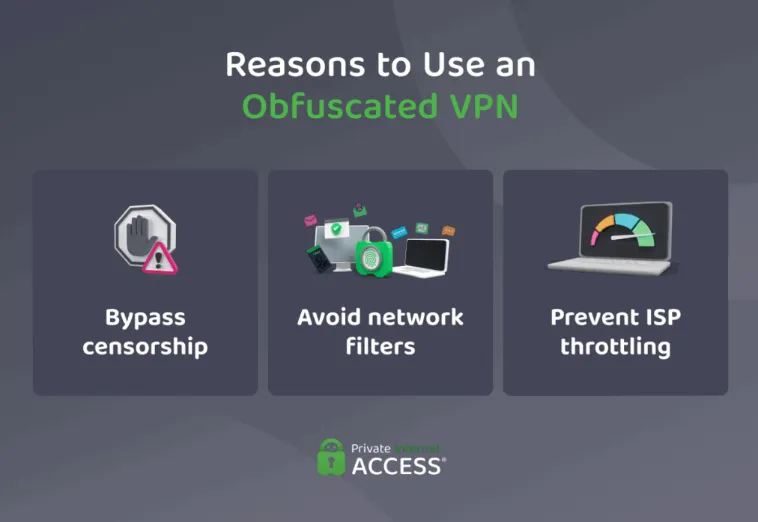
Since most free VPN services offer limited server options, slow speeds, and significant security risks, a premium VPN with a money-back guarantee is the only viable option. When making your selection, ensure the provider meets this critical checklist for reliability against the GFW:
-
China-Associated Servers: The VPN must have servers in Mainland China (usually virtual servers) or reliable, high-speed alternatives in close proximity, such as Hong Kong (HK) or Macau.
-
Obfuscation Technology: This is non-negotiable. The GFW uses Deep Packet Inspection (DPI) to identify and block standard VPN traffic. The best providers include Obfuscation, Stealth Mode, or a proprietary protocol (like OpenVPN over SSH/SSL) that masks the VPN connection, making it appear as regular, unencrypted traffic.
-
Essential Security Features: Ensure the service has a reliable Kill Switch (to prevent accidental IP leaks if the connection drops) and robust IP/DNS Leak Protection enabled by default.
-
No-Logs Policy: Due to the regulatory environment, a strict and independently audited No-Logs Policy is paramount to protecting your privacy.
The 5-Step Process: Obtaining Your Chinese IP
Follow these steps to securely and effectively route your connection through a Chinese IP address:
-
Select and Subscribe: Choose a premium VPN service that meets the GFW-Proof Checklist (Section A). Take advantage of their money-back guarantee to test its effectiveness first.
-
Download and Prepare Securely: Download and install the VPN app on your device. Before connecting, access the settings menu. Crucially, ensure the Kill Switch and all IP/DNS Leak Protection settings are enabled.
-
Activate Stealth/Obfuscation: Navigate to the advanced protocol settings and activate the feature designed to bypass network restrictions (e.g., “Stealth,” “Obfuscation,” or “Invisible Mode”). This is vital for consistent connectivity.
To use obfuscation mode in China, you need a VPN with this feature (like NordVPN, ExpressVPN, VyprVPN, Astrill) and enable it in settings before entering China, often by selecting "Obfuscated Servers," "Stealth VPN," or setting the protocol to OpenVPN (TCP/UDP) to disguise your VPN traffic as normal browsing, helping bypass the Great Firewall for access to blocked sites like Google.
-
Connect to a Chinese Server: Open the server list and select the optimal location. Prioritize servers in this order:
-
Mainland China (Virtual): If available, this gives the truest Chinese IP.
-
Hong Kong / Macau: Excellent alternatives for better speed and slightly lower latency, though they might not unblock all mainland-only content.
-
Verify Your New IP: Once the app confirms connection, open an independent IP checker website (search "What is my IP?") to confirm your new public IP address is registered as being in China. You can then safely access your desired streaming, social, or financial services.
Top 3 VPNs with Obfuscation for a Reliable Chinese IP (2026)
When choosing a service capable of consistently defeating the GFW's advanced blocking techniques, performance, security, and specialized server features are paramount. Here are three top-tier VPNs that offer reliability for obtaining a Chinese IP address in 2026.
1. Hotspot Shield
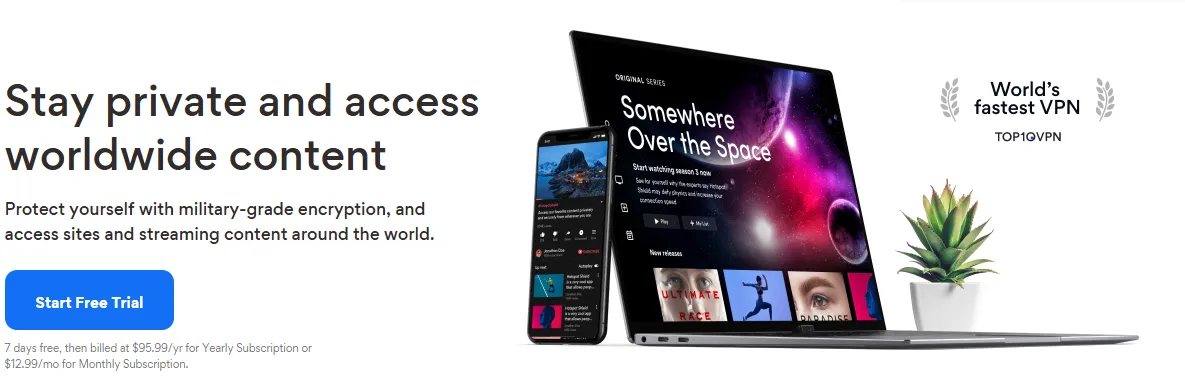
Hotspot Shield is renowned for its speed, largely due to its proprietary Hydra protocol. It maintains a large global server network and is often cited as a top choice for high-bandwidth activities like 4K streaming and gaming. It features a straightforward interface, making it suitable for users who prioritize performance and simplicity.
Server Network:1,800 servers in 80 countries (locations in China, Hong Kong, and Taiwan)
Core Advantages (Pros)
-
Exceptional Speed: The proprietary Hydra protocol delivers some of the fastest connection speeds on the market, minimizing latency.
-
Strong Encryption: Uses robust, military-grade encryption to secure your data.
-
User-Friendly Apps: Simple and intuitive applications across all major platforms (Windows, macOS, Android, iOS).
-
Streaming Optimization: Known for its dedicated servers optimized for streaming major international platforms.
Advantage for Chinese IP Access
While Hotspot Shield may not have physical servers in mainland China, its strength lies in its vast network of high-speed servers in adjacent regions like Hong Kong (HK) and Macau. The superior speed and stability of the Hydra protocol are crucial for maintaining a reliable connection despite the GFW's interference, making it an excellent option for streaming Chinese media without buffering.
2. Private Internet Access (PIA)
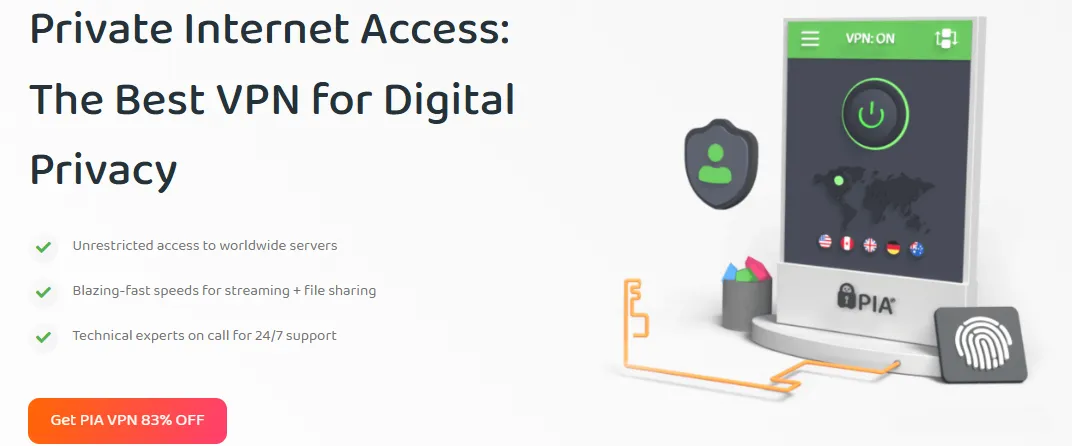
Private Internet Access (PIA) is one of the most respected names in the VPN industry, known for its strong commitment to user privacy, transparent policies, and deep customization options. It boasts one of the largest server networks globally and is a favorite among technical users who want granular control over their connection.
Server Network:29,650 servers in 91 countries (locations in China, Hong Kong, and Taiwan)
Core Advantages (Pros)
-
Unrivaled Privacy Commitment: Features an independently audited and court-proven strict No-Logs Policy.
-
Massive Server Count: Offers tens of thousands of servers worldwide, reducing congestion and improving reliability.
-
Advanced Customization: Allows technical users to adjust encryption levels, protocols, and ports for optimal performance and security.
-
Open Source: All their client software is open-source, promoting transparency and trust.
Advantage for Chinese IP Access
PIA's advantage for obtaining a Chinese IP lies in its customization and security features. Its strong encryption and ability to use different ports and protocols (often via Obfuscation or SOCKS5 proxy integration) make it highly effective at disguising VPN traffic from the GFW's Deep Packet Inspection (DPI). The immense server pool ensures that if one neighboring server (HK or Taiwan) becomes congested or blocked, there are always numerous alternative options available for a stable connection.
3. CyberGhost

CyberGhost is widely regarded as a beginner-friendly service that doesn't compromise on advanced features. With a massive global presence, it emphasizes ease of use, one-click access, and specialized servers for specific digital activities, all backed by a transparent and robust privacy policy.
Server Network:11,690 servers in 100 countries (locations in China, Hong Kong, and Taiwan)
Core Advantages (Pros)
-
Beginner-Friendly Interface: Exceptionally easy to navigate, making it ideal for first-time VPN users.
-
Specialized Servers: Offers dedicated servers for streaming, gaming, and torrenting, ensuring optimal performance for different tasks.
-
Extended Money-Back Guarantee: Often provides one of the longest money-back guarantees in the industry (e.g., 45 days), allowing extensive risk-free testing.
-
Solid Security: Includes a built-in Kill Switch and strong AES 256-bit encryption.
Advantage for Chinese IP Access
CyberGhost's strength is its specialized servers and ease of use. While its mainland China presence might be limited to virtual servers, its specialized HK and Macau servers are typically well-maintained for streaming, which is often the primary reason users seek a Chinese IP. Its large server footprint and user-friendly design make it a great choice for those who need a reliable connection without dealing with complex technical configurations.
Alternative Method: Chinese Proxy Server (Drawbacks & Risks)
While a Virtual Private Network (VPN) is the gold standard for securing a Chinese IP address, another method exists: using a Proxy Server. However, in the environment of 2026, this method comes with significant drawbacks, particularly when dealing with the Great Firewall.
A. How a Proxy Server Works
A proxy server acts as a middleman, forwarding your internet requests to the target website using the server's own IP address. If the proxy is located in China, it will grant you a Chinese IP. This typically relies on SOCKS5 or HTTP/HTTPS protocols.
-
SOCKS5 Proxy: More versatile as it can handle all types of traffic (not just web pages) and is generally faster than HTTP proxies.
-
HTTP/HTTPS Proxy: Used specifically for accessing websites.
B. Drawbacks and Risks in 2026
For accessing content behind the GFW or accessing geo-restricted Chinese platforms, a proxy server is generally not recommended due to critical security and reliability issues:
-
No Encryption: Unlike a VPN, most proxy services do not encrypt your connection. Your internet service provider (ISP), as well as the Great Firewall, can easily see your unencrypted data and the fact that you are attempting to use a proxy, leaving your traffic vulnerable to monitoring.
-
Ease of Detection and Blocking: Because proxies lack the sophisticated obfuscation techniques of premium VPNs, the GFW easily detects and blocks most public proxy IP addresses. This results in frequent disconnections and highly unreliable access.
-
Data Security Risk: Using free or unknown proxies is extremely dangerous. The proxy server owner can log all your activity, including sensitive information like login credentials and bank details.
-
Limited Functionality: Proxies are often configured on an application-by-application basis (e.g., only in your web browser), meaning other applications on your device will still use your local IP, leading to IP conflicts and service access errors.
C. When to Consider a Proxy
A proxy might only be considered for low-stakes, temporary use, such as browsing a non-critical website. For streaming, banking, or any sensitive communication, a premium VPN is the essential and secure choice.
D. How to Set Up a Chinese Proxy (Manual Steps)
If you must use a proxy for non-sensitive tasks, the setup process is manual and varies by operating system. You will need the Chinese proxy server’s IP address and port number.
-
Find a Proxy: Secure a reliable Chinese proxy address (usually SOCKS5 or HTTP) from a trusted, paid service. Avoid free proxies.
-
Configuration (Windows/macOS):
-
Navigate to your system’s network settings or browser settings (e.g., Chrome/Firefox proxy settings).
-
Locate the “Proxy” or “LAN Settings” option.
-
Enter the Chinese proxy server's IP address and port number under the corresponding protocol (HTTP, HTTPS, or SOCKS).
-
Authentication: If the proxy requires authentication (highly recommended for paid services), enter your username and password.
-
Save and Apply: Save the settings. All compatible applications will now route traffic through the Chinese IP address.
-
Important Note: Remember to disable the proxy settings immediately after use, as they can cause general connectivity issues for non-Chinese websites and services.
More Advanced Methods: Niche and Technical Solutions
For users with specific needs or who are technically inclined, there are a few other, more complex methods for obtaining a Chinese IP, though they are generally less reliable for bypassing the GFW than a premium VPN.
A. Dedicated Chinese IP
A dedicated IP address is a unique IP that only you use, unlike shared IPs used by general VPN servers.
-
How it Works: Some services offer a dedicated IP that is registered in a country of your choice, including China (usually a virtual location). Since it’s not shared, it’s less likely to be flagged by streaming services.
-
Drawbacks: While good for accessing services like banking that might flag shared VPN IPs, a dedicated IP is still often blocked by the GFW unless the provider is applying strong, consistent obfuscation at the routing level.
B. Smart DNS Services
Smart DNS services are primarily designed for streaming and are not recommended for security or GFW bypass.
-
How it Works: Smart DNS services change your DNS settings to route specific traffic related to geo-restricted content (like a Chinese streaming site) through a proxy server in the target country. It only changes how a site sees your location, not your entire connection.
-
Major Risks:
-
No Security: Smart DNS offers absolutely no encryption or security. Your actual IP address and traffic remain visible.
-
GFW Blocking: Because it offers no obfuscation, the GFW can easily detect and block the DNS rerouting, making it completely ineffective for accessing content from outside China.
-
Content Specific: It is often only configured for a small number of Chinese streaming sites and won't work for general browsing or financial services.
C. The Verdict on Advanced Methods
For overcoming the sophisticated censorship infrastructure of the Great Firewall, technical solutions like Smart DNS and Dedicated IP (without strong accompanying encryption/obfuscation) are highly prone to failure. A premium, GFW-specialized VPN remains the most practical and secure solution.
Best Ways to Get a China IP Address
To summarize the most effective and safe methods for obtaining a Chinese IP address in 2026, refer to the table below:
|
Method |
Security/Encryption |
GFW Bypass Reliability |
Best For |
Recommendation |
|
Premium VPN |
Excellent (AES-256) |
High (with Obfuscation) |
Streaming, Banking, Privacy |
Highly Recommended |
|
Proxy Server |
None/Poor |
Low |
Low-stakes browsing only |
Not Recommended |
|
Dedicated IP |
Varies (often good) |
Moderate (Needs VPN features) |
Avoiding shared IP blacklists |
Secondary Option |
|
Smart DNS |
None |
Very Low |
Streaming only (No security) |
Not Recommended |
Security & Legality: Is Using a VPN for a Chinese IP Legal?
Using any tool to circumvent the Great Firewall (GFW) or to route traffic through China, even for legitimate reasons like accessing local streaming or banking services, involves navigating a highly regulated and complex legal landscape. Understanding the risks and taking precautions is essential.
A. Legality & Penalties
The legal status of non-government-approved VPNs in China exists in a persistent "gray area." While the government encourages citizens and businesses to use state-sanctioned services (which comply with data logging and surveillance requirements), individual use of non-approved, foreign VPNs is heavily restricted and discouraged.
-
VPNs are Not Strictly Illegal, but the Government Aggressively Shuts Down Non-Compliant Services: The government's primary focus is on controlling the supply, rather than mass prosecution of users. Foreign VPN providers that do not obtain a license are continuously blocked using advanced technologies like Deep Packet Inspection (DPI) and IP blocking.
-
The Risk of Penalties for Using Non-Approved Services: While arrests of tourists or expatriates for simply using a VPN are extremely rare, the authorities do levy fines, primarily against local Chinese citizens found to be operating or selling unauthorized VPN services, or against individuals whose work is deemed to be "illegal business operations" using the VPN. For individuals, penalties are usually non-criminal and can include:
-
Fines (though inconsistently applied).
-
Police requiring the user to delete the VPN application from their device.
-
Temporary loss of cellular or internet service until VPN apps are removed.
B. Mandatory VPN Features for Safety
Since the Chinese government can inspect traffic and logs when the exit node is physically located in mainland China, and given the GFW's advanced detection methods, selecting a VPN with specific safety features is crucial for minimizing both security and legal risks, regardless of where you are connecting from.
-
Strict No-Logs Policy: This is the foundational security feature. A truly "no-logs" policy ensures that the VPN provider does not record any identifiable user data, such as connection timestamps, browsing history, or IP addresses. This prevents surveillance by prying eyes (ISP, Government, or malicious actors) because, even if the server is seized, there is no user activity data to share.
-
Robust Encryption & Obfuscation: The VPN must employ the highest standard of encryption (like AES-256) to route your traffic through a secure connection. Crucially, the VPN must also include advanced Obfuscation Technology (sometimes called Stealth Mode, Chameleon, or Scramble). This technology masks the VPN traffic, making it look like regular, unencrypted HTTPS traffic, which is essential for bypassing the GFW's Deep Packet Inspection (DPI).
-
Dedicated Servers for Performance: While not strictly a safety feature, for specific activities like high-definition streaming or high-speed data transfer, selecting a provider known for optimizing its network is key. Reputable services like Hotspot Shield or CyberGhost often mention optimized servers specifically for bandwidth-intensive tasks, ensuring a stable connection quality even when using obfuscation.
Troubleshooting: Why Your Chinese IP VPN Might Still Get Blocked
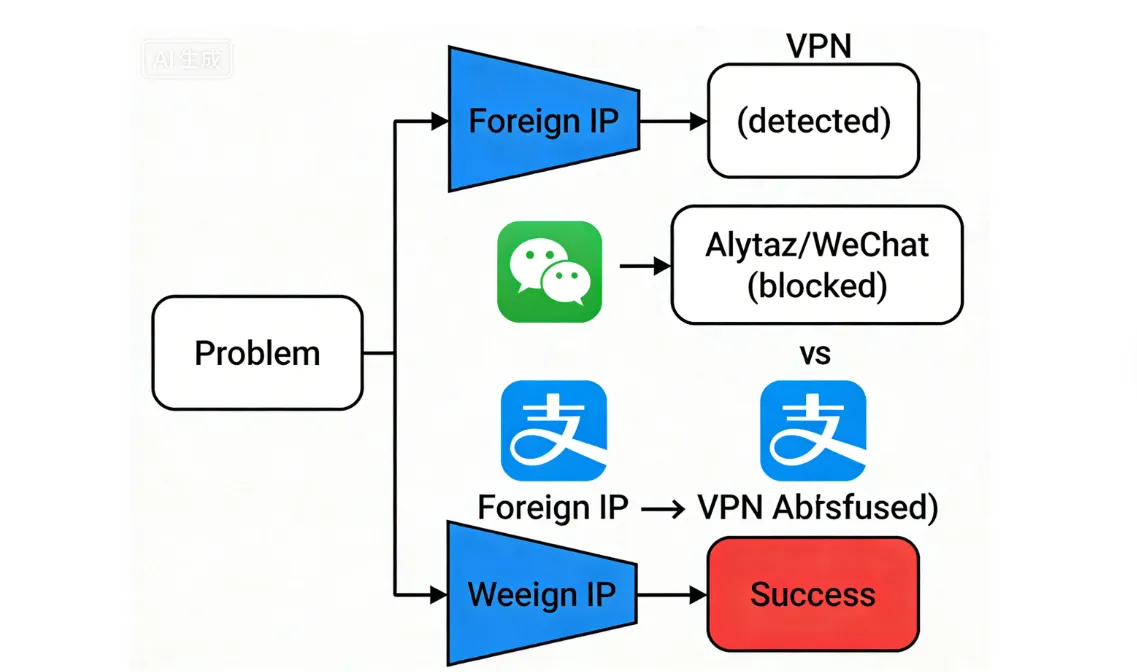
Successfully obtaining a Chinese IP address is only the first step. Due to the high sensitivity of Chinese online services, users often encounter practical issues that go beyond the basic technical challenge of bypassing the Great Firewall (GFW). These issues are typically triggered by using a non-standard or foreign-owned IP address.
A. Service Access Issues
Chinese financial and social platforms are highly sensitive to sudden changes in user location, especially if the new location originates from a known data center IP (common for VPNs).
-
Account Lockouts: Financial or social platforms (such as WeChat and Alipay) have sophisticated fraud detection systems. If they detect a sudden jump in location from outside China to a virtual Chinese IP, they may flag the activity as suspicious, temporarily freezing the account and requiring stringent re-verification via SMS to a mainland Chinese number or official identity documents.
-
Transaction Failures: Many e-commerce and payment gateways are hard-coded to reject transactions that attempt to combine a non-local payment method (e.g., a foreign credit card) with a Chinese IP address, or vice-versa. This is a security measure to block international fraud, resulting in blocked payments or required re-authentication.
B. User Experience Issues
Even when a connection is established, the user experience can be compromised by the site's protective measures or the nature of content localization.
-
Content Differences: By connecting through a Chinese IP (especially one associated with a data center or a virtual location like Hong Kong/Macau), you may receive censored or highly localized search results and streaming content libraries. The information presented may not be the complete, globally available version.
-
High CAPTCHA/2FA Rates: Websites, particularly large platforms and social media sites, may demand repeated security verifications (CAPTCHAs or Two-Factor Authentication) due to suspicious IP lookups. Datacenter or virtual IPs, which are shared among many users, are frequently flagged as bots or high-risk traffic, leading to repeated challenges.
-
IP Blocklist: Certain highly regulated Chinese platforms (e.g., banking portals, specific government sites) maintain private blocklists. They may actively flag and block IPs known to belong to VPN providers, data centers, or virtual Chinese servers, causing intermittent or permanent access failures even if the VPN is generally working.
C. Performance Concerns
Performance degradation is a common frustration, often resulting from the complex routing required to maintain an unblocked connection.
-
Poor Routing or Overloaded Nodes: The constant cat-and-mouse game between the GFW and VPN providers requires traffic to be routed through complex and sometimes slow paths (obfuscation layers). This can lead to:
-
Buffering and Lag: Especially severe for streaming (iQIYI, Youku) or online gaming.
-
Dropped Sessions: Unstable connections causing banking sessions or video calls to disconnect abruptly.
-
High Latency (Ping): Making real-time applications like VOIP and gaming unviable.
Conclusion
In 2026, obtaining and maintaining a reliable Chinese IP address is fundamentally a challenge of security and evasion, not just geography. The sophisticated defenses of the Great Firewall mean that simple proxy servers or unencrypted methods are consistently unreliable. The only practical, secure, and effective solution remains a premium Virtual Private Network (VPN). This solution must offer robust AES-256 encryption coupled with specialized obfuscation technology to mask its traffic and bypass detection systems.
Track Record and Trust
When selecting a service, user experience and privacy should be the priority, especially given the regulatory environment discussed in Section —”Security and Legal Risks: What You Must Know”. We recommend prioritizing providers that demonstrate:
-
A Proven Track Record Against the GFW: The service must have a history of successfully deploying and maintaining obfuscation servers that consistently work in challenging environments.
-
Strict No-Logs Policies: To safeguard against surveillance and legal risk, the provider must commit to an audited, zero-logging policy that ensures no personally identifiable traffic data is ever recorded.
-
Money-Back Guarantees: Given the unpredictable nature of censorship, a risk-free trial is essential to test the service's current reliability before committing to a long-term subscription.
Don't let geographic restrictions or censorship isolate you from essential services and content. Start your risk-free trial today with a highly-rated, GFW-specialized VPN provider to ensure reliable, secure, and uninterrupted access to Chinese internet services, whether for banking, streaming, or communication.
"Reverse VPN" vs. Standard VPN: Establishing Technical Authorit
While most readers use the general term "VPN," obtaining a Chinese IP address is technically a "Reverse VPN" setup. It is important to understand this distinction to choose the right tool for 2026:
-
Standard VPN (Outbound): Designed for users inside China to bypass the Great Firewall (GFW) and access global sites like Google or YouTube.
-
Reverse VPN (Inbound): Designed for users outside China to bypass domestic geo-restrictions and access local services like Youku, Bilibili, and mainland banking portals.
Frequently Asked Questions (FAQ)
Q: What is the most effective way to get a Chinese IP address in 2026?
A: The most reliable, secure, and effective method is using a premium Virtual Private Network (VPN). Due to the Great Firewall's sophisticated defenses, the VPN must include robust AES-256 encryption and specialized obfuscation technology (Stealth Mode) to ensure the connection is not detected and blocked.
Q: Why can't I just use a free proxy server or Smart DNS service instead of a VPN?
A: This is strongly discouraged. Free proxies and Smart DNS services offer little to no encryption, leaving your data vulnerable to surveillance. Furthermore, they are easily detected and blocked by the GFW, leading to unreliable access, high latency, and frequent disconnections. The risks outweigh any perceived cost savings.
Q: What are the mandatory security features I should look for in a VPN for China?
A: You must prioritize services that demonstrate:
-
A Strict No-Logs Policy (to protect your privacy and reduce legal risk).
-
Proven Obfuscation Capabilities (to bypass the GFW's Deep Packet Inspection).
-
Money-Back Guarantees (to ensure you can test its current reliability risk-free).
Q: Is using a VPN to get a Chinese IP address legal?
A: The use of non-government-approved VPNs exists in a persistent "gray area." While arrests for individual use are rare, fines are occasionally levied, primarily against local operators. It is essential to use a VPN with a strong No-Logs policy and advanced encryption to minimize any surveillance risk.
Q: Why am I getting locked out of WeChat or Alipay even with a Chinese IP?
A: Chinese financial and social platforms often detect virtual IP addresses (common for VPNs) and flag them as suspicious or high-risk activity, especially if you recently connected from abroad. This can trigger account lockouts or require re-verification via a mainland Chinese phone number, as detailed in Section VIII.
PS: All images in this article are sourced from the merchant's official website(or AI) and are copyrighted by the merchant.