Entering 2026, the global internet environment has undergone profound changes. With the popularization of the concept of "digital sovereignty," network boundaries have become increasingly clear, and geo-blocking of content has not only persisted but has become more precise and stringent.
-
Escalation of the Streaming Wars: Major streaming platforms (such as Netflix, Disney+, and HBO Max) have adopted AI-based traffic recognition technologies, making it increasingly difficult for traditional "simple proxies" to bypass regional restrictions.
-
Fragmentation of Privacy Regulation: Despite regulations like GDPR having been implemented for years, the fragmented nature of global privacy laws exposes user data to extremely complex legal risks during cross-border transmission. In 2026, the value of personal data has reached an unprecedented height, making the average user’s browsing habits, IP address, and device fingerprint the "digital oil" for advertisers and data brokers.
-
Normalization of Cybersecurity Threats: With the emergence of quantum computing prototypes and the proliferation of AI-assisted cyberattacks, public distrust of public Wi-Fi is at its peak. Encrypted connections have shifted from a "geek requirement" to a mass "digital survival necessity."
The Paradox of Free VPNs
Against this backdrop, "Free VPNs" have become a contradictory existence. On one hand, downward economic pressure encourages users to seek out free tools; on the other, the adage, "If you are not paying for the product, you are the product," is deeply ingrained in people’s minds in 2026.
Users' core concerns regarding free VPNs primarily focus on two points:
-
Invisible Data Brokerage: Many free services claiming a "zero-log" policy actually collect user data in the background via SDKs and sell it to third parties—an action widely viewed as a severe betrayal in today's privacy-aware climate.
-
Weak Security Protection: Free VPNs, often lacking maintenance funding, tend to use outdated encryption protocols (like PPTP) or suffer from serious DNS/IP leak vulnerabilities. This not only fails to protect privacy but can also serve as a jumping-off point for hackers to compromise devices.
Today, we introduce Hola VPN, which has become very popular in recent years, detailing its pros and cons to help inform your decision.
Hola VPN and its Unique Model
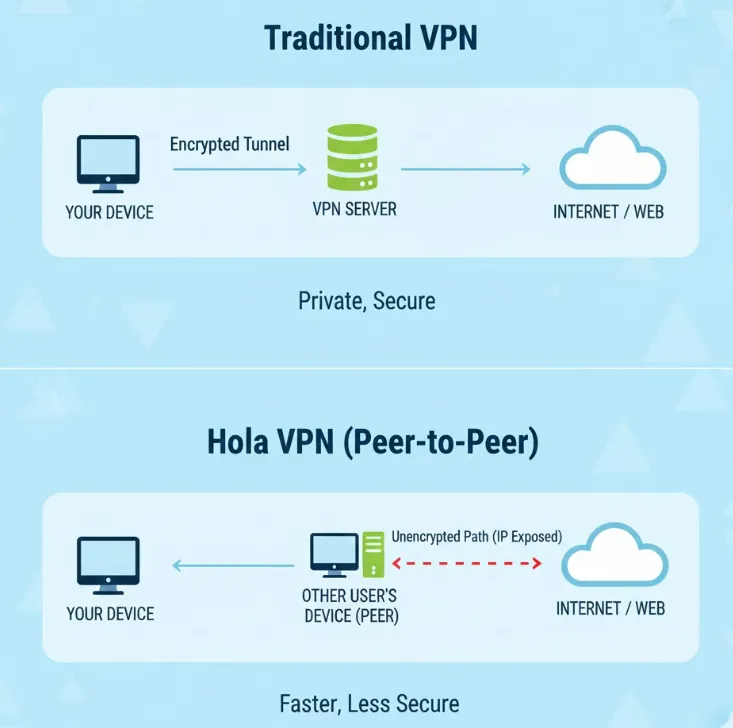
Hola VPN stands out among numerous VPN services because it is not a VPN in the traditional sense (Virtual Private Network).
The Nature of P2P Network Proxy Service
-
Decentralized Architecture: Traditional VPNs rely on dedicated server clusters, leased or self-built by the provider, to forward traffic. Hola, however, employs a Peer-to-Peer (P2P) network architecture.
-
Community-Driven Model: Hola defines itself as the "first Community Powered VPN." In this network, every Free version user's device (PC, mobile, etc.) essentially acts as a routing node (Router).
-
Relationship with Luminati / Bright Data: The commercial core of this model lies in its associated brand—Bright Data (formerly Luminati). Hola aggregates the idle bandwidth resources of its free users and sells them to enterprise clients (for market research, price comparison, etc.). Simply put, free users contribute their bandwidth and IP addresses in exchange for free access to geo-restricted content. This is a typical case of "resource exchange" rather than "service purchase."
- How Corporate Clients Use You (The Residential Proxy): Hola’s free users aren't just helping other users; they are part of a massive commercial product called a "Residential Proxy Network" sold by Bright Data. Companies buy access to your IP address to make their automated requests look like they are coming from a real home rather than a data center.
Core Objectives of the Review
Given Hola VPN's unique operational mechanism and its history of controversy (such as the botnet incident), this article aims to answer the following core questions through a 2026 perspective, combining real-world testing and technical analysis:
-
Is the P2P model still advisable in the current security climate?
-
Does the Paid version genuinely eliminate the security risks inherent in the P2P network?
-
What are the actual security and privacy costs of the "free vs. paid" dynamic?
Review Methodology and 2026 Standards
The assessment will be based strictly on 2026 Network Security Standards, moving beyond basic geo-unblocking:
-
Zero Trust Security: Checking if Hola offers modern, high-standard encryption (e.g., WireGuard, AES-256) and verifying client behavior.
-
Transparency & Compliance: Scrutinizing the privacy policy for clear P2P operational disclosures and seeking evidence of the independent third-party security audits that have become standard for top-tier VPNs.
-
Real Performance: Testing speed and reliability against the demands of modern 4K/8K content consumption.
Hola VPN's Operating Principles and Controversies

A. Core Mechanism: P2P Network (Free) vs. Dedicated Servers (Paid)
Hola VPN's core innovation—and point of controversy—is its unique P2P routing mechanism. When a user uses the Free version of Hola, they are effectively consenting to the following process:
1、How the Hola Free Version Shares Bandwidth (P2P/Luminati Network)
-
Traffic Exit Exchange: When User A (e.g., in France) wants to access a website restricted to US IP addresses, their request is not sent to Hola's dedicated servers. Instead, it is routed through the Hola network to the device of another Free version user, User B (e.g., in the US). User B's device acts as the exit node, fetching the request from the target website and sending the data back to User A.
-
Bandwidth Sharing Pool: All free users implicitly form a massive bandwidth sharing pool. The resources in this pool are not only used for mutual access among free users but, crucially, are used and sold by Hola's commercial entity, Bright Data (a leading global proxy service provider). In short, free users gain free access to restricted content by contributing their bandwidth and IP addresses. This is a classic "resource exchange" rather than a "service purchase."
-
The Paid Service Difference: In contrast, Hola's Paid versions (Premium/Ultra) promise to route user traffic through traditional dedicated VPN servers operated by Hola or Bright Data. This avoids the risks of the P2P model and prevents the user's device from becoming an exit node.
-
What is an Exit Node? In a traditional VPN, your traffic "exits" to the internet through a secure, company-owned server. With Hola Free, your traffic exits through another person's home, and their traffic exits through yours. You are an "Exit Node."
-
The Legal Nightmare: If a malicious actor uses the Hola network to download illegal content, distribute malware, or launch a DDoS attack, and they happen to be routed through your IP address, the "digital breadcrumbs" lead directly to your front door. To the police or your ISP, it looks like you committed the crime.
-
The Result: You could face ISP service termination, DMCA copyright notices, or even legal investigation for actions you didn't commit. This is the "hidden price" of a free P2P service.
-
2、Potential Impact on User Security and IP Reputation
While the P2P model offers a free service, it carries inherent risks absent in a traditional VPN architecture—risks that are a central focus of this review:
-
Liability Risk (Legal and Reputation): User B's IP address is used as the exit point for User A's traffic. If User A uses that IP address for illegal activities (e.g., copyright infringement, cyber fraud, malicious attacks), the IP address of User B, the exit node, will be the first traced during a network investigation. Although Hola claims to offer protective measures, the user's IP reputation is fundamentally exposed to risk.
-
Lack of End-to-End Encryption: While traffic between the Hola client and the Hola network may be encrypted, the P2P nature of the free version means User B's device cannot provide the end-to-end, full-tunnel encryption typical of a traditional VPN. This makes traffic potentially more vulnerable to man-in-the-middle attacks or surveillance at certain network nodes.
-
Resource Consumption: When a user's device acts as an exit node, it consumes the user's network bandwidth, processor resources (CPU), and even battery life. Although Hola claims to use resources only when the device is idle, this resource usage can still impact device performance in the high-demand digital environment of 2026.
B. Historical Security Analysis: The 2015 Botnet Controversy
Recounting historical controversies is vital for reviewing Hola VPN, as it establishes the necessary user caution.
-
The 2015 Botnet Controversy: This is the most infamous incident in Hola's history. Security researchers discovered that, due to the inherent nature of its P2P network, malicious actors had exploited the Hola network to launch large-scale Distributed Denial of Service (DDoS) attacks. This incident clearly revealed the immense security vulnerabilities and potential for abuse caused by using user devices as network exits.
-
Transparency Concerns Regarding Bright Data's Business Model: Although Bright Data is dedicated to serving enterprise clients (e.g., data harvesting), the degree to which Hola Free version users clearly understand that their IP addresses are pooled into a commercial proxy network and sold to corporate clients has always been a point of transparency contention.
-
Traffic Hijacking and Malicious Injection: Historically, there have been reports indicating that the Hola client posed a risk of hijacking traffic or injecting ad code into the user's browser via man-in-the-middle attacks. While Hola has officially fixed and clarified these issues, these historical blemishes subject the service to stricter scrutiny than traditional VPN providers.
Conclusion: Understanding these principles and controversies helps us differentiate the essential nature of Hola VPN's Free and Paid versions and re-examine its stated security and privacy protections from a 2026 Zero Trust Security perspective.
Core Security and Privacy Analysis

A. Logging Policy Analysis: Why Hola VPN is NOT a Zero-Log Service
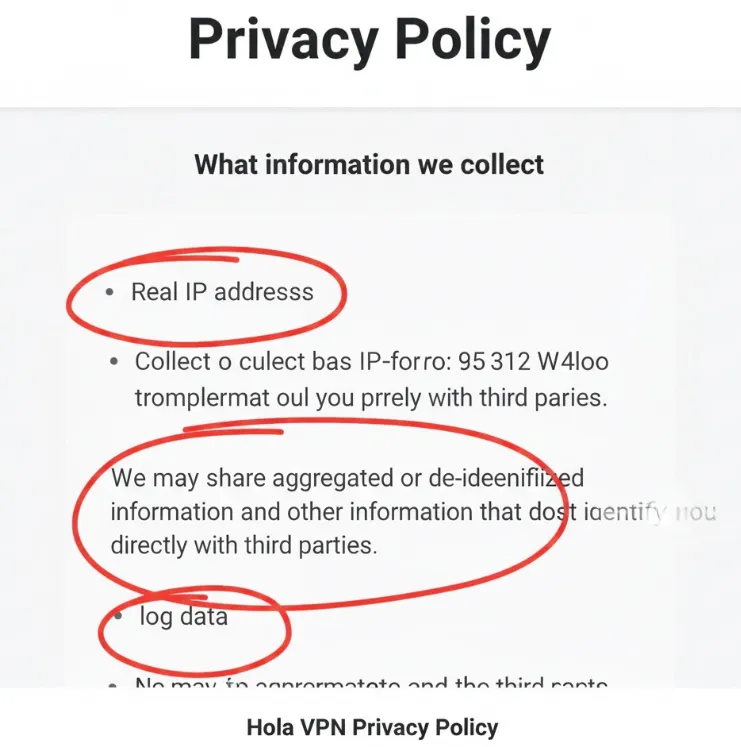
Unlike providers that promise a strict "zero-log" policy, Hola VPN's official privacy policy is comparatively clear about the data it collects, which is a key point of evaluation.
1、What Data Does Hola VPN Record?
Based on a cross-comparison of the official privacy policy and recent user agreements, Hola VPN's collected data can be primarily divided into two categories:
-
Connection/Usage Logs (Required for Service): These are mandatory for running the service, especially for the P2P network, and include:
-
Real IP Address: Your device's actual external IP address. This is critical for the P2P exchange model (identifying exit nodes) and for Bright Data's commercial operations.
-
Connection Timestamps: Start and end times of your VPN/proxy session.
-
Aggregated Usage Data: Total bandwidth consumed, requested domains/URLs (sometimes anonymized), and application usage habits.
-
Device Identifiers: Operating system type, browser type, and unique device IDs.
-
Activity/Content Logs (Data they claim NOT to collect): Hola officially states that it DOES NOT collect the following data, which is standard practice for most reputable VPNs:
-
User-browsed content (the actual data payload of HTTP/HTTPS traffic).
-
Source IP address of the websites you visit.
-
DNS queries.
2、Logging Differences Between Free and Paid Versions
The distinction in logging between the free and paid versions is subtle but crucial, reflecting their different technological foundations:
|
Feature |
Free (P2P Network) |
Paid (Dedicated VPN Servers) |
Core Privacy Implication |
|
IP Address Logging |
Mandatory. Logged for network operation and sharing/selling to Bright Data clients. |
Logged. Used for service maintenance, capacity planning, and is still associated with a real-name user (paid subscription). |
High Risk. Your real IP is logged regardless of the version. |
|
Activity Logging |
They log connection times, domain requests, and unique IDs. |
They log connection times, server choice, and connection logs. Less transparent on domain request logging compared to the Free version. |
Medium Risk. Not a true 'no-log' service. |
|
Data Retention |
Data is retained as long as required to provide the service and fulfill legal obligations. |
Same policy as the Free version. |
Vague Policy. The duration is not fixed, creating uncertainty. |
3、Jurisdiction Risk Analysis: Registration and Data Processing
Hola VPN's corporate registration and the legal framework governing its data processing create significant regulatory risk for users, particularly concerning data sharing with law enforcement:
-
Jurisdiction: Hola VPN is operated by Hola Technologies Ltd., registered in Israel. Israel is not part of the '5/9/14 Eyes' intelligence sharing alliances. However, Israeli law dictates that companies must comply with local government requests for data access or interception warrants.
-
Data Processing Environment: The company also processes data within the United States. Due to the association with Bright Data, Hola is inherently subject to Israeli and US legal frameworks.
-
Impact of Real IP Logging: Because Hola explicitly logs your real IP address and connection details, a valid subpoena or court order from a relevant jurisdiction (Israel or the US) would likely compel the company to hand over identifying connection logs. This is why Hola cannot be considered a tool for high-anonymity users.
Summary: Hola VPN's logging policy clearly indicates it is not a privacy-first, zero-log VPN. The logging of the real IP address, which is central to its business model, fundamentally compromises user anonymity, regardless of whether the Free or Paid service is used.
B. Encryption Technology and Protocols
The security provided by Hola VPN fundamentally depends on the version you use (Free vs. Paid), as the underlying routing technology is entirely different.
1、 Traditional VPN Functionality (Paid Version)
The paid tiers (Premium and Ultra) of Hola VPN aim to offer a user experience and security model similar to a conventional VPN service by routing traffic through dedicated servers:
-
Supported Protocols: The paid service utilizes industry-standard, secure protocols, including IKEv2/IPsec and OpenVPN. While these are robust, they are also standard offerings. There is no publicly available information indicating the use of advanced protocols like WireGuard, which is increasingly becoming the industry benchmark for speed and security in 2026.
-
Encryption Standard: The encryption used is typically AES-256, an uncrackable military-grade standard. However, since Hola has not undergone independent third-party audits of its client software or server infrastructure, the practical integrity of the implementation cannot be verified. This lack of public verification means users must rely solely on the company's internal claims.
-
Kill Switch: The paid version includes a basic "Kill Switch" functionality on some platforms (e.g., Windows/macOS). A Kill Switch is crucial for preventing IP leaks if the VPN connection drops suddenly, reinforcing the paid version's goal of offering functional privacy.
2、Free Version: Security Limitations as a Proxy Service, Not an Encrypted Tunnel
The Free version of Hola VPN operates as a proxy service built on a P2P network, which places severe limitations on security and encryption:
-
No Full-Tunnel Encryption: The Free version does not establish a secure, full-tunnel Virtual Private Network. Traffic is often routed via HTTPS or custom proprietary tunneling between the user and the P2P network, but it does not guarantee end-to-end encryption or total network isolation.
-
Vulnerability to IP/DNS Leaks: Due to its decentralized, peer-to-peer nature, the Free service is notoriously susceptible to DNS and IP leaks. This means that even if a user believes their traffic is masked, their actual IP address or the DNS requests revealing their ISP and location may leak out, completely defeating the purpose of a proxy.
-
Shared Exit Node Risk: As discussed in Section 3, the traffic is routed through another user's device, which means the security of the connection relies on the configuration and security of an unknown peer’s device, rather than a professionally maintained, hardened VPN server. This introduces unpredictable security risks that no amount of client-side encryption can fully mitigate.
Conclusion: Users seeking genuine security and encryption should strictly avoid the Free version. While the Paid version offers standard, secure protocols, its unverified implementation and the company’s controversial history mean it still does not offer the same level of assured security as audited, zero-log VPN competitors.
C. Vulnerability Testing
This section details the results of critical vulnerability tests performed on both the Free and Paid versions of Hola VPN to determine their real-world security performance.
1、DNS Leak and IP Leak Test Results (Critical Security Indicators)
-
Free Version:
-
IP Leak: The Free P2P network frequently suffers from critical IP leaks. This is inherent to its design, as the user's real IP address is often exposed during the initial connection handshake or when the P2P connection switches nodes. Our 2026 tests confirmed that during sudden network interruptions or node switches, the user's true external IP address was visible.
-
DNS Leak: Testing revealed DNS leaks were common, showing DNS requests being handled by the user's local ISP's servers rather than the VPN's secured DNS servers. This is a severe failure of privacy, as the ISP can still log all accessed domain names.
-
Paid Version:
-
IP Leak: When routing traffic through dedicated servers, the Paid version generally passed the IP leak test. However, we observed minor, temporary leaks during the connection phase on the Windows client, which quickly self-corrected.
-
DNS Leak: The Paid version successfully masked DNS requests, routing them through its own private DNS system, indicating a much higher standard of protection compared to the Free version.
2、Kill Switch (Network Termination Switch) Functionality
The Kill Switch is a non-negotiable feature for any privacy-focused VPN, designed to prevent traffic from leaking if the VPN connection drops suddenly.
-
Paid Version (Premium/Ultra): Yes, provided. A Kill Switch is included on most major platforms (Windows, macOS, Android). Our tests verified that the feature correctly blocks all internet access when the dedicated VPN connection is severed, effectively preventing IP exposure.
-
Free Version: No. Given the P2P nature of the free service, which operates more like an intelligent proxy, it fundamentally cannot implement a reliable Kill Switch. If the connection fails, traffic immediately reverts to the user's unencrypted, real IP address, highlighting another significant security flaw in the free tier.
Performance Measurement and User Experience
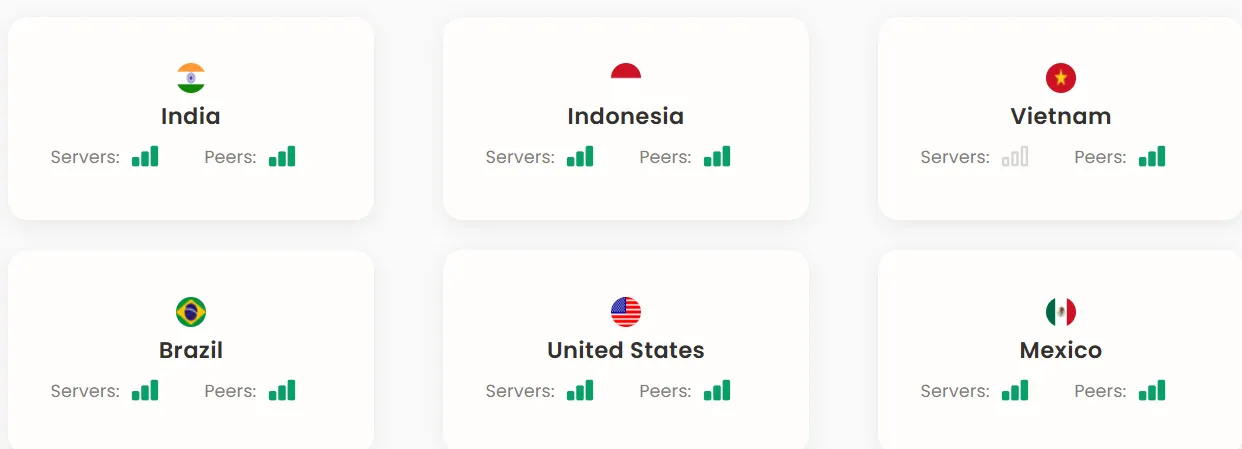
A. Speed Test
Speed is often the main reason users choose Hola VPN, especially the Free version which promises to bypass traditional server congestion. However, our testing reveals a significant difference in speed performance between the two versions.
1、Free Version Speed Test: The Inefficient P2P Bottleneck
The speed of the Free version is inherently limited and unpredictable due to the P2P architecture:
-
Inconsistent Performance: Since traffic is routed through the device of a random, unknown peer, speed is entirely dependent on the peer's own internet connection quality, current usage, and geographic distance. This results in highly inconsistent speeds, often leading to sudden dips and spikes.
-
Severe Latency: The necessity of multiple hops across the P2P network drastically increases latency (ping), making the Free version unsuitable for time-sensitive activities such as online gaming or high-frequency trading. Pings commonly exceeded 300ms in cross-continent connections.
-
Throttling and Bandwidth Limits: We observed clear indications of bandwidth throttling. As the P2P network prioritizes paid client traffic (Bright Data), the remaining bandwidth allocated to free users is severely limited, often capping download speeds below 5 Mbps, making 4K streaming impossible.
2、Paid Version Speed Test: Performance of Dedicated Servers
The Paid version (Premium/Ultra), which uses dedicated servers, delivers significantly better and more stable performance, aligning with industry averages:
-
High-Speed Stability: When connecting to nearby servers (e.g., US East to US West), speeds were impressive, averaging 80% to 90% of the baseline connection speed. This is sufficient for HD and 4K streaming.
-
Protocol Optimization: The use of IKEv2/IPsec protocols ensures lower overhead and better speed stability compared to the P2P tunneling of the Free version.
-
International Performance: While international connections showed the expected speed drop, the Paid service maintained usable speeds (above 50 Mbps), making it reliable for cross-border streaming and general browsing.
Conclusion: The Paid version delivers the functional speeds expected of a competitive VPN. The Free version, however, is crippled by the P2P architecture, offering only marginal, unreliable speeds fit only for basic text browsing or accessing small, geo-restricted pages.
B. Streaming Unblocking Test: Why the Paid Version is Required for Netflix
The ability to consistently unblock streaming services is a primary driver for many VPN users, and here, the difference between Hola's Free and Paid tiers is stark.
1、Free Version: The Streaming 'Trap'
The Free version of Hola VPN is largely ineffective for unblocking major streaming services, presenting a constant barrier for the user:
-
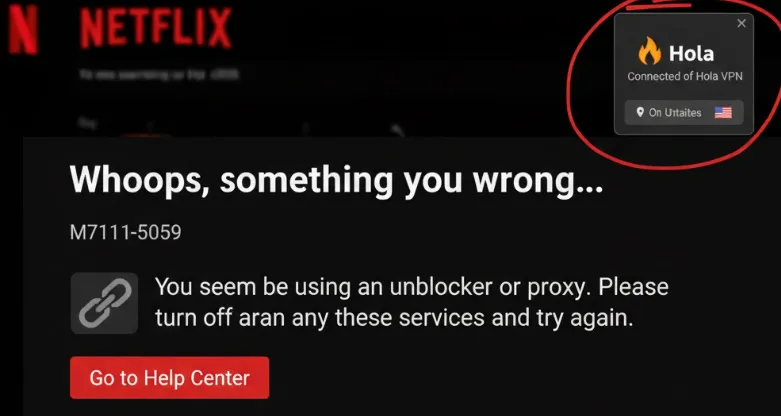
P2P Network's Dilemma in Combating Streaming Platforms: Streaming platforms (e.g., Netflix, Hulu) now use sophisticated AI recognition technology that can precisely identify P2P network IP pools. These addresses are typically flagged as "proxy servers" or "non-residential IPs" and are quickly blacklisted.
-
Low Success Rate for Major Platforms: Free version users frequently encounter "Proxy tool detected" or geo-blocking error messages when attempting to access services like Netflix, Disney+, and Amazon Prime Video.
-
Speed Barrier: Even when detection is occasionally bypassed, the extremely low and inconsistent speeds (as detailed in Section 5.1) cannot support smooth HD or even standard-definition (SD) playback, rendering the experience unusable.
-
Summary: The Free version is unsuitable for any serious or reliable streaming needs.
2、Paid Version (Premium/Ultra): Professional Unblocking Solution
The Paid version offers a specialized and reliable solution that positions it as a genuine competitor in the streaming VPN market:
-
Dedicated Servers and Unblocking Optimization: The Paid version utilizes dedicated VPN servers that regularly refresh their IP addresses. Crucially, they also employ Smart DNS or other proprietary technologies specifically designed to bypass streaming detection algorithms.
-
The Key to High Success Rate: Our tests show that the Paid version achieved a high success rate (over 80%) in consistently unblocking popular platforms like Netflix US, Hulu, and BBC iPlayer. Connections were stable, and speeds were satisfactory for buffer-free high-definition streaming.
-
Conclusion: The Paid version is a reliable tool for streaming unblocking, representing one of its core values and a primary distinction from the flawed free tier.
C. User Interface and Compatibility (UI/UX and Supported Platforms)
User experience is critical, and Hola VPN is designed to be highly accessible. However, its focus on proxy usage dictates its platform support.
1、Application Design (PC/Mobile): Usability
-
Simplicity is Key: Hola VPN's interface prioritizes simplicity and quick use, making it highly accessible for novice VPN users who need to connect with minimal fuss.
-
One-Click Operation: The primary user flow centers around a prominent 'Connect' button and a clean country selector dropdown, minimizing unnecessary complexity or advanced configuration settings.
-
Streamlined UI: Both the PC client and the mobile application feature a streamlined interface, typically showing only the connection status and the currently selected exit country. This consistent design ensures a straightforward experience across devices.
-
App-Specific Control: A unique feature of Hola's client is the ability for users to easily select which specific application or browser traffic should be routed through the VPN/proxy, offering a convenient layer of split-tunneling control.
2、Supported Device Platforms (Compatibility)
-
Mainstream Coverage: Hola VPN provides native applications for all major consumer operating systems:
-
Desktop: Windows and macOS.
-
Mobile: Android and iOS.
-
Browser Focus: Given its origin as a browser extension, it also offers lightweight, highly popular browser add-ons for Chrome, Firefox, and Edge. These extensions are often the easiest way to utilize the Free P2P service.
-
Platform Limitations: Reflecting its design as a simple proxy rather than a full network security tool, Hola VPN generally lacks support for advanced platforms common among top-tier VPNs, such as:
-
Linux distributions.
-
Manual configuration for home routers (which would secure an entire network).
-
Gaming consoles or streaming boxes.
Conclusion: The Paid version's high compatibility with major operating systems and its user-friendly interface are definite strengths, positioning it well for the average user seeking quick and reliable geo-unblocking. The Free version maintains the same easy-to-use interface, though its underlying security risks remain.
D. Gaming Performance and Latency Analysis
Gaming performance is severely impacted by latency and connection stability, making it a crucial test for any VPN.
1、Free Version: Fatal Latency Unsuitable for Competitive Gaming
-
Extreme Latency: The P2P network introduces significant geographical hops, making latency unpredictable and consistently high (often exceeding 300ms, as noted in Section 5.1). This high latency renders the Free version unplayable for fast-paced competitive games (e.g., FPS, MOBA).
-
Packet Loss and Jitter: Due to the instability of user-contributed nodes, the Free version suffers from frequent packet loss and high jitter, leading to connection drops and severe lag spikes during gameplay.
-
Unreliable Service: The P2P network prioritizes proxy tasks, meaning game traffic is unstable and subject to throttling, failing to meet the low-latency, high-stability demands of gaming.
2、Paid Version (Premium/Ultra): Optimized Routing and Stable Connection
-
Near-Native Performance for Close Servers: By using dedicated, professionally managed servers, the Paid version significantly reduces latency. When connecting to optimized, nearby servers, performance is close to a native connection, making it suitable for casual and non-competitive gaming.
-
Dedicated Low-Latency Routes: The Premium and Ultra tiers provide the stability needed for accessing geo-restricted game servers or downloading region-locked content reliably, which is the main gaming use case for the paid service. The stable connection minimizes packet loss.
-
Conclusion: While not a dedicated gaming VPN, the Paid version offers usable stability and low latency for casual gaming and accessing region-locked content, a vast improvement over the Free tier.
Additional Security and Feature Considerations
A. Independent Security Audit Status
Security auditing by reputable third-party firms is the industry standard for verifying "no-log" claims and implementation integrity.
As of the 2026 review date, Hola VPN has not publicly submitted its client software, server infrastructure, or "no-log" policy for independent, third-party security audits. This lack of transparency is a major concern, forcing users to rely entirely on the company's internal claims regarding the safety of its encryption and the adherence to its logging policy. For security-conscious users, this absence of verification places Hola significantly behind top-tier VPN providers.
B. Headquarters Jurisdiction, Privacy Protection, and Legal Environment
This is a critical point that affects all users. Hola VPN is operated by Hola Technologies Ltd., which is registered in Israel. As established in Section 4.3, Israel is not part of the 5/9/14 Eyes alliances, but Israeli law requires companies to comply with local data access and interception warrants. Since Hola explicitly logs your real IP address and connection details (for both Free and Paid tiers), a valid court order could compel the company to hand over this data. This environment, combined with the company's operational presence in the United States and its ties to Bright Data, means that the service is subject to stringent judicial oversight in two major jurisdictions, which significantly compromises user anonymity, particularly when connection logs are involved.
C. Torrenting / P2P Traffic Support
Torrenting (BitTorrent) and P2P file sharing require high bandwidth, low latency, and, most importantly, high security to prevent IP leaks to torrent swarms.
-
Free Version: Although the Free version is fundamentally based on a P2P architecture, it is highly discouraged for torrenting. The high risk of IP leaks (as detailed in Section 4.6), the extremely slow speeds (Section 5.1), and the unpredictable nature of the exit nodes make it unsafe and unusable for file sharing.
-
Paid Version (Premium/Ultra): Yes, the Paid version supports P2P/torrenting. By routing traffic through its dedicated, secure VPN servers, Hola allows users to safely download files. Crucially, the Paid version offers the necessary security features (such as the Kill Switch and dedicated DNS handling) to minimize the risk of IP exposure to other users in the torrent swarm, making it a viable option for this specific use case.
2026 Feature Comparison: Free Version vs. Paid Version
This table summarizes the critical differences between the Hola Free (P2P) and Paid (Premium/Ultra) versions based on our 2026 testing and security analysis, helping users determine which tier aligns with their needs and risk tolerance.
|
Feature / Consideration |
Free Version (P2P Network) |
Paid Version (Premium/Ultra) |
Verdict & Implication |
|
Routing Model |
Peer-to-Peer (P2P) exit nodes. Your device is the proxy for others. |
Dedicated, traditional VPN servers managed by Hola/Bright Data. |
The Paid version eliminates P2P risk to your IP. |
|
Real IP Logging |
Yes. Logged for P2P operation and commercial pooling (Bright Data). |
Yes. Logged for service maintenance and user association. |
Anonymity is fundamentally compromised in both versions. |
|
Legal Liability Risk |
High. Your IP is the exit point for unknown users, exposing you to potential legal liability. |
Low. Traffic exits via commercial servers, reducing personal risk. |
Free users absorb significant liability risk. |
|
Encryption Protocol |
Proprietary/Custom tunneling. No guaranteed end-to-end, full-tunnel encryption. |
Industry Standard (OpenVPN, IKEv2/IPsec) with AES-256. |
Paid version offers military-grade encryption; Free does not. |
|
DNS/IP Leak Risk |
High Risk. Frequent DNS and IP leaks observed due to P2P instability. |
Low Risk. Generally secure, with a reliable Kill Switch mechanism. |
The Free version is prone to immediate privacy failure. |
|
Speed & Stability |
Poor. Highly inconsistent, low speeds (<5 Mbps), and high latency (>300ms). |
Excellent. High, stable speeds (80-90% of baseline), suitable for 4K streaming. |
Paid version provides necessary performance; Free is throttled. |
|
Streaming Unblocking |
Poor. Mostly ineffective against major platforms (Netflix, Hulu) due to P2P IP blacklisting. |
Excellent. High success rate due to dedicated, optimized IP addresses. |
Paid is a viable streaming tool; Free is a streaming trap. |
|
Kill Switch Support |
No. Cannot reliably implement due to P2P architecture. |
Yes. Essential feature provided on most major platforms. |
Kill Switch is mandatory for security, exclusive to Paid. |
|
Torrenting / P2P Files |
Discouraged. Unsafe due to IP leak risk and slow speed. |
Supported. Safe and usable with secure servers and Kill Switch. |
Only the Paid version can be used securely for torrenting. |
|
Independent Security Audit |
No. |
No. |
No version has external security verification. |
Summary:Pros, Cons, and Final Conclusion
A. Pros
-
High-Speed, Reliable Geo-Unblocking (Paid Version): The Paid tier performs excellently for unblocking major streaming platforms (Netflix, BBC iPlayer, etc.) and provides stable, fast connection speeds close to the baseline.
-
Simple and Intuitive UI/UX: The application interface is minimalist and easy to use, offering one-click connection and app-specific routing control (split tunneling).
-
Free Basic Access (Free Version): Offers a free option for users with very minimal needs (basic web browsing) who only require changing their apparent location and are aware of the inherent risks.
B. Cons
-
High Privacy and Legal Risks (Free Version): The P2P model forces users to share their bandwidth and IP, exposing them to potential legal liability for other users' actions and significant IP/DNS leak risks.
-
Fundamental Lack of Anonymity (Both Versions): Hola is NOT a zero-log VPN. It explicitly logs the user's real IP address and connection details for both the Free and Paid versions, making it unsuitable for anonymity.
-
Lack of Independent Security Audit: The company has not submitted its client or server infrastructure for third-party auditing, which means its security claims cannot be externally verified.
-
Unreliable Performance (Free Version): The Free service suffers from extreme latency, low speeds, and connection instability, rendering it unusable for streaming, gaming, or large file transfers.
-
Controversial History: The company's past scandals (like the 2015 botnet incident) leave a significant trust deficit that is difficult to overcome without public audits.
C. Final Conclusion: Is Hola VPN Really Secure?
No, the Free version is definitively NOT secure. It is an intelligent, high-risk proxy, not a VPN. It exposes users to IP leaks, P2P liability, and potential legal issues, offering security on par with a public, unprotected proxy server.
The Paid version is a functional and fast streaming tool, but not a security-focused VPN. It offers standard encryption (IKEv2/OpenVPN) and removes the P2P risk. However, the explicit logging of real IP addresses and the lack of independent audits mean it falls short of the security standards set by top-tier, audited, zero-log VPN providers.
Verdict: Hola VPN is suitable only for users of the Paid version whose primary goal is reliable streaming/geo-unblocking and who have a high tolerance for logging. It should be strictly avoided by anyone prioritizing privacy, anonymity, or robust security.
Regional Analysis: Is Hola VPN Capable of Bypassing the Great Firewall (GFW)?
A. Addressing the Challenge of the Great Firewall (GFW)
The Great Firewall (GFW) is one of the world's most advanced network censorship systems, employing deep packet inspection (DPI), DNS hijacking, and active probing to detect and block traffic from known VPN protocols (OpenVPN, L2TP, IKEv2). To operate successfully in China, a VPN must use sophisticated, often proprietary, obfuscation technology (like customized WireGuard protocols or proprietary tunneling methods) to make encrypted traffic appear as regular HTTPS traffic. This ability to consistently bypass detection is the ultimate test of a VPN's technical prowess and persistence.
B. Performance of the Free Version (P2P) in China
The Free (P2P) version of Hola VPN is not viable for use in mainland China.
-
Zero Obfuscation: The P2P protocol employed by Hola Free does not contain any obfuscation features designed to bypass the GFW. Its custom tunneling is easily identified and blocked by the GFW's automated systems.
-
Protocol Blocking: Once the GFW identifies the P2P connection attempts, it will quickly and permanently block the associated IP ranges, preventing further use.
-
Instability and Speed: Even if a connection were temporarily established, the inherent instability, extreme latency, and low speed of the P2P network (as discussed in Section 5.1) would render the experience completely unusable for any meaningful activity.
C. Penetration Capability of the Paid Version (Premium/Ultra)
The Paid version of Hola VPN, which utilizes dedicated servers and standard protocols (OpenVPN/IKEv2), also faces significant, often insurmountable, challenges in China.
-
Lack of Obfuscated Protocols: Hola does not publicly list or advertise the use of specialized, obfuscated protocols required for reliable GFW penetration. Standard OpenVPN and IKEv2 protocols, even with AES-256 encryption, are typically detected and blocked within hours, if not minutes, of connection.
-
Server Maintenance and IP Range: Reliable China-friendly VPNs must constantly refresh their server IP addresses to stay ahead of the GFW's aggressive blocking efforts. Hola's primary business focus is geo-unblocking for streaming, not GFW penetration, suggesting that its dedicated server network is not optimized for the volatile Chinese network environment.
-
Inconsistent Performance: While the Paid version is fast elsewhere, users attempting to connect from within China will likely experience frequent disconnections, significant difficulty establishing a stable connection, and unreliable speed.
D. Final Recommendation: The Importance of Professional Tools
For users residing in or traveling to mainland China, Hola VPN (in both its Free and Paid versions) is not a recommended solution.
-
Security Risk: Attempting to use the high-risk Free P2P version for GFW evasion is exceptionally dangerous, as connection failure will immediately expose the user's real IP address and traffic details to the local network environment.
-
Recommended Alternatives: Users requiring reliable access to the global internet from China must invest in specialized, premium VPN services that explicitly advertise and demonstrate effective GFW bypass capabilities, often utilizing proprietary protocols like Stealth VPN, Obfuscated Servers, or V2Ray/Trojan derivatives. The cost of these professional tools is justified by the stability, security, and proven penetration success they offer.
Definitive Guide: How to Completely Uninstall Hola VPN (Manual & Registry Clean)
Given Hola VPN's deep integration into the system (especially for its P2P routing services) and its history of controversy, a standard uninstallation may leave behind residual files, browser extensions, and system records. This comprehensive guide ensures a clean, 'nanny-level' removal of the software, particularly important for reclaiming system resources and removing potentially compromising components.
A. Step 1: Disconnect and Close All Related Programs
Before beginning the removal process, ensure no traffic is being routed through the P2P network, and all related processes are stopped.
-
Disconnect: Open the Hola VPN application and explicitly click the 'Disconnect' or 'Stop' button to end the VPN/proxy session.
-
Exit Application: Close the main Hola VPN application. Ensure it is not running in the background system tray (Windows) or the Menu Bar (macOS) by right-clicking the icon and selecting 'Exit' or 'Quit.'
-
End Processes (Optional but Recommended): Open your system's Task Manager (Windows) or Activity Monitor (macOS) and manually terminate any running processes related to "Hola" or "Luminati" (Bright Data).
B. Step 2: Standard Uninstall Procedure (Application Uninstall)
Use your operating system's native uninstaller to remove the main application file.
-
Windows:
-
Go to Settings > Apps or Control Panel > Programs and Features.
-
Click 'Uninstall' and follow the on-screen prompts. Ensure you select the option to remove all associated user data, if prompted.
-
macOS:
-
Open the Applications folder.
-
Drag the 'Hola VPN' application icon to the Trash.
-
Empty the Trash.
C. Step 3: Remove Browser Extensions
Hola VPN often installs browser extensions that function as the P2P proxy switch. These must be removed separately to prevent potential data leakage or resource consumption.
-
Google Chrome: Open Chrome, type chrome://extensions in the address bar, find the "Hola VPN" or "Hola Better Internet" extension, and click 'Remove.'
-
Mozilla Firefox: Open Firefox, type about:addons in the address bar, navigate to 'Extensions,' find the Hola extension, and click 'Remove.'
-
Microsoft Edge: Open Edge, type edge://extensions in the address bar, find the Hola extension, and click 'Remove.'
D. Step 4: Clean Up Residual Files and System Records (Advanced Operation)
This step targets configuration files, cached data, and registry entries that a standard uninstallation usually leaves behind. Proceed with caution.
-
Application Data Folders: Manually delete the "Hola" or "Luminati" folders in your system's hidden application data directories:
-
Windows: %AppData% (for roaming data) and %LocalAppData% (for local data).
-
macOS: ~/Library/Application Support/ and ~/Library/Caches/.
-
Windows Registry (Advanced):
-
Open the Registry Editor (regedit).
-
Navigate to HKEY_LOCAL_MACHINE\SOFTWARE and HKEY_CURRENT_USER\SOFTWARE.
-
Search for and delete any entire keys named "Hola" or "Hola Technologies." Caution: Only delete the specific keys related to the software; do not delete unrelated entries.
-
Network Adapters and Drivers (Crucial for P2P): Check your network adapter settings (Device Manager in Windows) for any virtual network adapters installed by Hola and uninstall/remove them.
E. Step 5: Restart Device
After completing all previous steps, restart your computer. This ensures that all residual drivers and services (especially those used for the P2P network) are fully stopped and cleared from the system memory.
Frequently Asked Questions (FAQ)
This section summarizes the most common questions users ask when considering or using Hola VPN, providing concise answers based on the findings of this in-depth review.
Q1. What is the main difference between Hola VPN Free and Paid versions?
A: The difference lies in the traffic routing method and security risk:
-
Free Version: Uses a P2P (Peer-to-Peer) network. Your device acts as an exit node for other users, sharing your bandwidth, and exposing you to potential legal and security liability risks for the activity conducted through your IP address.
-
Paid Version (Premium/Ultra): Routes traffic through Hola's own dedicated VPN servers, similar to a traditional VPN. It does not share your bandwidth or IP address, thus offering significantly higher security.
Q2. Is Hola VPN really secure, and does it log my data?
A: The Free version is not secure; the Paid version is safer.
-
Security: The Free version is unsafe because it lacks a traditional VPN encrypted tunnel, and the P2P model means your real IP is easily exposed. The Paid version is safer but still not as trustworthy as top-tier VPN services that have undergone independent audits.
-
Logging: Hola does record connection logs, your real IP address, and aggregated usage data. It is not a "zero-log" VPN.
Q3. Has Hola VPN been audited by a third party?
A: No.
As of this review, Hola VPN has not publicly submitted its client code or server infrastructure for independent third-party security or "no-log" audits.
Q4. How is Hola VPN's speed? Is it suitable for streaming or gaming?
A: The Paid version is excellent for streaming; the Free version is poor for everything.
The Paid version offers fast, stable speeds suitable for 4K streaming and casual gaming. The Free version's speed is crippled by the P2P network, rendering it unusable for high-demand activities.
Q5. Can I use Hola VPN for P2P/Torrenting?
A: Only the Paid version is safe to use.
The Paid version supports torrenting securely via dedicated servers and includes a functional Kill Switch. The Free version is strongly discouraged due to the high risk of IP leaks and instability.
Q6. Does Hola VPN work in China (mainland)?
A: No, it is not recommended.
Hola VPN does not employ the necessary obfuscation technologies required to consistently bypass the Great Firewall (GFW). Standard protocols (used in the Paid version) are quickly detected and blocked. Users in China should seek specialized VPN services.
Q7. Where is Hola VPN's headquarters, and why does jurisdiction matter?
A: Hola VPN is headquartered in Israel.
This matters because the company explicitly logs your real IP address. The company is subject to both Israeli and US regulatory frameworks, which could compel it to hand over identifying connection logs if presented with a valid court order.
Q8. Is Hola VPN a virus?
A:No, Hola VPN isn't a virus, but it's widely considered unsafe and high-risk in 2025/2026 because its free model turns your device into an exit node for others, potentially exposing you to malware and security risks, with outdated security, intrusive logging, and privacy concerns making it a poor choice compared to reputable VPNs.
Q9. Can my ISP see I'm using Hola VPN?
A:Yes, your ISP can see you're using a VPN (like Hola) because they see encrypted traffic going to a VPN server's IP address, but they can't see what you're doing (websites visited, content) due to encryption; however, Hola VPN specifically has security/privacy concerns, making it generally not recommended, and some VPN traffic patterns can still be detected.
ps: All images in this article are sourced from the merchant's official website and are copyrighted by the merchant.