Quick Comparison Table: Top 5 Australian VPNs (2026)
|
VPN Provider |
Best For |
Key Feature |
Device Connections |
Speed Rating |
|---|---|---|---|---|
|
All-Around Champion |
NordLynx (WireGuard) & Meshnet |
10 Devices |
⭐⭐⭐⭐⭐ |
|
|
Best Value |
Unlimited Connections & CleanWeb 3.0 |
Unlimited |
⭐⭐⭐⭐☆ |
|
|
Privacy & Security |
Swiss-based & Open Source / Stealth |
10 Devices |
⭐⭐⭐⭐☆ |
|
|
Premium Streaming |
Lightway Protocol & Best Unblocking |
8 Devices |
⭐⭐⭐⭐⭐ |
|
|
Budget & Large Families |
10-Year Proven No-Logs & Massive Network |
Unlimited |
⭐⭐⭐⭐☆ |
Summary: In the 2026 Australian digital landscape, these five VPNs serve distinct needs: NordVPN and ExpressVPN set the industry benchmark for speed and performance, making them the top choices for 4K streaming and high-speed NBN plans. Surfshark and PIA dominate the value segment with their "Unlimited Connections" policies, perfect for large households or multi-device power users, while Proton VPN remains the premier fortress for privacy enthusiasts seeking Swiss-grade security and transparency. Your final choice should depend on whether you prioritize raw performance, household flexibility, or total anonymity.
Why Do You Need a VPN in Australia in 2026?
As we enter 2026, Australia’s internet environment has become increasingly complex. With three core issues—personal privacy protection, content access restrictions, and cybersecurity risks—VPNs have evolved from a niche tool into an essential necessity for most internet users. For Australian residents, international students, expats, and cross-border workers, a reliable VPN is no longer optional; it has become an indispensable tool for ensuring a smooth daily online experience.
First, the risk of privacy breaches remains high. Australian internet service providers are legally allowed to collect users’ browsing history, download data, and other information. Public Wi‑Fi is especially a prime target for hackers seeking to steal accounts, passwords, and payment information, leaving daily online privacy completely unprotected.
Second, strict geo‑copyright restrictions apply. The content libraries of local Australian streaming platforms are far smaller than those overseas. Exclusive content on platforms such as Netflix, Disney+, Hulu, and BBC iPlayer cannot be viewed directly. Popular overseas dramas, sports events, and movies are blocked by geo‑restrictions, making them difficult for local users to access.
Third, high gaming latency and network lag are serious problems. Australia has few local game servers, so playing on overseas servers often results in frequent high latency, packet loss, and lag, severely damaging the competitive experience. Some games and gaming streaming platforms also enforce regional access bans.
In addition, Australia’s ban on social media for users under 16, implemented in late 2025, along with new age‑verification rules for various online content, has made using a VPN a legitimate way for some users to bypass unreasonable restrictions and access the internet normally. Meanwhile, for cross‑border work, overseas shopping, and international financial transactions, a VPN encrypts internet connections, preventing hijacking and data theft.
In short, using a VPN in Australia in 2026 is primarily about protecting personal privacy, unlocking global content, improving online experience, and ensuring internet security.
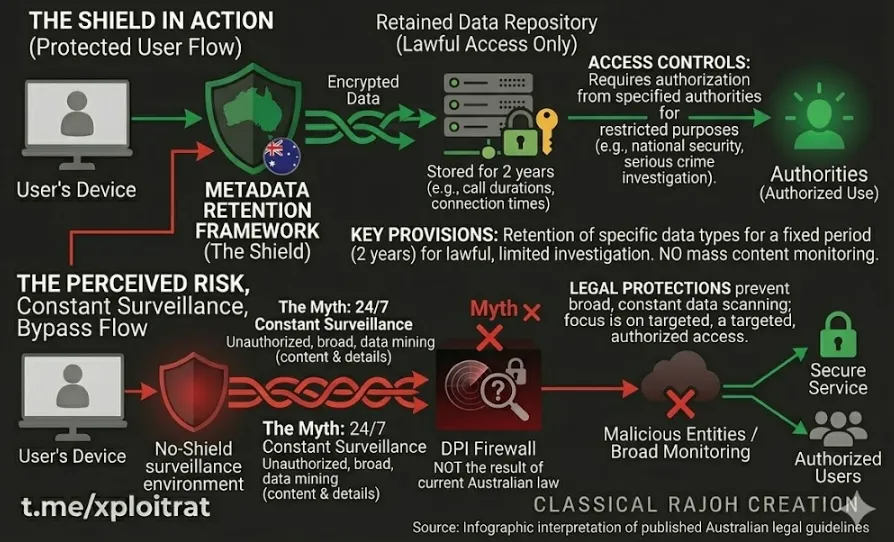
Australian Metadata Retention Laws: The Shield Against 24/7 Surveillance
Under the Australian Telecommunications (Interception and Access) Act, your ISP is legally required to store your metadata for at least two years. This includes your IP address, the time and duration of your connections, and even your location—all of which can be accessed by various government agencies without a warrant. Furthermore, as a key member of the 5/9/14 Eyes Intelligence Alliance, Australia frequently shares this data with international partners.
How a VPN Bypasses the TIA Act
When you use a top-tier VPN like NordVPN (Panama) or ExpressVPN (British Virgin Islands), you are moving your digital footprint outside Australian jurisdiction.
-
Encryption Over ISP Logs: Your ISP can see that you are connected to a VPN, but the "what, where, and when" of your browsing becomes an unreadable encrypted mess. They can no longer log which specific websites you visit or what content you download.
-
Jurisdictional Sovereignty: Because these providers are registered in privacy-friendly nations, they are not subject to Australian data retention laws. Even if AU authorities requested logs, these companies literally have nothing to provide due to their RAM-only server architecture which wipes data upon reboot.
Core Prerequisites: Legal Compliance + Red Lines (Must Read)
Many Australian users worry that using a VPN is illegal. Let’s state the core conclusion clearly:
For individuals, legitimate and compliant use of VPNs is completely legal in Australia. Australian law does not ban individuals from using VPNs to protect privacy, access legitimate overseas content, or optimize their online experience. This is a fundamental difference from some countries that restrict VPN usage.
However, legal use has clear boundaries. Crossing the following red lines will not only void VPN protection but also expose you to legal risks, account bans, and device security threats. Please keep these in mind.
I. Legitimate Use Boundaries (Safe to Do)
-
Personal privacy protection: Encrypt network traffic, prevent ISPs and hackers from stealing personal data, and browse safely on public Wi‑Fi.
-
Access to legitimate content: Unlock overseas legitimate streaming services and global game servers, and watch authorized content that does not infringe copyright.
-
Network optimization: Reduce gaming latency, stabilize connections, and securely access networks for cross‑border work and remote learning.
-
Bypass unreasonable geo‑restrictions: Normally access overseas social media, news, and educational platforms without violating platform terms of service.
II. Strict Red Lines (Must Never Cross)
The following acts are illegal or non‑compliant and are strictly prohibited:
-
Illegal activities: Accessing illegal websites involving pornography, violence, terrorism, or online gambling; engaging in cyber fraud, hacking, data theft, or other criminal activities.
-
Copyright infringement: Downloading or distributing pirated movies, music, software, or other copyrighted content via VPN. Violating Australia’s copyright law can result in heavy fines.
-
Malicious circumvention of regulations: For example, assisting minors to maliciously bypass social media age restrictions for improper online behavior.
-
Using unregulated VPN tools: Avoid uncertified, unencrypted, or unknown free VPNs, as these tools may themselves steal user data and are considered non‑compliant network software.
-
Illegal commercial use: Unauthorized commercial use of VPNs to bypass restrictions, scrape data, evade tax regulation, or other improper business activities.
Simple Summary
Personal use, compliance, legitimate content, and security are the core rules for using a VPN in Australia. As long as you follow these principles, you do not need to worry about legal risks.
2026 Best VPN Comprehensive Evaluation Metrics
To choose a VPN suitable for the Australian NBN environment in 2026, we follow these metrics:
|
Dimension |
Core Indicators |
Requirements & Parameters |
|
1. Privacy & Security |
Encryption & Logs |
AES-256 encryption; WireGuard/OpenVPN; 100% No-Logs (Independently Audited). |
|
2. AU Compatibility |
Local Servers |
High-speed nodes in Sydney, Melbourne, Perth, etc.; NBN/5G optimization. |
|
3. Streaming |
Unlocking Capability |
Stable access to Netflix (all regions), Disney+, Hulu, and local 'Stan'. Supports 4K/8K. |
|
4. Gaming |
Latency & Stability |
Packet loss < 1%; UDP protocol optimization; Support for PC/Consoles (PS5/Xbox/Switch). |
|
5. Value |
Support & Price |
5-10 simultaneous devices; 7x24 Customer Support; 30-day money-back guarantee. |
In 2026, the VPN market is highly mixed. Free VPNs contain hidden risks, while low-cost VPNs offer poor performance. When choosing a VPN suitable for Australia, you should not rely solely on marketing. A strict evaluation must be conducted based on five core dimensions: local adaptation for Australia, privacy and security, streaming unblocking, gaming performance, and cost-performance ratio. The specific indicators are as follows:
1. Core Privacy & Security Indicators
-
Encryption protocols: Must support AES-256 military-grade encryption, and be compatible with mainstream secure protocols including WireGuard, OpenVPN, and IKEv2; weak encryption is unacceptable.
-
Logging policy: Strict no-logs policy, with no storage of browsing history, connection logs, or IP addresses, verified by independent third-party audits.
-
Server jurisdiction: Servers located in privacy-friendly countries, outside the surveillance zones of the Five Eyes, Nine Eyes alliances, or supported by dedicated no-logs server guarantees.
-
Extra security features: Include Kill Switch, DNS/IPv6 leak protection, ad blocking, malicious website filtering, double VPN, and similar functions.
2. Australia-Specific Adaptation Indicators
-
Local Australian servers: Provide high-speed local servers in Australia to ensure stable domestic connectivity.
-
Overseas server coverage: Extensive coverage in key regions for streaming and gaming, including the US, UK, Japan, Singapore, and Europe, with a sufficient number of servers.
-
Network compatibility: Optimized for Australia’s NBN network, 5G, and public Wi‑Fi, without excessive bandwidth consumption or speed reduction.
3. Streaming Unblocking Capability
-
Full-platform unblocking: Reliably access regional libraries of Netflix, Disney+, Hulu, Amazon Prime, BBC iPlayer, Stan, and other major platforms, bypassing geo-restrictions.
-
HD playback support: Smooth 4K/8K streaming with no buffering, and IPs not detected or blocked by platforms.
-
Stability: Consistent long-term unblocking performance, without frequent disconnections, IP bans, or constant server switching.
4. Gaming Performance Indicators
-
Latency performance: Low latency for cross-region gaming, packet loss rate < 1%, no significant lag or ping spikes.
-
Dedicated gaming nodes: Optimized gaming servers for Steam, Epic, PS5, Xbox, Switch, and other platforms.
-
Connection stability: Stable connections during long gaming sessions, UDP optimization, and support for various online game network requirements.
5. Practicality & Cost-Performance Ratio
-
Device support: Compatible with Windows, Mac, iOS, Android, routers, TV boxes, and allows a sufficient number of simultaneous connections.
-
Customer support: 24/7 English/Chinese customer service, with a reliable refund policy (industry-standard 30-day money-back guarantee).
-
Pricing & plans: Transparent monthly and annual plans with no hidden fees, high cost-performance, suitable for long-term use.
Deep Dive: Top 5 VPNs for Australia 2026
1. NordVPN — The 2026 All-Around Champion
The market leader in Australia with 10Gbps physical servers across Melbourne, Sydney, Brisbane, Adelaide, and Perth.
-
Pros: Over 200 high-speed AU servers; NordLynx protocol maintains 97% of original bandwidth.
-
Features: Post-Quantum Cryptography (future-proofing against computer threats); Threat Protection Pro (real-time malware blocking).
-
Best For: Users seeking the best balance of speed, security, and ease of use.
2. Surfshark — Best Value & Unlimited Devices
Popular for its "unlimited devices" policy, effectively protecting an entire household.
-
Pros: Connect unlimited devices; extremely competitive pricing for long-term plans.
-
Features: Dynamic MultiHop (custom double encryption paths); affordable Dedicated IP options.
-
Best For: Students on a budget or large families with many smart devices.
3. Proton VPN — The Ultimate Privacy Guardian
Based in Switzerland (outside "14-Eyes" jurisdiction), it is the sanctuary for privacy advocates.
-
Pros: Neutral jurisdiction; Secure Core architecture (routes traffic through hardened Swiss/Icelandic servers first).
-
Features: Stealth protocol to bypass strict firewall inspections (school/office); 100% Open Source and audited.
-
Best For: Journalists, business professionals, and privacy enthusiasts.
4. ExpressVPN — Premium Performance & Compatibility

Known for its "plug-and-play" experience and industry-leading hardware compatibility.
-
Pros: Proprietary Lightway protocol for near-instant reconnection; excellent Apple TV and Router support.
-
Cons: Higher price point; 8-device limit.
-
Best For: High-end users who want 4K streaming and zero-hassle setup.
5. Private Internet Access (PIA) — P2P & Customization Choice
A veteran in the industry with the highest server density and a court-proven no-logs policy.
-
Pros: Exceptional P2P performance with Port Forwarding; highly transparent.
-
Features: Advanced customization (choose AES-128 or AES-256); MACE (DNS-level ad/tracker blocker).
-
Best For: Torrent users and tech-savvy "geeks" who want to tweak network parameters.
Our 2026 Testing Methodology: Real-World AU Benchmarks
At the Global VPN Guide, we believe that theoretical speeds mean nothing if they don't hold up under the unique conditions of the Australian internet. For this 2026 update, our team conducted a 6-week intensive testing phase to ensure our recommendations are based on hard data, not marketing claims.
1. Testing Locations & Infrastructure
We conducted physical tests across four major Australian hubs to account for regional peering differences:
-
Sydney & Melbourne: Testing for primary data center performance and ultra-low latency.
-
Perth: Evaluating long-distance performance for users connecting to Asia and Europe.
-
Brisbane: Specialized testing for 5G Home Internet stability.
2. Network Tiers (NBN & Beyond)
Tests were performed across multiple connection types to reflect the average Australian household:
-
NBN Home Superfast (250/25 Mbps) and Ultrafast (1000/50 Mbps) via HFC and FTTP.
-
Fixed Wireless & Starlink: Specifically testing protocol efficiency for rural Australian users.
3. Our 4-Tier Evaluation Protocol
-
Speed & Latency Benchmarks: We utilized Ookla and custom speed test servers located in Los Angeles, London, and Tokyo. We measured "Speed Retention"—how much of your original NBN speed remains after the VPN tunnel is active.
-
The "8K Buffer" Test: We performed 4-hour stress tests on YouTube 8K and Netflix Ultra-HD to verify if the VPN protocols could handle the high bitrates required in 2026 without throttling.
- Gaming Jitter Analysis: Using a 10Gbps fiber baseline, we measured "Jitter" (ping consistency) on FACEIT Singapore servers and US West CoD Warzone servers to ensure zero micro-stuttering.
-
Privacy Leak Audits: Every VPN was subjected to multiple DNS leak, IPv6 leak, and WebRTC leak tests using both browser-based tools and specialized networking software to ensure no data escapes the tunnel.
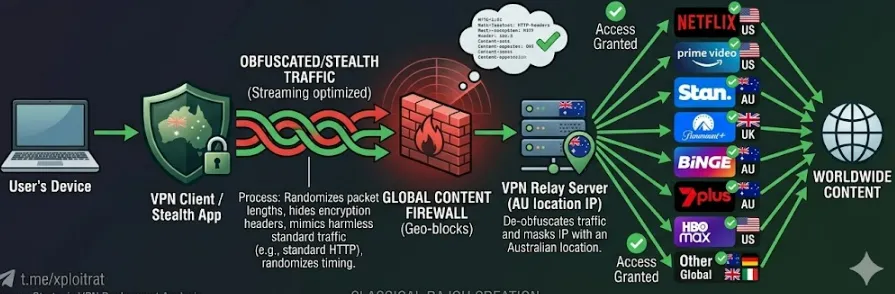
Streaming Strategy: Watching the World from AU
Local Australian streaming platforms offer limited content. With the VPNs mentioned above, you can easily unlock a vast library of legitimate global content. Below is a step-by-step guide suitable for beginners.
1. Step-by-Step Guide for Major Platforms
-
Select a suitable VPN, register and log in, then connect to a server in your target region (e.g., US server for American Netflix, UK server for BBC iPlayer).
-
Clear your browser cache and cookies, or restart the streaming app to avoid location detection issues.
-
Log in to your streaming account – the regional library will automatically switch, allowing you to watch exclusive overseas content.
-
If you receive an IP ban message, simply switch to another server in the same region and reconnect the VPN.
2. Recommended Best Servers by Platform
-
Netflix: Los Angeles (US), London (UK), Tokyo (Japan) – for smooth 4K playback.
-
Disney+: United States, Australia local, Singapore – for full regional access.
-
BBC iPlayer: London, Manchester (UK) – stable and ban-resistant.
-
Amazon Prime: United States, Europe.
-
Stan (local) + overseas content: Switch between Australian local and US servers.
3. Pro Tips for Trouble-Free Streaming
-
Avoid free VPNs: Their IPs are frequently banned, with strict bandwidth limits that prevent HD streaming.
-
Use the WireGuard protocol: Faster than OpenVPN, ideal for buffer-free 4K playback.
-
Avoid peak hours: Internet congestion occurs in Australia between 8–10 PM; switch to less popular servers for better speed.
-
TV box setup: Install the VPN on your router. TVs and streaming boxes will work without extra configuration.
Gaming Optimization Guide
Australian players often suffer from high latency and packet loss when playing on overseas servers. With a VPN and proper settings, you can significantly reduce latency and improve your gaming experience. A detailed guide is provided below.
I. VPN Gaming Optimization Settings
-
Choose gaming-optimized servers: NordVPN, ExpressVPN, and CyberGhost all offer dedicated gaming servers — use these first.
-
Protocol selection: Prioritize WireGuard and UDP protocols. They are better for gaming than TCP, with lower latency and less packet loss.
-
Disable extra features: Turn off ad blocking, malware scanning, and other add‑on functions to save bandwidth.
-
Connect to nearby servers: For US servers, connect to the West Coast (Los Angeles); for Asian servers, use Singapore or Japan. The shorter the physical distance, the lower the latency.
II. Extra Device-Side Optimizations
-
PC: Close background downloads, streaming, and live‑streaming software. Enable Game Mode and disable IPv6.
-
Consoles (PS5 / Xbox / Switch): Install the VPN on your router or share your PC’s internet connection. Use a wired connection instead of Wi‑Fi.
-
Network improvements: Use a wired NBN connection, avoid public Wi‑Fi, upgrade your broadband plan, and reduce network congestion.
III. Recommended Latency Standards for Australian Players
-
Local Australian games: Latency below 50ms = excellent
-
US servers: Latency below 150ms = smooth and playable
-
Asian servers: Latency below 120ms = smooth and playable
Advanced Privacy Protection Settings
A regular VPN connection only provides basic encryption. For maximum privacy protection, advanced configurations are required to completely eliminate data leaks and online tracking. This is ideal for privacy-conscious users in Australia.
I. Core VPN Advanced Settings
-
Enable Kill Switch: Automatically cuts off all internet access if the VPN connection drops unexpectedly, preventing IP exposure.
-
Turn on DNS/IPv6 Leak Protection: Avoids revealing your real location through DNS resolution; disable IPv6 to reduce tracking risks.
-
Choose Privacy-Friendly Servers: Connect to servers in privacy-friendly countries such as Switzerland, Iceland, and Panama, and avoid surveillance zones of the Five Eyes alliance.
-
Use Double VPN: Data is encrypted twice, doubling privacy protection — suitable for transmitting sensitive information.
II. Supporting Privacy Habits
-
Regularly clear browser cache and cookies; use privacy-focused browsers (Tor, Brave).
-
Avoid connecting to unsecured public Wi‑Fi. If you must connect, keep VPN enabled at all times.
-
Do not disclose personal information casually; disable app location permissions to avoid online tracking.
-
Regularly update your VPN password and enable two-factor authentication (2FA) to secure your account.
Best VPNs for Torrenting in Australia: A Safe P2P Guide
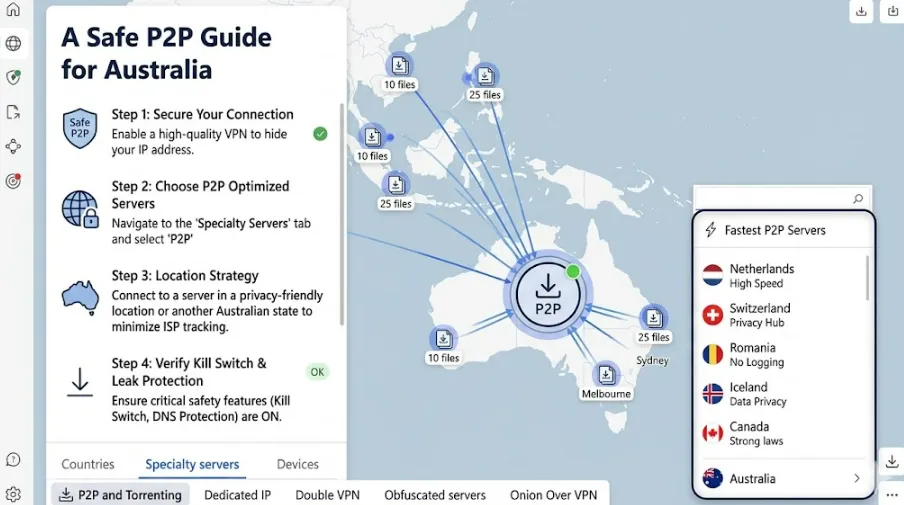
For many Australians, a VPN is primarily a tool for safe P2P file sharing. In 2026, the risk of receiving "Copyright Infringement" notices or having your connection throttled by NBN providers during large downloads is higher than ever. Here is how to ensure your torrenting is both fast and anonymous.
1. Private Internet Access (PIA): The Torrenting Veteran
PIA has long been a favorite in the AU torrenting community for several reasons:
- Proven No-Logs Policy: PIA is one of the few providers whose "No-Logs" claims have been verified multiple times in actual court cases.
-
Port Forwarding: A critical feature for torrenting that most VPNs (like Nord or Express) lack. Port forwarding allows you to connect to more peers in the swarm, significantly increasing your download and upload speeds.
-
MACE DNS Ad-Blocker: Automatically blocks malicious trackers and suspicious domains at the DNS level before they can reach your device.
2. Proton VPN: The High-Security Fortress
If your priority is absolute anonymity combined with advanced protection, Proton VPN is the top choice:
-
NetShield Ad-blocker: Uses high-speed filtering to strip away ads and malware trackers that often plague torrent sites.
-
Kill Switch Reliability: In 2026, Proton's Kill Switch remains the gold standard. If your VPN connection drops for even a millisecond, it instantly severs your internet connection, preventing your real Australian IP from being exposed to the swarm.
-
Swiss Privacy: Being based in Switzerland, Proton is completely insulated from Australian and US legal pressures, providing a truly neutral haven for P2P users.
3. The "Golden Rules" for Safe Torrenting in AU
-
Always Use a Kill Switch: Never start a torrent client without the VPN Kill Switch enabled.
-
Bind Your IP (Advanced): Configure your torrent client (like qBittorrent) to only use the VPN network interface. This ensures that if the VPN app crashes, the torrenting traffic stops immediately.
-
Check for DNS Leaks: Before starting a session, use a tool like
dnsleaktest.comto ensure your ISP's DNS is not visible.
Conclusion: How to Choose the Best VPN for You?
There is no absolute “best” VPN for Australia in 2026 — only the one that best fits your needs. Match your core requirements to the recommendations below to make a quick decision:
-
Best All‑Round Choice: NordVPN. Delivers top‑tier privacy, streaming, and gaming performance. Perfect for home users.
-
Best Budget Value: SurfShark. Low cost with unlimited device connections. Ideal for students and single users.
-
Best for Gaming & Streaming: ExpressVPN. Industry-leading speed. The premium choice for users who prioritize performance.
-
Maximum Privacy: PIA. Open‑source and transparent, designed for tech‑savvy users.
-
Best for Beginners: CyberGhost. One‑click setup, simple and hassle‑free.
Final Reminder: Always use a legitimate paid VPN and avoid free VPNs. Most free VPNs profit by stealing user data and injecting ads, resulting in poor performance and privacy leaks.
Always comply with Australian laws and use VPNs only for legal personal purposes. This way you can safely enjoy true privacy, full global content access, and a smooth online experience.
Frequently Asked Questions (FAQ)
Q: Can I still use free VPNs in 2026?
A: Strongly not recommended. Free VPNs usually profit by selling user data. Under Australia’s strict data regulations, they cannot provide effective privacy protection. In addition, most of them have been blocked by Netflix.
Q: Will using a VPN slow down my internet speed?
A: All VPNs cause a small speed overhead due to encryption. However, with the mainstream WireGuard protocol in 2026, on Australia’s NBN 100M or 5G networks, the speed reduction is usually less than 10%.
Q: Can I install a VPN directly on my router in Australia?
A: Yes. We recommend routers that support VPN protocols, such as ASUS or GL.iNet. This way, all your smart home devices, projectors, and game consoles will be automatically protected.
Q: What should I do if I get a “VPN detected” error?
A: Try switching to another server node in the same country, or change the connection protocol (from WireGuard to OpenVPN UDP).
Q: Can I be fined or prosecuted for using a VPN in Australia?
A: Legitimate personal use of VPNs (for privacy protection, accessing legitimate streaming services, gaming optimization) is completely legal and will not result in fines or legal action.
Legal risks only apply if you use VPNs for illegal activities, piracy, or other violations. Normal use is safe.
Q: Are free VPNs safe to use? What’s the difference between free and paid VPNs?
A: Free VPNs are not recommended.
They have limited bandwidth, excessive ads, and easily blocked IPs, making 4K streaming and gaming impossible. More importantly, most free VPNs collect browsing data and account passwords to sell to third parties, leaving you with zero privacy.
Paid VPNs offer strong encryption, no-logs policies, high-speed servers, and customer support — the difference in performance and security is night and day.
Q: Does a VPN slow down my local Australian internet?
A: Premium VPNs (Nord, Express, SurfShark) only cause negligible speed loss.
When connecting to Australian local servers, speed is almost unaffected.
When connecting to overseas servers, speed depends on node distance and network congestion. Choosing nearby high-quality servers minimizes the loss.
Q: Can a VPN unlock all streaming platforms?
A: The 5 recommended VPNs can unlock 99% of major legitimate streaming platforms.
A small number of niche or strictly geo-restricted platforms may require specific nodes, but the overall unblocking rate is extremely high and fully satisfies daily streaming needs.
Q: How to use a VPN for console gaming (PS5/Xbox)?
A: Two methods:
① Install the VPN on your home router; the console will automatically use the VPN when connected to the router.
② Enable VPN on your PC, then share the internet to your console via cable or Wi‑Fi. Both methods provide gaming acceleration.
Q: Are VPN refund policies reliable?
A: All recommended VPNs offer a 30–45 day money-back guarantee.
As long as you do not abuse the service within the period, your refund will be processed smoothly. Beginners can test risk-free and request a refund if unsatisfied.
Q: Can one VPN account be used on phone, computer, and TV at the same time?
A: Yes.
-
NordVPN: supports 6 devices
-
ExpressVPN: supports 5 devices
-
SurfShark & PIA: unlimited devices
This is more than enough for a household with multiple devices, including TV boxes and routers.